
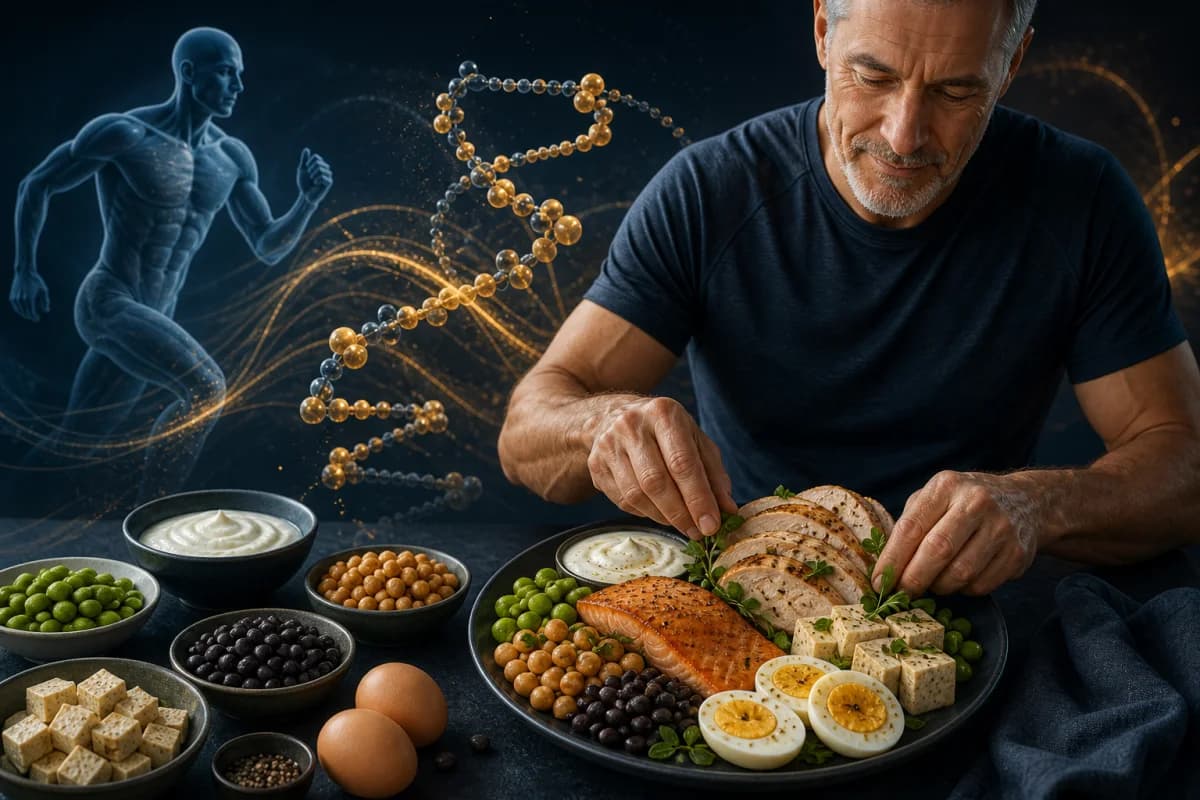
The 10 rules to remember
- The 0.8 g/kg reference intake is a population baseline, not a universal optimum.See reference 1
- Many active and older adults can use roughly 1.2-1.6 g/kg/day when appropriate.See reference 2
- Resistance training is the signal; protein supports the response.See reference 3
- Spread protein across three or four meaningful meals.See reference 4
- A meal containing roughly 0.3-0.4 g/kg is a useful starting point, not a hard ceiling.See reference 5
- Plant proteins work; variety and sufficient total intake matter.See reference 6
- Whole foods usually bring more nutrients and satiety than powders.See reference 7
- Protein above about 1.6 g/kg/day has not added average lean-mass benefit in resistance-training meta-analysis.See reference 8
- Healthy kidneys and chronic kidney disease are different contexts.See reference 9
- Do not let protein displace vegetables, fibre, unsaturated fats and sufficient energy.See reference 10
First principles: what protein does
Dietary proteins are digested into amino acids used for tissue turnover, enzymes, transport and signalling. The body has no dedicated protein storage tank comparable to fat.See reference 1,See reference 2
Muscle protein balance reflects both synthesis and breakdown. Resistance exercise increases sensitivity to amino acids, which is why training and protein work together.See reference 2,See reference 3
A daily target is an accounting tool. Food quality, total energy, meal distribution, age, training and disease modify the real response.See reference 3,See reference 4
Choose a target by context
- Context
- Generally healthy sedentary adult
- Starting range
- About 0.8-1.2 g/kg/day
- Meal pattern
- 3 meals
- Boundary
- Avoid unintended shortfallSee reference 1
- Context
- Active or strength training
- Starting range
- About 1.2-1.6 g/kg/day
- Meal pattern
- 3-4 meals
- Boundary
- Training drives adaptationSee reference 2
- Context
- Healthy older adult
- Starting range
- Often 1.0-1.2+ g/kg/day
- Meal pattern
- Protein each meal
- Boundary
- Higher needs with illness or trainingSee reference 3
- Context
- Kidney disease or prescribed diet
- Starting range
- Individualized
- Meal pattern
- Clinician directed
- Boundary
- Do not self-prescribeSee reference 4
Build the habit over four weeks
- Week
- 1
- Action
- Estimate current intake
- Example
- Track 3 typical days
- Check
- Find low-protein mealsSee reference 1
- Week
- 2
- Action
- Fix breakfast
- Example
- Yogurt, eggs, tofu or legumes
- Check
- SatietySee reference 2
- Week
- 3
- Action
- Add protein to lunch and dinner
- Example
- Food-first portions
- Check
- Daily totalSee reference 3
- Week
- 4
- Action
- Align with training
- Example
- Meal within a few hours
- Check
- Strength and digestionSee reference 4
Build protein into ordinary meals
- Set the daily range using kilograms and health context.See reference 1
- Divide it by three or four eating occasions.See reference 2
- Choose a clear protein anchor before adding powder.See reference 3
- Combine varied plant sources across the day when eating mostly plants.See reference 4
- Place a meal near training when convenient; a narrow anabolic window is unnecessary.See reference 5
- Review strength, appetite, digestion, kidney context and overall diet quality.See reference 6
What the evidence supports
- Outcome
- Muscle with resistance training
- Best interpretation
- Adequate protein modestly augments gains
- Confidence
- High
- Boundary
- Benefits plateau on averageSee reference 1
- Outcome
- Healthy aging
- Best interpretation
- Higher intake may support muscle when paired with activity
- Confidence
- Moderate
- Boundary
- Needs vary with illness and energy intakeSee reference 2
- Outcome
- Satiety and weight management
- Best interpretation
- Protein can improve fullness
- Confidence
- Moderate
- Boundary
- Energy balance still determines weight trendSee reference 3
- Outcome
- Longevity
- Best interpretation
- Source and dietary pattern associate with outcomes
- Confidence
- Low to moderate observational
- Boundary
- No protein target guarantees longer lifeSee reference 4
Does protein timing matter?
Daily total and training consistency matter more than a 30-minute post-workout window. Eating protein within a few hours is practical.See reference 4,See reference 5
Spreading protein across meals may stimulate muscle protein synthesis more evenly than concentrating nearly all intake at dinner.See reference 5,See reference 6
Before sleep protein can support overnight synthesis in some training studies, but it is optional and must fit energy, reflux and sleep.See reference 6,See reference 7
How to calculate and verify intake
Use body weight in kilograms, but consider ideal or adjusted weight with a dietitian when severe obesity, oedema or rapid weight change distorts the calculation.See reference 7,See reference 8
Food labels and databases are estimates. A few tracked days can calibrate portions without requiring permanent weighing.See reference 8,See reference 9
Progress is better judged by strength, function, weight goals, appetite and clinically indicated kidney tests than by protein grams alone.See reference 9,See reference 10
Common protein myths
- Claim
- More protein always builds more muscle
- Better answer
- The response plateaus
- Why
- Training and total dose limit benefitSee reference 1
- Claim
- You must drink a shake immediately
- Better answer
- A wider meal window works
- Why
- Daily intake matters moreSee reference 2
- Claim
- Plant protein is useless
- Better answer
- It can fully contribute
- Why
- Total, variety and digestibility matterSee reference 3
- Claim
- High protein damages every healthy kidney
- Better answer
- Evidence in healthy adults differs from kidney disease
- Why
- Risk depends on contextSee reference 4
- Claim
- Protein alone prevents frailty
- Better answer
- Strength, energy and overall nutrition are essential
- Why
- One nutrient cannot replace the systemSee reference 5
What the science cannot yet tell us
Many protein trials are short and focus on muscle outcomes rather than long-term disease or mortality.See reference 2,See reference 6
Optimal intake is less certain in very old, frail, pregnant or chronically ill populations.See reference 3,See reference 8
Industry funding is common in sports-nutrition research and should be considered alongside methods and replication.See reference 5,See reference 10
Do not copy a high-protein target into kidney disease
People with chronic kidney disease, a prescribed protein limit, significant liver disease, metabolic disorders, pregnancy complications or unexplained weight loss need individualized advice. Sudden weakness, swelling, persistent vomiting, dehydration or inability to eat is not solved by a protein shake.See reference 1,See reference 9,See reference 10
Who should get individualized guidance first?
Kidney disease may require a lower or differently distributed intake depending on stage, dialysis and nutritional status.See reference 1,See reference 9
Older adults with poor appetite or unintentional weight loss need adequate total energy and assessment for underlying disease.See reference 2,See reference 10
Athletes cutting weight, vegans with restricted variety and people with eating disorders benefit from dietitian support.See reference 4,See reference 8
Track five useful protein signals
- Approximate grams per day across typical days.See reference 1
- Protein at breakfast, lunch and dinner.See reference 2
- Strength and training progression.See reference 3
- Appetite, digestion and overall fibre intake.See reference 4
- Clinically indicated kidney function and weight trend.See reference 5
Frequently asked questions
How much protein do I need?
About 0.8 g/kg/day is the adult reference intake; many active or older adults use roughly 1.2-1.6 g/kg/day when appropriate.See reference 3
How much protein per meal?
About 0.3-0.4 g/kg per meal is a useful starting point across three or four meals.See reference 4
Is 2 g/kg too much?
It may be unnecessary for many people and needs context; chronic kidney disease requires individualized guidance.See reference 5
Do I need protein powder?
No. Powder is a convenient food product, not a requirement, when ordinary food meets the target.See reference 6
Is plant protein enough?
Yes, with adequate total intake, varied sources and attention to nutrients such as vitamin B12 where relevant.See reference 7
When should I take protein after training?
A meal within a few hours is practical; the total day matters more than a narrow window.See reference 8
Does protein help weight loss?
It can improve satiety and preserve lean mass, but an energy deficit still drives weight loss.See reference 9
Can protein hurt kidneys?
People with healthy kidneys and people with kidney disease require different answers; diagnosed disease needs clinical guidance.See reference 10
Connect protein to strength and biomarkers
LongevityMate helps place nutrition, strength, body composition and laboratory context together so a protein target remains a means, not the goal.
See how LongevityMate worksGet the weekly longevity brief
The week's best longevity research in plain English. Free, every Tuesday.
References
- 1. Dietary Reference Intakes for macronutrients
National Academies of SciencesGuideline
- 2. PROT-AGE recommendations for dietary protein in older people
Journal of the American Medical Directors AssociationGuideline
- 3. ESPEN practical guideline: clinical nutrition and hydration in geriatrics
Clinical NutritionGuideline
- 4. Protein supplementation and resistance-training gains
British Journal of Sports MedicineMeta-analysis
- 5. International Society of Sports Nutrition position stand: protein and exercise
Journal of the International Society of Sports NutritionGuideline
- 6. Protein intake and meal distribution in older adults
NutrientsEvidence review
- 7. Plant versus animal protein and muscle outcomes
NutrientsMeta-analysis
- 8. Changes in kidney function with high-protein diets in healthy adults
Advances in NutritionSystematic review
- 9. KDIGO 2024 clinical practice guideline for chronic kidney disease
Kidney Disease: Improving Global OutcomesGuideline
- 10. Pre-sleep protein ingestion and muscle adaptive response
Frontiers in NutritionEvidence review
Editorial transparency
- Published by
- LongevityMate Editorial Team
- Published
- Updated
Medical disclaimer
This guide provides general nutrition education. It does not prescribe protein for kidney, liver or metabolic disease, diagnose malnutrition, or replace advice from a clinician or dietitian who knows your health and medicines.