
The rules to remember
- Warm hands, elbows and shouldersSee reference 1,See reference 2
- Start with carries or squeezesSee reference 2,See reference 3
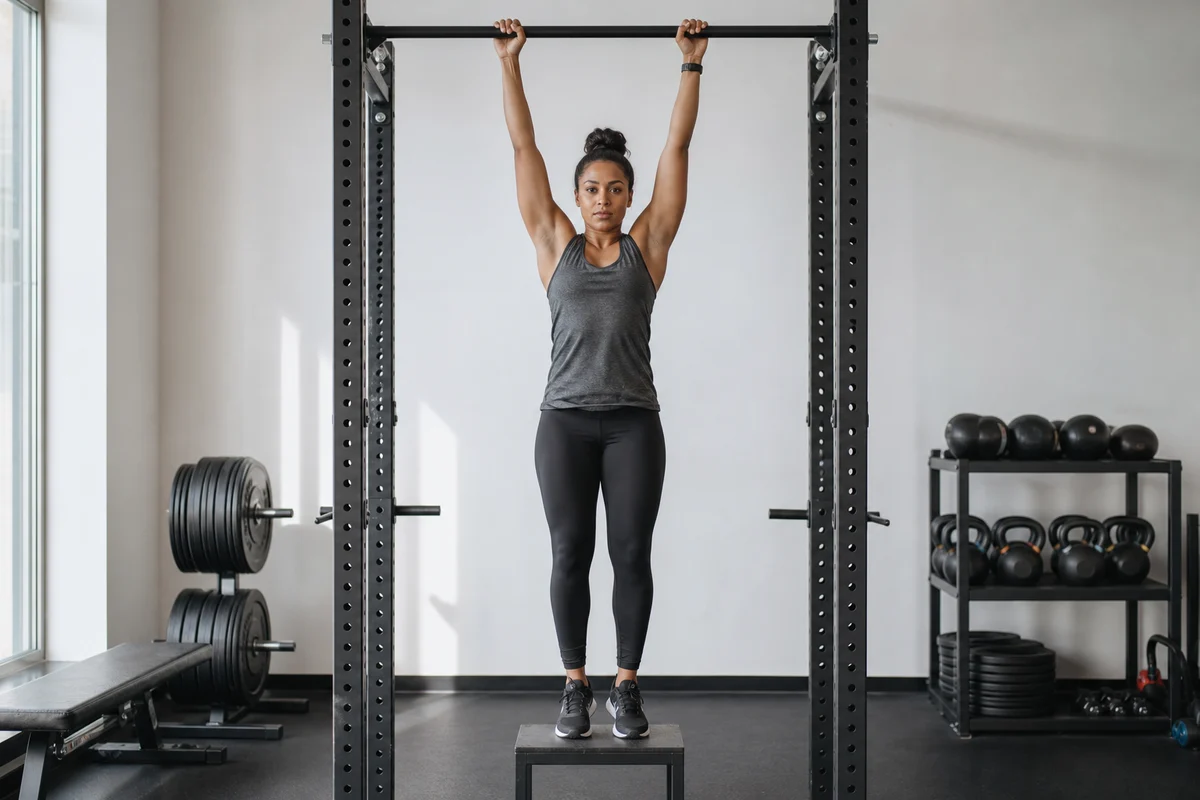
- Use feet to support early hangsSee reference 3,See reference 4
- Keep shoulders active and pain-freeSee reference 4,See reference 5
- Use several short setsSee reference 5,See reference 6
- Progress time before full bodyweightSee reference 6,See reference 7
- Avoid breath holding during hard effortsSee reference 7,See reference 8
- Pair with pulling and whole-body trainingSee reference 8,See reference 9
- Retest under the same conditionsSee reference 9,See reference 10
- Check the official guidance and evidence boundaries before escalating the protocol.See reference 10,See reference 1
First principles: what this can actually change
Grip depends on hand and forearm force plus neural drive, pain tolerance and upper-limb function.See reference 1,See reference 2
Supported hangs load grip and shoulders while allowing dose control through the feet.See reference 2,See reference 3
Low grip predicts adverse outcomes in cohorts largely because it reflects broader health and function, not because hanging is a proven lifespan intervention.See reference 3,See reference 4
A practical protocol
- Stage
- Define
- What to do
- Warm hands, elbows and shoulders
- Why it matters
- Reduce avoidable errorSee reference 1,See reference 2
- Stage
- Screen
- What to do
- Start with carries or squeezes
- Why it matters
- Reduce avoidable errorSee reference 2,See reference 3
- Stage
- Apply
- What to do
- Use feet to support early hangs
- Why it matters
- Keep the dose repeatableSee reference 3,See reference 4
- Stage
- Apply
- What to do
- Keep shoulders active and pain-free
- Why it matters
- Keep the dose repeatableSee reference 4,See reference 5
- Stage
- Review
- What to do
- Use several short sets
- Why it matters
- Keep the dose repeatableSee reference 5,See reference 6
- Stage
- Review
- What to do
- Progress time before full bodyweight
- Why it matters
- Keep only what helpsSee reference 6,See reference 7
Timing and frequency
- Decision
- Starting frequency
- Practical answer
- Two to three sessions weekly, leaving at least one recovery day when tendons are adapting.See reference 2,See reference 3
- Decision
- First review
- Practical answer
- 6–8 weeksSee reference 3,See reference 4
- Decision
- Best timing
- Practical answer
- After a general warm-up and before fatigue compromises shoulder position.See reference 4,See reference 5
- Decision
- Stop rule
- Practical answer
- Stop for sharp shoulder pain, tingling, loss of grip, marked swelling or elbow pain that persists beyond normal training soreness.See reference 5,See reference 6,See reference 7
What to measure
- Signal
- Pain-free carry load or supported-hang time
- How to use it
- Record a baseline and compare at the review point
- Caveat
- Use the same method and conditionsSee reference 3,See reference 4
- Signal
- Standardized grip dynamometer result
- How to use it
- Track a weekly trend
- Caveat
- Expect normal variationSee reference 4,See reference 5
- Signal
- Adherence
- How to use it
- Record the exact dose and timing
- Caveat
- No exposure means no fair testSee reference 5,See reference 6
- Signal
- Interpretation
- How to use it
- Ask whether the result changes a real decision
- Caveat
- Grip scores vary with device, posture, hand size, pain and motivation.See reference 6,See reference 7
What the evidence actually shows
Meta-analysis shows exercise can improve grip in older adults, while cohort reviews show grip is a prognostic marker of health and function.See reference 1,See reference 2,See reference 3
Direct evidence for passive dead hangs as a unique longevity tool is sparse; shoulder benefits and risks depend on anatomy and technique.See reference 4,See reference 5,See reference 6
Most studies measure short-term symptoms, physiology or biomarkers rather than clinical events or lifespan. The evidence supports a bounded experiment, not a longevity guarantee.See reference 6,See reference 7,See reference 8
Evidence strength by claim
- Claim
- Pain-free carry load or supported-hang time
- Evidence
- Moderate for grip training; limited for hangs as a standalone tool
- Verdict
- Meta-analysis shows exercise can improve grip in older adults, while cohort reviews show grip is a prognostic marker of health and function.See reference 1,See reference 2
- Claim
- Standardized grip dynamometer result
- Evidence
- Mixed or context-dependent
- Verdict
- Direct evidence for passive dead hangs as a unique longevity tool is sparse; shoulder benefits and risks depend on anatomy and technique.See reference 3,See reference 4
- Claim
- Safety
- Evidence
- Depends on screening and dose
- Verdict
- Avoid painful hanging with shoulder instability, recent dislocation, acute tendinopathy, neuropathy or uncontrolled cardiovascular strain. Use support, avoid maximal breath holding and obtain clinical assessment for weakness, numbness or trauma.See reference 5,See reference 7
- Claim
- Longer life
- Evidence
- Not directly tested
- Verdict
- Do not turn an intermediate outcome into a lifespan promise.See reference 6,See reference 8
Limits and common overclaims
Prediction studies do not prove that raising the number changes mortality.See reference 2,See reference 3
Rock-climbing and athletic studies do not generalize to frail beginners.See reference 3,See reference 4
Tendons adapt more slowly than enthusiasm or muscle effort.See reference 4,See reference 5
A four-step implementation plan
- Define the exact reason you are trying grip training.See reference 1
- Record a baseline for pain-free carry load or supported-hang time.See reference 2
- Use the same protocol until the 6–8 weeks review point.See reference 3
- Continue only if benefit outweighs cost, time, discomfort and risk.See reference 4
Troubleshooting
- Problem
- No benefit
- What to do
- Check adherence, dose and whether pain-free carry load or supported-hang time is the right outcomeSee reference 2
- Problem
- Discomfort
- What to do
- Reduce the dose and stop for warning symptomsSee reference 3
- Problem
- Confusing data
- What to do
- Use the same measurement conditions and a longer trendSee reference 4
- Problem
- Too much burden
- What to do
- Choose the simpler intervention that solves the same problemSee reference 5
Safety and who should be cautious
Avoid painful hanging with shoulder instability, recent dislocation, acute tendinopathy, neuropathy or uncontrolled cardiovascular strain. Use support, avoid maximal breath holding and obtain clinical assessment for weakness, numbness or trauma. Stop for sharp shoulder pain, tingling, loss of grip, marked swelling or elbow pain that persists beyond normal training soreness.See reference 5,See reference 6,See reference 7
Who is most likely to benefit
Adults wanting better carrying capacity and a measurable upper-limb function goal benefit most when grip work supplements whole-body training.See reference 2,See reference 3
It is less useful when adopted only because a score, trend or influencer made grip training seem mandatory.See reference 4,See reference 5
People with symptoms, diagnosed disease, pregnancy, recent surgery or complex medicines should adapt the protocol with an appropriate clinician.See reference 6,See reference 7
Track five things
- Pain-free carry load or supported-hang timeSee reference 1
- Standardized grip dynamometer resultSee reference 2
- The exact dose and timingSee reference 3
- Symptoms and adverse effectsSee reference 4
- Whether the result changes a real decisionSee reference 5
Frequently asked questions
What is Grip training and supported hangs?
Grip strength is a useful marker of overall physical capacity, but improving a grip score is not automatically the same as improving longevity. Train it as part of whole-body resistance work using carries, hand exercises and supported hangs, with slow progression and pain-free shoulder mechanics.See reference 1,See reference 2
How often should I use grip training?
Two to three sessions weekly, leaving at least one recovery day when tendons are adapting.See reference 2,See reference 3
How long before grip training works?
Use 6–8 weeks as the first meaningful review point. Immediate sensations or device scores are not durable health outcomes.See reference 3,See reference 4
What should I track?
Track pain-free carry load or supported-hang time, standardized grip dynamometer result, adherence and adverse effects under similar conditions.See reference 4,See reference 5
Is grip training safe?
Avoid painful hanging with shoulder instability, recent dislocation, acute tendinopathy, neuropathy or uncontrolled cardiovascular strain. Use support, avoid maximal breath holding and obtain clinical assessment for weakness, numbness or trauma.See reference 5,See reference 6
When should I stop?
Stop for sharp shoulder pain, tingling, loss of grip, marked swelling or elbow pain that persists beyond normal training soreness.See reference 6,See reference 7
Does grip training increase lifespan?
No human trial proves that this tool extends an individual's lifespan. Its value depends on whether it improves a relevant symptom, behavior, function or established risk factor.See reference 7,See reference 8
Can it replace sleep, exercise, nutrition or medical care?
No. It is an optional layer around the fundamentals and should not delay evaluation of persistent or serious symptoms.See reference 8,See reference 9
Connect the protocol to your wider health picture
LongevityMate helps organize habits, symptoms, measurements and trends so one intervention stays in context instead of becoming the whole plan.
See how LongevityMate worksGet the weekly longevity brief
The week's best longevity research in plain English. Free, every Tuesday.
References
- 1. Hand-grip dynamometry predicts future outcomes in aging adults.
Journal of geriatric physical therapy (2001)Systematic review
- 2. Effects of Exercise Training on Handgrip Strength in Older Adults: A Meta-Analytical Review.
GerontologyMeta-analysis
- 3. Physical and Physiological Determinants of Rock Climbing.
International journal of sports physiology and performanceObservational study
- 4. Hangboard training in advanced climbers: A randomized controlled trial.
Scientific reportsRandomized trial
- 5. Effects of Different Hangboard Training Intensities on Finger Grip Strength, Stamina, and Endurance.
Frontiers in sports and active livingEvidence review
- 6. Strength Training in Climbing: A Systematic Review.
Journal of strength and conditioning researchSystematic review
- 7. WHO guidelines on physical activity and sedentary behaviour
World Health OrganizationGuideline
- 8. Physical activity guidelines for Americans
U.S. Department of Health and Human ServicesGuideline
- 9. Exercise and physical fitness
National Institute on AgingOfficial guidance
- 10. Shoulder problems
National Health ServiceOfficial guidance
Editorial transparency
- Published by
- LongevityMate Editorial Team
- Published
- Updated
Medical disclaimer
This guide provides general health education. It does not diagnose a condition, prescribe treatment, replace individualized medical care, or guarantee a health or longevity outcome.