
The 10 rules to remember
- Build baseline strength and balanceSee reference 1
- Learn quiet aligned landingsSee reference 2
- Start with low-amplitude hops or throwsSee reference 3
- Use 2–4 drillsSee reference 4
- Perform 3–5 sets of 3–5 repsSee reference 5
- Rest fully between setsSee reference 6
- Stop when quality declinesSee reference 7
- Progress one variable at a timeSee reference 8
- Allow at least 48 hours recoverySee reference 1
- Review jump, throw or task power after 6–12 weeks; stop if the result does not justify the burden.See reference 2
First principles: what this can actually change
Rapid eccentric-to-concentric actions use stored elastic energy and neural coordination to improve rate of force development.See reference 1,See reference 2
Fatigue reduces landing control and movement speed, so quality and recovery are more important than chasing exhaustion.See reference 2,See reference 3
Power declines with age and is relevant to stairs, balance reactions and sport, but the drill must match the person's capacity and goals.See reference 3,See reference 4
A practical protocol
- Stage
- Start
- What to do
- Build baseline strength and balance
- Why it matters
- Define the goal and baselineSee reference 1,See reference 2
- Stage
- Set up
- What to do
- Learn quiet aligned landings
- Why it matters
- Reduce avoidable errorSee reference 2,See reference 3
- Stage
- Apply
- What to do
- Start with low-amplitude hops or throws
- Why it matters
- Use a repeatable doseSee reference 3,See reference 4
- Stage
- Review
- What to do
- Use 2–4 drills
- Why it matters
- Keep only what helpsSee reference 4,See reference 5
Timing and frequency
- Decision
- Starting dose
- Practical answer
- One to two sessions weekly for beginners; trained athletes may use two or three within a periodized program.See reference 2,See reference 3
- Decision
- First review
- Practical answer
- 6–12 weeksSee reference 3,See reference 4
- Decision
- Best timing
- Practical answer
- Perform after the warm-up and before fatiguing strength or endurance work, when coordination and landing quality are highest.See reference 4,See reference 5
- Decision
- Stop rule
- Practical answer
- Stop for sharp pain, swelling, loss of balance, repeated hard landings or technique breakdown; seek assessment for persistent bone or tendon pain.See reference 5,See reference 6
What to measure
- Signal
- Jump, throw or task power
- How to use it
- Record before starting and at the review point
- Caveat
- Use the same methodSee reference 3,See reference 4
- Signal
- Landing quality, pain and functional performance
- How to use it
- Track weekly rather than reacting daily
- Caveat
- Expect normal variationSee reference 4,See reference 5
- Signal
- Adherence
- How to use it
- Record sessions or days used
- Caveat
- No exposure means no fair testSee reference 5,See reference 6
- Signal
- Adverse effects
- How to use it
- Record symptoms and severity
- Caveat
- Jump height can improve through technique without representing a broad change in health or injury resilience.See reference 6,See reference 7
What the evidence actually shows
Meta-analyses support plyometric training for power, jump and sprint performance, and emerging evidence supports appropriately scaled power training for function in older adults.See reference 1,See reference 2,See reference 3
Sport-performance effects do not prove injury prevention or longevity. High boxes, depth jumps and large contact volumes are advanced methods, not prerequisites.See reference 4,See reference 5,See reference 6
Most studies measure short-term symptoms, physiology or performance rather than clinical events or lifespan. Results therefore support a bounded use case, not broad longevity marketing.See reference 6,See reference 7,See reference 8
Evidence strength by claim
- Claim
- Jump, throw or task power
- Evidence
- Strong for power performance; moderate for function
- Verdict
- Meta-analyses support plyometric training for power, jump and sprint performance, and emerging evidence supports appropriately scaled power training for function in older adults.See reference 1,See reference 2
- Claim
- Landing quality, pain and functional performance
- Evidence
- Mixed or context-dependent
- Verdict
- Sport-performance effects do not prove injury prevention or longevity. High boxes, depth jumps and large contact volumes are advanced methods, not prerequisites.See reference 3,See reference 4
- Claim
- Safety
- Evidence
- Depends on screening and dose
- Verdict
- Scale impact for osteoporosis, arthritis, balance impairment or previous tendon and joint injury. Use a stable non-slip surface and qualified coaching when risk is elevated.See reference 5,See reference 6
- Claim
- Longer life
- Evidence
- Not directly tested
- Verdict
- Do not convert an intermediate outcome into a lifespan promiseSee reference 7,See reference 8
Limits and common overclaims
Training age and exercise selection create large differences in response.See reference 2,See reference 3
Injury reporting is inconsistent across trials.See reference 3,See reference 4
Older-adult trials are supervised and may not generalize to unsupervised jumping.See reference 4,See reference 5
A four-step implementation plan
- Define the exact reason you are trying plyometric training.See reference 1
- Record a baseline for jump, throw or task power.See reference 2
- Use the same protocol for 6–12 weeks.See reference 3
- Continue only if benefit outweighs cost, time, discomfort and risk.See reference 4
Troubleshooting
- Problem
- No benefit
- What to do
- Check adherence, dose and whether jump, throw or task power is the right outcomeSee reference 2
- Problem
- Discomfort
- What to do
- Reduce the dose; stop for warning symptomsSee reference 3
- Problem
- Confusing data
- What to do
- Use a longer trend and the same measurement conditionsSee reference 4
- Problem
- Too much burden
- What to do
- Choose the simpler intervention that solves the same problemSee reference 5
Safety and who should be cautious
Scale impact for osteoporosis, arthritis, balance impairment or previous tendon and joint injury. Use a stable non-slip surface and qualified coaching when risk is elevated. Stop for sharp pain, swelling, loss of balance, repeated hard landings or technique breakdown; seek assessment for persistent bone or tendon pain.See reference 5,See reference 6,See reference 7
Who is most likely to benefit
It benefits athletes and capable older adults who need to preserve or improve the ability to produce force quickly.See reference 2,See reference 3
It is less useful when adopted only because a score, trend or influencer made it seem mandatory.See reference 4,See reference 5
People with symptoms, diagnosed disease, pregnancy, recent surgery or complex medicines should adapt the protocol with an appropriate clinician.See reference 6,See reference 7
Track five things
- Jump, throw or task powerSee reference 1
- Landing quality, pain and functional performanceSee reference 2
- The exact dose and timingSee reference 3
- Symptoms and adverse effectsSee reference 4
- Whether the result changes a real decisionSee reference 5
Frequently asked questions
What is Plyometric and power training?
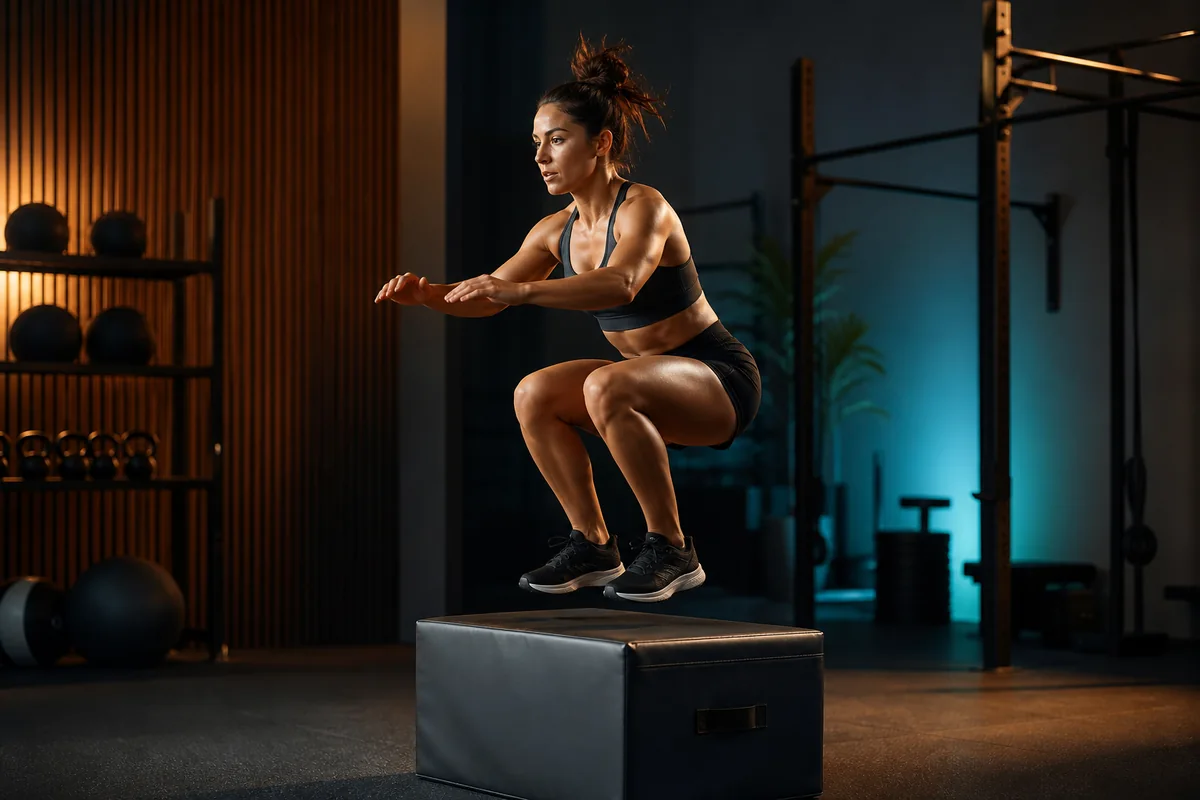
Plyometric training uses rapid stretch-shortening actions such as hops, jumps and bounds to improve force produced quickly. Power matters for sport and everyday function, but safe progression begins with landing and lower-intensity drills.See reference 1,See reference 2
How often should I use plyometric training?
One to two sessions weekly for beginners; trained athletes may use two or three within a periodized program.See reference 2,See reference 3
How long before plyometric training works?
Use 6–12 weeks as the first meaningful review point. Immediate comfort or device readings are not the same as a durable health effect.See reference 3,See reference 4
What should I track?
Track jump, throw or task power, landing quality, pain and functional performance, adherence and adverse effects under similar conditions.See reference 4,See reference 5
Is plyometric training safe?
Scale impact for osteoporosis, arthritis, balance impairment or previous tendon and joint injury. Use a stable non-slip surface and qualified coaching when risk is elevated.See reference 5,See reference 6
When should I stop?
Stop for sharp pain, swelling, loss of balance, repeated hard landings or technique breakdown; seek assessment for persistent bone or tendon pain.See reference 6,See reference 7
Does plyometric training increase lifespan?
No trial proves that this tool extends an individual's lifespan. Its value depends on whether it improves a relevant symptom, behavior, function or established risk factor.See reference 7,See reference 8
Can it replace sleep, exercise, nutrition or medical care?
No. It is an optional layer around the fundamentals and should not delay evaluation of persistent or serious symptoms.See reference 8,See reference 1
Connect the protocol to your wider health picture
LongevityMate helps organize habits, symptoms, measurements and trends so one intervention stays in context instead of becoming the whole plan.
See how LongevityMate worksGet the weekly longevity brief
The week's best longevity research in plain English. Free, every Tuesday.
References
- 1. The Efficacy and Safety of Lower-Limb Plyometric Training in Older Adults: A Systematic Review.
Sports medicine (Auckland, N.Z.)Systematic review
- 2. Effects of Power Training on Functional Capacity Related to Fall Risk in Older Adults: A Systematic Review and Meta-analysis.
Archives of physical medicine and rehabilitationMeta-analysis
- 3. Effects of Plyometric Jump Training on the Reactive Strength Index in Healthy Individuals Across the Lifespan: A Systematic Review with Meta-analysis.
Sports medicine (Auckland, N.Z.)Meta-analysis
- 4. Effects of Plyometric Training on Physical Performance: An Umbrella Review.
Sports medicine - openSystematic review
- 5. Does plyometric training improve vertical jump height? A meta-analytical review.
British journal of sports medicineMeta-analysis
- 6. Body composition adaptations to lower-body plyometric training: a systematic review and meta-analysis.
Biology of sportEvidence review
- 7. Physical activity and older adults
World Health OrganizationGuideline
- 8. Exercise and physical activity
National Institute on AgingOfficial guidance
Editorial transparency
- Published by
- LongevityMate Editorial Team
- Published
- Updated
Medical disclaimer
This guide provides general health education. It does not diagnose a condition, prescribe treatment, replace individualized medical care, or guarantee a health or longevity outcome.