
The 10 rules to remember
- Screen when speech, tinnitus, noise exposure or withdrawal suggests a problem.See reference 1
- Use a validated screen only as a first pass.See reference 2
- Confirm suspected loss with pure-tone and speech audiometry.See reference 3
- Protect hearing around damaging noise.See reference 4
- Choose devices for the measured loss and real listening needs.See reference 5
- Allow several weeks for brain and habit adaptation.See reference 6
- Wear devices consistently during meaningful listening.See reference 7
- Return for fit, wax, comfort and programming problems.See reference 8
- Repeat testing when hearing or function changes.See reference 9
- Hearing treatment supports function; it is not a guaranteed dementia-prevention treatment.See reference 10,See reference 9
First principles: what this tool can actually change
Hearing depends on audibility and the brain's ability to separate speech from competing sound; a normal conversation in a quiet room can miss early difficulty in noise.See reference 1,See reference 2
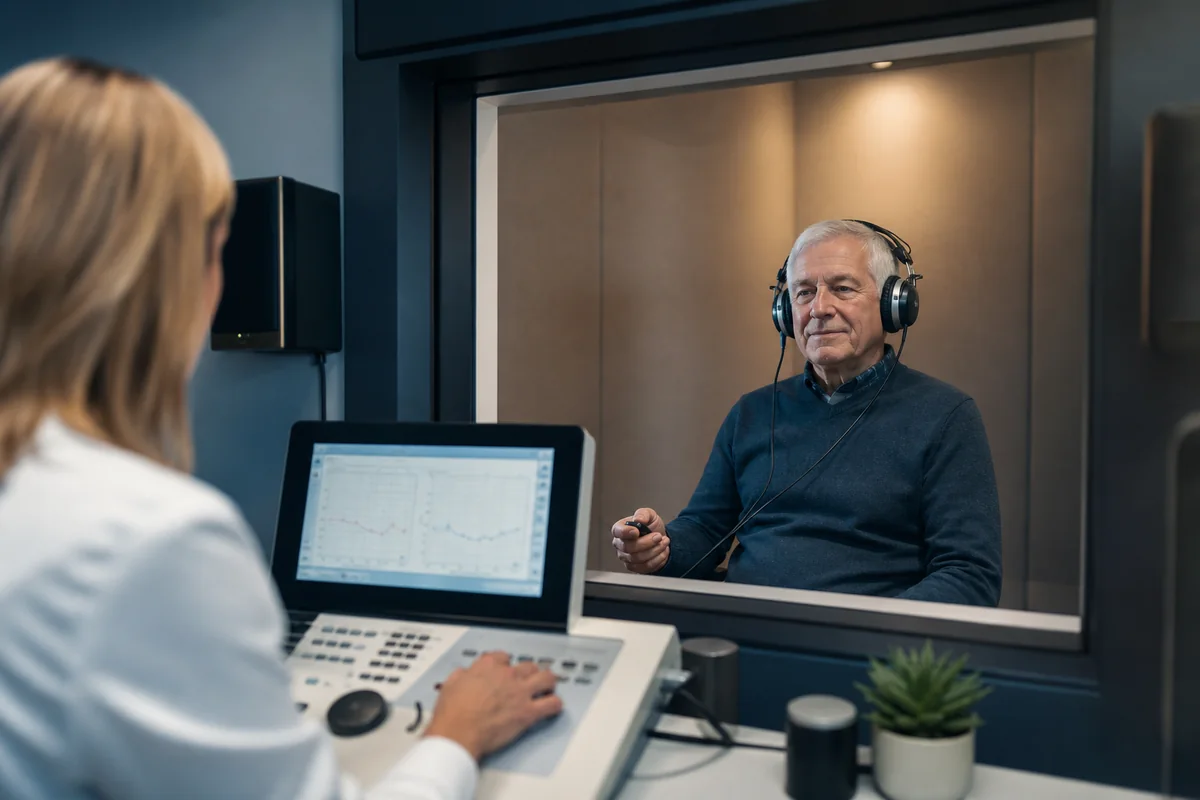
An audiogram measures thresholds across frequencies, while speech testing and real-life goals show whether those thresholds matter functionally.See reference 2,See reference 3
Untreated hearing loss is associated with isolation and cognitive decline, but association alone does not prove that hearing aids prevent dementia.See reference 3,See reference 4
A practical protocol
- Stage
- Screen
- What to do
- Validated digits-in-noise or clinic screen
- Why it matters
- Finds people who need diagnostic testingSee reference 2
- Stage
- Confirm
- What to do
- Audiology history, otoscopy, pure-tone and speech testing
- Why it matters
- Identifies type, severity and asymmetrySee reference 3
- Stage
- Treat
- What to do
- Appropriate hearing aids, assistive listening or medical referral
- Why it matters
- Matches intervention to the causeSee reference 4
- Stage
- Follow up
- What to do
- Verify fit, use, comfort and speech goals
- Why it matters
- A device only helps when it works in daily lifeSee reference 5
Timing and frequency
- When
- Now
- Action
- Urgent assessment for sudden or rapidly worsening hearing lossSee reference 3
- When
- When difficulty appears
- Action
- Arrange screening rather than waiting for severe lossSee reference 4
- When
- After fitting
- Action
- Review within the first weeks and adjust programmingSee reference 5
- When
- Ongoing
- Action
- Retest when function changes or at the interval advised by audiologySee reference 6
What to measure
- Signal
- Pure-tone threshold
- How
- Audiogram in dB HL
- Interpretation
- Degree and frequency pattern of lossSee reference 4
- Signal
- Speech understanding
- How
- Words or sentences in quiet and noise
- Interpretation
- Functional communication challengeSee reference 5
- Signal
- Daily use
- How
- Device logs plus self-report
- Interpretation
- Whether adaptation and benefit are plausibleSee reference 6
- Signal
- Real-world benefit
- How
- Conversation, work, safety and participation goals
- Interpretation
- The outcome that matters mostSee reference 7
What the evidence supports
Hearing aids improve audibility, communication and hearing-related quality of life for many adults with aidable loss.See reference 2,See reference 4
The ACHIEVE randomized trial found no overall cognitive benefit in the combined cohort, but a prespecified higher-risk subgroup declined more slowly with the hearing intervention.See reference 3,See reference 5
Noise protection and safe listening reduce preventable additional damage but cannot reverse established sensorineural loss.See reference 4,See reference 6
Evidence strength by claim
- Claim
- Hearing aids improve access to sound and speech
- Confidence
- Moderate to strong
- Important boundary
- Benefit depends on fitting, use and the listening environmentSee reference 1,See reference 2
- Claim
- Hearing care improves communication and quality of life
- Confidence
- Variable
- Important boundary
- Adaptation varies and background noise can remain difficultSee reference 3,See reference 4
- Claim
- Hearing treatment prevents dementia
- Confidence
- Limited or indirect
- Important boundary
- Risk-factor change is not proof of disease preventionSee reference 5,See reference 6
- Claim
- It extends human lifespan
- Confidence
- Not established
- Important boundary
- Association is not proof of causationSee reference 7,See reference 8,See reference 9,See reference 10
Limitations and common overclaims
Online tests cannot inspect the ear, determine the cause of loss or replace diagnostic audiology.See reference 5,See reference 7
Hearing aids do not restore normal hearing and cannot eliminate every difficulty in noise.See reference 6,See reference 8
The dementia evidence must not be presented as a universal preventive effect because the main ACHIEVE analysis was neutral.See reference 7,See reference 9
How to make it stick
Choose the smallest version you can repeat under normal conditions. Consistency creates a useful signal; a heroic one-off session does not.See reference 1,See reference 2
Change one variable at a time and write down the protocol. Otherwise an apparent improvement may reflect different timing, equipment or conditions.See reference 3,See reference 4
Review the result after a pre-defined period. Continue only when the benefit is meaningful, the burden is acceptable and no safety signal has appeared.See reference 5,See reference 6
Troubleshooting
- Problem
- Whistling or feedback
- Likely issue
- Fit, wax or seal problem
- Better next step
- Check the ear and device fitSee reference 5
- Problem
- Speech is loud but unclear
- Likely issue
- Programming or distortion may be wrong
- Better next step
- Request speech testing and adjustmentSee reference 6
- Problem
- Devices stay in a drawer
- Likely issue
- Comfort, expectations or handling barrier
- Better next step
- Simplify controls and use a gradual adaptation planSee reference 7
- Problem
- One-sided or sudden change
- Likely issue
- Possible medical cause
- Better next step
- Seek prompt clinical assessmentSee reference 8
Safety and when to stop
Sudden hearing loss, new marked asymmetry, ear pain, drainage, severe vertigo or neurologic symptoms require prompt medical assessment. Avoid unsafe listening volumes and do not buy amplification as a substitute for evaluating red flags. Hearing aids should be fitted and reviewed so over-amplification, poor comfort, wax or skin problems are corrected.See reference 1,See reference 5,See reference 9
Who is most likely to benefit
Adults noticing speech-in-noise difficulty, tinnitus, increasing volume or communication withdrawal benefit most from early assessment.See reference 2,See reference 6
People with occupational or recreational noise exposure need both monitoring and prevention.See reference 3,See reference 7
Partners and family often notice communication change first and can help define meaningful goals.See reference 4,See reference 8
Track five things
- Speech understanding in the situations that matter.See reference 1
- Comfort and hours of device use.See reference 2
- Listening fatigue and social participation.See reference 3
- Noise exposure and protection habits.See reference 4
- Any sudden, one-sided or rapidly worsening change.See reference 5
Frequently asked questions
How often should adults get a hearing test?
There is no single interval for every adult; test when symptoms or risk appear and follow the interval recommended after a baseline assessment.See reference 1
Are online hearing tests accurate?
Validated tests can flag risk, but they cannot diagnose the cause or replace audiology.See reference 2
Do hearing aids prevent dementia?
That is not established for everyone; one major trial was neutral overall but suggested benefit in a higher-risk subgroup.See reference 3
How long does hearing-aid adaptation take?
Many people need several weeks of consistent use plus follow-up adjustments.See reference 4
Can hearing loss be reversed?
Wax or some conductive causes can improve with treatment; common age-related sensorineural loss is usually managed rather than reversed.See reference 5
When is hearing loss urgent?
Sudden loss, especially in one ear, needs urgent assessment.See reference 6
Connect the protocol to your wider health picture
LongevityMate helps organize measurements, habits, symptoms and trends so one tool stays in context instead of becoming the whole plan.
See how LongevityMate worksGet the weekly longevity brief
The week's best longevity research in plain English. Free, every Tuesday.
References
- 1. Hearing intervention versus health education to reduce cognitive decline: ACHIEVE trial
The LancetRandomized trial
- 2. World report on hearing
World Health OrganizationGuideline
- 3. Hearing aid service delivery approaches
World Health OrganizationOfficial guidance
- 4. Hearing Loss in Older Adults: Screening
U.S. Preventive Services Task ForceGuideline
- 5. Age-Related Hearing Loss
National Institute on Deafness and Other Communication DisordersOfficial guidance
- 6. Hearing Aids
National Institute on Deafness and Other Communication DisordersOfficial guidance
- 7. Noise-Induced Hearing Loss
National Institute on Deafness and Other Communication DisordersOfficial guidance
- 8. Hearing loss in adults: assessment and management
NICEGuideline
- 9. Hearing aids for mild to moderate hearing loss in adults
CochraneSystematic review
- 10. Sudden Deafness
National Institute on Deafness and Other Communication DisordersOfficial guidance
Editorial transparency
- Published by
- LongevityMate Editorial Team
- Published
- Updated
Medical disclaimer
This guide provides general health education. It does not diagnose a condition, prescribe treatment, replace individualized professional care, or guarantee a health or longevity outcome.