
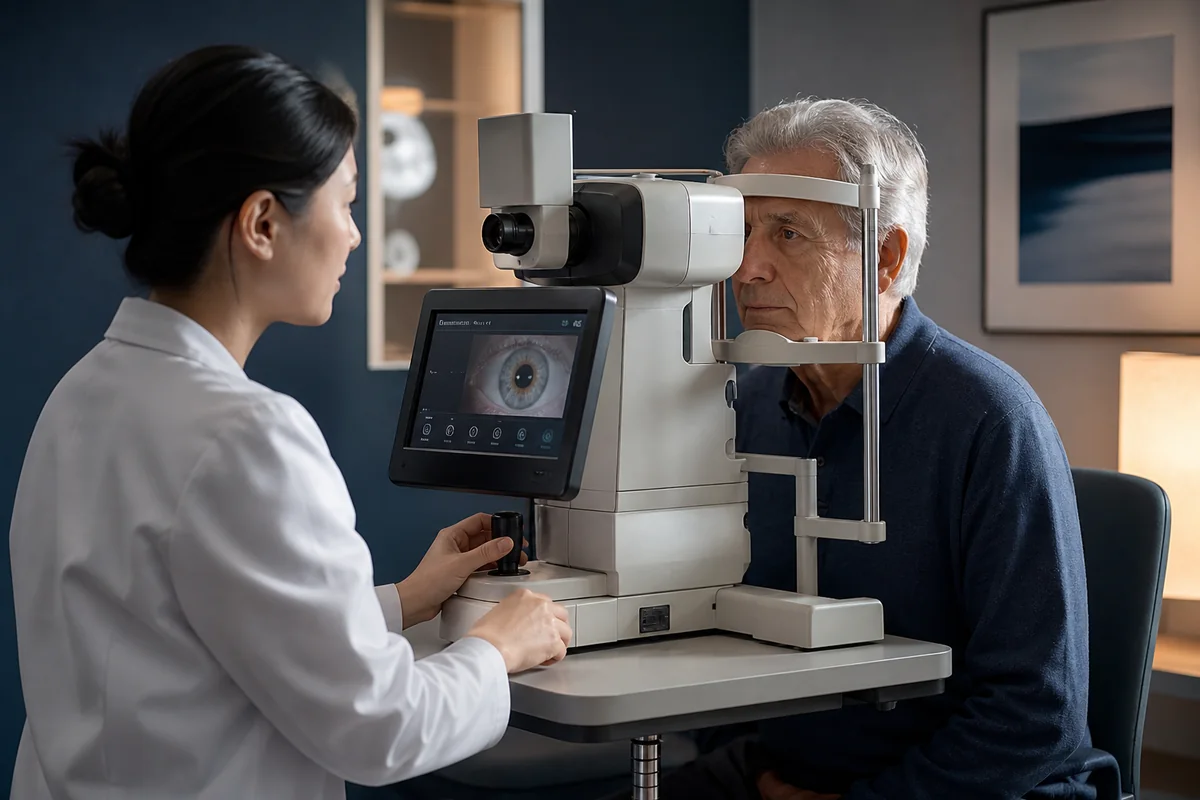
The 10 rules to remember
- Use objective visual acuity rather than symptoms alone.See reference 1
- Match examination frequency to age and risk.See reference 2
- Update refractive correction when function changes.See reference 3
- Check for cataract, glaucoma, macular and diabetic eye disease when relevant.See reference 4
- Use better lighting and contrast for stairs and reading.See reference 5
- Protect eyes from ultraviolet exposure.See reference 6
- Do not ignore driving or falls difficulty.See reference 7
- Track each eye separately when a change is suspected.See reference 8
- Seek urgent care for sudden loss, flashes, floaters or severe pain.See reference 9
- Vision correction supports function; observational dementia links do not prove a guaranteed cognitive benefit.See reference 10,See reference 9
First principles: what this tool can actually change
Visual acuity measures detail at high contrast, but eye health also depends on fields, contrast, pressure, retina, lenses and neurologic pathways.See reference 1,See reference 2
Many eye diseases progress silently, which is why symptom-free people with risk factors may need comprehensive examination rather than a chart alone.See reference 2,See reference 3
Vision impairment is associated with falls, isolation and cognitive decline; correcting a reversible cause improves sight, while wider longevity effects remain uncertain.See reference 3,See reference 4
A practical protocol
- Stage
- Baseline
- What to do
- History, acuity and risk review
- Why it matters
- Sets the appropriate exam pathwaySee reference 2
- Stage
- Comprehensive exam
- What to do
- Refraction plus eye-health assessment
- Why it matters
- Finds correctable and disease-related causesSee reference 3
- Stage
- Correction
- What to do
- Glasses, contacts, rehabilitation or treatment
- Why it matters
- Restores function where possibleSee reference 4
- Stage
- Follow-up
- What to do
- Repeat at clinician-advised interval
- Why it matters
- Tracks progression and treatmentSee reference 5
Timing and frequency
- When
- Immediately
- Action
- Sudden loss, severe pain, curtain, flashes or new shower of floatersSee reference 3
- When
- When function changes
- Action
- Book an eye examinationSee reference 4
- When
- At older age or higher risk
- Action
- Use the interval advised for the specific conditionSee reference 5
- When
- After correction
- Action
- Recheck comfort, acuity and real-world functionSee reference 6
What to measure
- Signal
- Visual acuity
- How
- Test each eye separately
- Interpretation
- Clarity at distance and nearSee reference 4
- Signal
- Refraction
- How
- Lens comparison
- Interpretation
- Correctable focusing errorSee reference 5
- Signal
- Eye health
- How
- Pressure, slit lamp and retinal assessment as indicated
- Interpretation
- Disease detectionSee reference 6
- Signal
- Function
- How
- Reading, driving, falls and daily activity
- Interpretation
- Whether correction changes lifeSee reference 7
What the evidence supports
Accurate refraction and treatment of cataract or other disease can materially improve visual function and independence.See reference 2,See reference 4
WHO guidance supports objective case-finding and timely comprehensive eye care for older adults.See reference 3,See reference 5
Vision impairment and cognition are associated in observational evidence, while trials proving dementia prevention from correction remain limited.See reference 4,See reference 6
Evidence strength by claim
- Claim
- Correction improves measured and functional vision
- Confidence
- Moderate to strong
- Important boundary
- Only when the cause is correctableSee reference 1,See reference 2
- Claim
- Eye care supports independence and safety
- Confidence
- Variable
- Important boundary
- Benefit depends on disease, treatment and environmentSee reference 3,See reference 4
- Claim
- Vision correction prevents dementia
- Confidence
- Limited or indirect
- Important boundary
- Risk-factor change is not proof of disease preventionSee reference 5,See reference 6
- Claim
- It extends human lifespan
- Confidence
- Not established
- Important boundary
- Association is not proof of causationSee reference 7,See reference 8,See reference 9,See reference 10
Limitations and common overclaims
A supermarket or online acuity check is not a comprehensive eye-health examination.See reference 5,See reference 7
A normal pressure reading alone does not rule out glaucoma, and a clear eye chart does not rule out retinal disease.See reference 6,See reference 8
Cognitive associations may reflect shared aging and health factors; they should not be presented as causal proof.See reference 7,See reference 9
How to make it stick
Choose the smallest version you can repeat under normal conditions. Consistency creates a useful signal; a heroic one-off session does not.See reference 1,See reference 2
Change one variable at a time and write down the protocol. Otherwise an apparent improvement may reflect different timing, equipment or conditions.See reference 3,See reference 4
Review the result after a pre-defined period. Continue only when the benefit is meaningful, the burden is acceptable and no safety signal has appeared.See reference 5,See reference 6
Troubleshooting
- Problem
- New glasses feel wrong
- Likely issue
- Adaptation, measurement or prescription issue
- Better next step
- Return for fit and refraction reviewSee reference 5
- Problem
- Good chart result but poor night driving
- Likely issue
- Contrast, glare or retinal/lens issue
- Better next step
- Request broader assessmentSee reference 6
- Problem
- One eye seems worse
- Likely issue
- Asymmetric change may be hidden
- Better next step
- Test each eye and arrange examinationSee reference 7
- Problem
- Sudden flashes or curtain
- Likely issue
- Possible retinal emergency
- Better next step
- Seek urgent eye careSee reference 8
Safety and when to stop
Sudden vision loss, severe eye pain, a curtain or shadow, new flashes with many floaters, eye injury, or visual change with weakness or speech difficulty needs urgent care. Diabetes, glaucoma risk, retinal disease, high myopia or steroid exposure may require closer monitoring. Do not use supplements or online screening as a substitute for examination.See reference 1,See reference 5,See reference 9
Who is most likely to benefit
Older adults and anyone noticing blur, glare, reading difficulty, falls or driving problems benefit from timely assessment.See reference 2,See reference 6
People with diabetes, strong family history, high myopia or previous eye disease need risk-based care.See reference 3,See reference 7
Those with irreversible loss can benefit from low-vision rehabilitation and environmental changes, not only stronger lenses.See reference 4,See reference 8
Track five things
- Acuity in each eye.See reference 1
- Reading, driving and stair confidence.See reference 2
- Prescription and treatment changes.See reference 3
- Eye symptoms and urgent warning signs.See reference 4
- The clinician-advised follow-up date.See reference 5
Frequently asked questions
How often should I get an eye exam?
Frequency depends on age, symptoms and risk; use the interval recommended after a baseline comprehensive examination.See reference 1
Is a vision screening the same as an eye exam?
No. Screening is narrower and may miss disease that a comprehensive exam evaluates.See reference 2
Can glasses prevent dementia?
That has not been proven; correction improves vision and function, while cognitive evidence is largely observational.See reference 3
What tests for glaucoma?
Assessment can include pressure, optic nerve examination and visual fields; no single test is sufficient in every case.See reference 4
Are new floaters normal?
They are common, but a sudden shower, flashes or curtain requires urgent retinal assessment.See reference 5
Can cataract surgery improve cognition?
Observational studies suggest an association, but randomized proof of dementia prevention is lacking.See reference 6
Connect the protocol to your wider health picture
LongevityMate helps organize measurements, habits, symptoms and trends so one tool stays in context instead of becoming the whole plan.
See how LongevityMate worksGet the weekly longevity brief
The week's best longevity research in plain English. Free, every Tuesday.
References
- 1. Integrated care for older people: visual impairment evidence profile
World Health OrganizationGuideline
- 2. World report on vision
World Health OrganizationGuideline
- 3. Vision impairment and cognitive decline among older adults: systematic review
BMJ OpenSystematic review
- 4. Cataract surgery and cognitive benefits: systematic review and meta-analysis
OphthalmologyMeta-analysis
- 5. Keep an Eye on Your Vision Health
Centers for Disease Control and PreventionOfficial guidance
- 6. Get a Dilated Eye Exam
National Eye InstituteOfficial guidance
- 7. Glaucoma
National Eye InstituteOfficial guidance
- 8. Cataracts
National Eye InstituteOfficial guidance
- 9. Diabetic Retinopathy
National Eye InstituteOfficial guidance
- 10. Retinal Detachment
National Eye InstituteOfficial guidance
Editorial transparency
- Published by
- LongevityMate Editorial Team
- Published
- Updated
Medical disclaimer
This guide provides general health education. It does not diagnose a condition, prescribe treatment, replace individualized professional care, or guarantee a health or longevity outcome.