
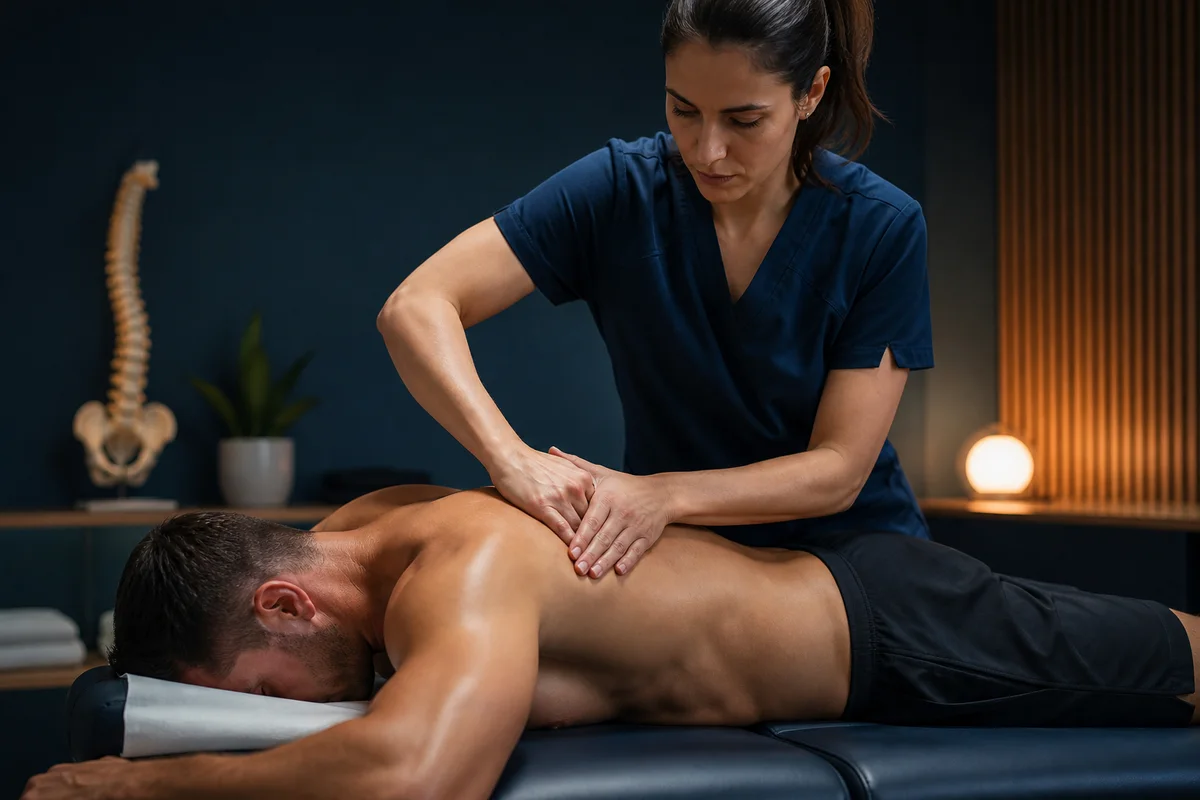
The 10 rules to remember
- Massage is an optional symptom-management tool, not a required recovery treatment.See reference 1
- Sports massage does not reliably improve strength, sprinting, jumping or endurance performance.See reference 2
- It may reduce delayed-onset muscle soreness, but average effects and study quality vary.See reference 3
- Recovery benefits are mainly subjective; sleep, nutrition and load management remain foundational.See reference 4
- Rare serious adverse events have occurred, especially with aggressive techniques or vulnerable patients.See reference 5
- Pressure should be negotiated continuously; more pain does not prove a better treatment.See reference 6
- Avoid deep unfamiliar work immediately before an important performance.See reference 7
- Do not massage an unexplained swollen calf or limb when a blood clot is possible.See reference 8
- Measure function and symptom duration, not vague claims about toxins or circulation.See reference 9
- Massage has not been shown to prevent aging or extend human lifespan.See reference 10
First principles: what this tool can actually change
Massage applies pressure, movement and touch to skin, fascia and muscle while also changing sensory input, attention and autonomic arousal. Immediate comfort does not require the therapist to physically break adhesions or flush toxins.See reference 1,See reference 2
Post-exercise soreness reflects a complex response to unfamiliar loading. Massage can reduce the perception of soreness in some settings, but biomarkers and performance do not consistently move in parallel.See reference 3,See reference 4
The useful outcome is better comfort or function at acceptable cost and risk. If the benefit disappears before it changes sleep, movement or training, the practical value may be limited even when the session feels good.See reference 5,See reference 6
A practical protocol
- Stage
- Set the goal
- What to do
- Choose soreness, pain, relaxation or range of motion
- Why it matters
- Different goals require different timing and pressureSee reference 1
- Stage
- Screen
- What to do
- Share injuries, medicines, skin problems and clot risk
- Why it matters
- Allows the therapist to modify or decline treatmentSee reference 2
- Stage
- Dose
- What to do
- Start with 20-30 minutes and tolerable pressure
- Why it matters
- Limits unnecessary post-treatment sorenessSee reference 3
- Stage
- Review
- What to do
- Check the target at 24 and 48 hours
- Why it matters
- Shows whether the appointment changed anything usefulSee reference 4
Timing and frequency
- When
- Before training
- Action
- Use brief, light and familiar work; still complete an active warm-upSee reference 5
- When
- After hard training
- Action
- Optional 20-30 minutes for soreness or relaxationSee reference 6
- When
- Next 24-48 hours
- Action
- Track soreness, function and unusual bruisingSee reference 7
- When
- Recurring care
- Action
- Book only at a frequency that produces a repeatable benefitSee reference 8
What to measure
- Signal
- Soreness
- How
- 0-10 score at the same post-exercise times
- Interpretation
- Look for a useful rather than merely statistical changeSee reference 7
- Signal
- Function
- How
- One affected movement or training task
- Interpretation
- Improvement should transfer beyond the tableSee reference 8
- Signal
- Relaxation or sleep
- How
- Same brief rating or sleep diary
- Interpretation
- Subjective but valid when it is the stated goalSee reference 9
- Signal
- Adverse effects
- How
- Bruising, swelling, neurologic symptoms or worsened pain
- Interpretation
- Guides pressure reduction or medical reviewSee reference 10
What the evidence supports
Sports-massage reviews find little evidence of direct performance enhancement, with possible small improvements in flexibility and delayed-onset muscle soreness.See reference 1,See reference 3
Massage may reduce soreness after strenuous exercise and can be one part of recovery, but findings do not establish faster structural muscle repair.See reference 2,See reference 4
Evidence for specific pain conditions is mixed and technique-dependent; a personal time-limited trial is more defensible than treating massage as a universal therapy.See reference 5,See reference 6
Evidence strength by claim
- Claim
- Reduces perceived post-exercise soreness
- Confidence
- Low to moderate
- Important boundary
- Effect size and optimal protocol varySee reference 1,See reference 2
- Claim
- Improves immediate athletic performance
- Confidence
- Not supported overall
- Important boundary
- Brief flexibility changes may occurSee reference 3,See reference 4
- Claim
- Provides short-term relief for some pain conditions
- Confidence
- Variable
- Important boundary
- Not a substitute for diagnosis or active rehabilitationSee reference 5,See reference 6
- Claim
- Detoxifies tissue, breaks all adhesions or extends lifespan
- Confidence
- Not established
- Important boundary
- These claims lack direct human evidenceSee reference 7,See reference 8,See reference 9,See reference 10
Limitations and common overclaims
Massage studies combine different techniques, therapists, pressures, session lengths and control groups, so an exact best protocol cannot be inferred.See reference 3,See reference 7
Blinding is difficult and expectation strongly influences pain and relaxation outcomes. This does not make the experience fake, but it limits causal certainty.See reference 5,See reference 8
A therapist's explanation of knots, toxins or fascia may sound anatomical without being a measured diagnosis. Judge treatment by outcomes and safety.See reference 9,See reference 10
How to make it stick
Tell the therapist the outcome, pressure preference and areas to avoid before the session starts. Consent can be changed at any time.See reference 1,See reference 2
Use a simple stoplight: comfortable pressure is green, intense but controllable is amber, sharp, electric, nauseating or frightening is red and should stop.See reference 3,See reference 4
Pair passive relief with the active plan that changes capacity—appropriate exercise, sleep and medical or rehabilitation care when needed.See reference 5,See reference 6
Troubleshooting
- Problem
- Very sore the next day
- Likely issue
- Pressure or session length was excessive
- Better next step
- Reduce dose and avoid treating pain as proof of effectivenessSee reference 2,See reference 3
- Problem
- Benefit lasts only an hour
- Likely issue
- The response may be mainly short-term relaxation
- Better next step
- Decide whether that benefit justifies the costSee reference 4,See reference 5
- Problem
- Numbness or weakness
- Likely issue
- Possible nerve irritation or another problem
- Better next step
- Stop and seek prompt clinical assessmentSee reference 6,See reference 7
- Problem
- Therapist ignores boundaries
- Likely issue
- Consent and safety process has failed
- Better next step
- End the session and choose a different providerSee reference 8,See reference 9,See reference 10
Safety and when to stop
Avoid massage over suspected deep-vein thrombosis, acute fracture, severe or unexplained swelling, open wounds, active skin infection, burns, uncontrolled bleeding, or recent surgery that has not been cleared. Tell the therapist about anticoagulants, osteoporosis, cancer treatment, neuropathy and pregnancy. Stop for sharp or electric pain, numbness, weakness, shortness of breath, chest pain, fainting or rapidly increasing swelling and obtain appropriate medical care.See reference 1,See reference 5,See reference 9
Who is most likely to benefit
Massage is most reasonable for people who value short-term relief from soreness, selected musculoskeletal pain or stress and can identify a repeatable benefit.See reference 2,See reference 4
It is less useful when it replaces progressive rehabilitation, medical assessment or basic recovery behaviors, or when the therapist makes universal claims.See reference 5,See reference 7
People with clotting risk, fragile bones or skin, neurologic deficits, active cancer treatment or recent surgery need individualized clearance and technique modification.See reference 8,See reference 10
Track five things
- The exact goal for the session.See reference 1
- Technique, duration and pressure.See reference 2
- Symptoms before, 24 hours and 48 hours later.See reference 3
- Movement or training performance.See reference 4
- Bruising, swelling or neurologic symptoms.See reference 5
Frequently asked questions
How long should a massage session be?
A focused 20-30 minute trial is enough to test value; longer sessions are preference-based and can increase cost or soreness.See reference 1
Is massage best before or after exercise?
Brief light massage can be used before activity but does not replace warming up. Post-exercise massage is more commonly used for soreness and relaxation.See reference 2
Does deep tissue massage need to hurt?
No. Strong pressure can be used with consent, but sharp, electric or escalating pain is not a quality marker.See reference 3
Does massage remove lactic acid?
Lactate is cleared rapidly through normal metabolism. Delayed soreness days later is not trapped lactic acid.See reference 4
Can massage speed muscle healing?
Evidence supports possible soreness relief more clearly than faster structural repair.See reference 5
How often should I get a massage?
There is no evidence-based universal schedule. Use the lowest frequency that produces a meaningful, repeatable benefit.See reference 6
Can I get massage while taking blood thinners?
Bruising and bleeding risk may be higher. Discuss suitability and pressure with your prescriber and therapist.See reference 7
Can massage improve longevity?
No direct human evidence shows that massage extends lifespan.See reference 8
Connect the protocol to your wider health picture
LongevityMate helps organize measurements, habits, symptoms and trends so one tool stays in context instead of becoming the whole plan.
See how LongevityMate worksGet the weekly longevity brief
The week's best longevity research in plain English. Free, every Tuesday.
References
- 1. Massage Therapy: What You Need To Know
National Center for Complementary and Integrative HealthOfficial guidance
- 2. Effect of sports massage on performance and recovery
BMJ Open Sport & Exercise MedicineMeta-analysis
- 3. Massage alleviates delayed onset muscle soreness
Frontiers in PhysiologyMeta-analysis
- 4. Evidence-based post-exercise recovery techniques
Frontiers in PhysiologyMeta-analysis
- 5. Adverse events of massage therapy in pain-related conditions
Evidence-Based Complementary and Alternative MedicineSystematic review
- 6. Massage and performance recovery: meta-analytical review
Sports MedicineMeta-analysis
- 7. Massage for low-back pain
Cochrane Database of Systematic ReviewsSystematic review
- 8. Massage therapy for neck and shoulder pain
Evidence-based reviewSystematic review
- 9. Effects of recovery techniques on delayed-onset muscle soreness
Frontiers in PhysiologyMeta-analysis
- 10. Massage Therapy for Health: What the Science Says
National Center for Complementary and Integrative HealthEvidence review
Editorial transparency
- Published by
- LongevityMate Editorial Team
- Published
- Updated
Medical disclaimer
This guide provides general health education. It does not diagnose a condition, prescribe treatment, replace individualized medical care, or guarantee a health or longevity outcome.