
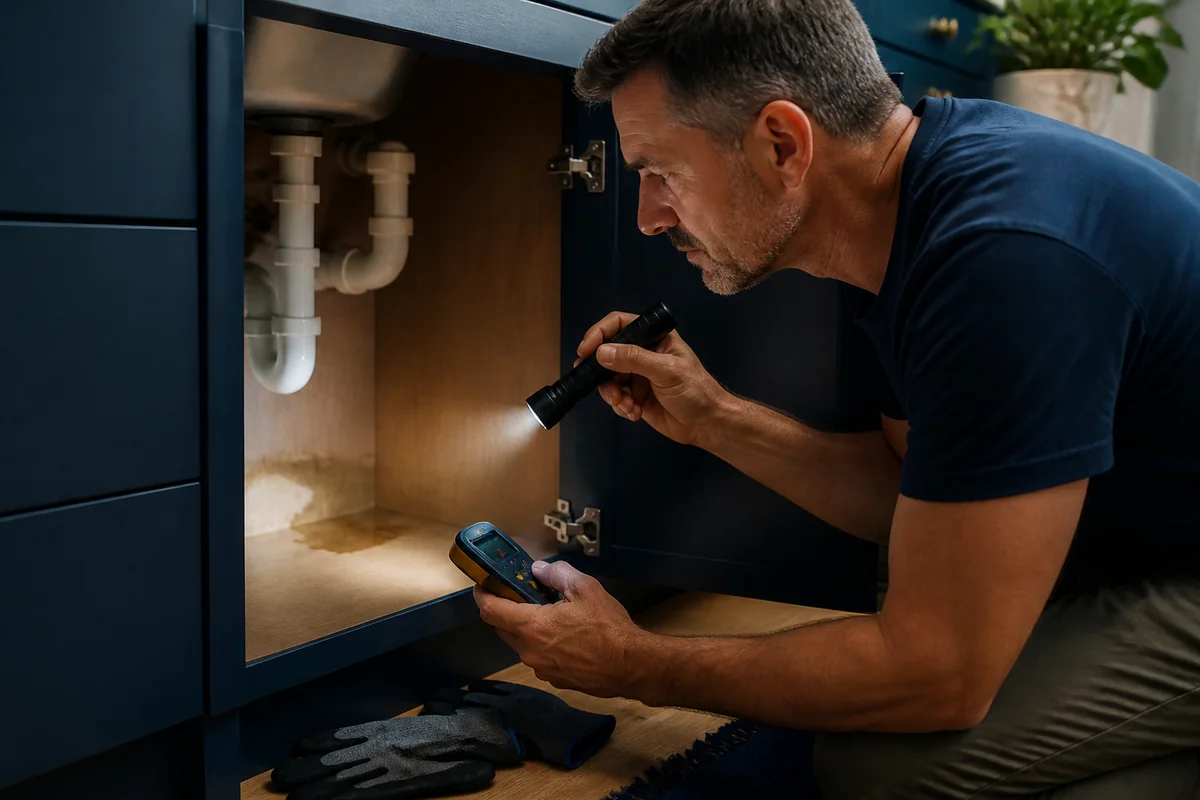
The 10 rules to remember
- Fix the leak or moisture source first.See reference 1
- Dry wet materials as quickly as practical.See reference 2
- Use a hygrometer to track indoor humidity.See reference 3
- Vent bathrooms and kitchens outdoors where possible.See reference 4
- Remove badly damaged porous material when it cannot be cleaned.See reference 5
- Use gloves, eye protection and at least an N95 for cleanup exposure.See reference 6
- Keep high-risk occupants away from remediation.See reference 7
- Use professionals for large, hidden, sewage or HVAC contamination.See reference 8
- Verify dryness and watch for recurrence.See reference 9
- Source control and drying are the intervention; fogging, ozone and a single air test cannot certify a building as safe.See reference 10,See reference 9
First principles: what this tool can actually change
Fungi are common in the environment, but persistent water allows amplification on building materials.See reference 1,See reference 2
Visible dampness, water damage and mold odor often guide action better than one air sample because exposure varies by time and location.See reference 2,See reference 3
Damp buildings are associated with respiratory symptoms, allergies and asthma exacerbation, but symptoms are nonspecific and do not identify one mold species as the cause.See reference 3,See reference 4
A practical protocol
- Stage
- Find
- What to do
- Inspect roofs, plumbing, windows, HVAC and wet rooms
- Why it matters
- Locates the water pathwaySee reference 2
- Stage
- Stop
- What to do
- Repair leaks and control condensation
- Why it matters
- Prevents regrowthSee reference 3
- Stage
- Dry/remove
- What to do
- Dry salvageable material and remove damaged porous items
- Why it matters
- Eliminates the reservoirSee reference 4
- Stage
- Verify
- What to do
- Check moisture, humidity and recurrence
- Why it matters
- Confirms the fix lastedSee reference 5
Timing and frequency
- When
- Immediately
- Action
- Stop active water and protect occupantsSee reference 3
- When
- Within 24–48 hours
- Action
- Dry wet materials when feasibleSee reference 4
- When
- During cleanup
- Action
- Isolate dust and use appropriate protectionSee reference 5
- When
- After remediation
- Action
- Recheck moisture and visible regrowthSee reference 6
What to measure
- Signal
- Relative humidity
- How
- Hygrometer
- Interpretation
- Moisture risk contextSee reference 4
- Signal
- Material moisture
- How
- Moisture meter and inspection
- Interpretation
- Whether drying is completeSee reference 5
- Signal
- Visible area
- How
- Document location and extent
- Interpretation
- Helps decide DIY versus professionalSee reference 6
- Signal
- Recurrence
- How
- Odor, staining and moisture after repair
- Interpretation
- Whether the source persistsSee reference 7
What the evidence supports
WHO and public-health guidance consistently identify persistent dampness prevention as the central control strategy.See reference 2,See reference 4
Remediation can reduce respiratory symptoms, although intervention studies vary in building type and quality.See reference 3,See reference 5
The value is removing a recognized environmental risk, not proving that mold caused every symptom or that detoxification is needed.See reference 4,See reference 6
Evidence strength by claim
- Claim
- Moisture control prevents mold growth and recurrence
- Confidence
- Moderate to strong
- Important boundary
- Hidden reservoirs and building defects may require professional investigationSee reference 1,See reference 2
- Claim
- Remediation can improve respiratory symptoms
- Confidence
- Variable
- Important boundary
- Response varies and evidence quality is mixedSee reference 3,See reference 4
- Claim
- A home mold test diagnoses illness or proves whole-building safety
- Confidence
- Limited or indirect
- Important boundary
- Risk-factor change is not proof of disease preventionSee reference 5,See reference 6
- Claim
- It extends human lifespan
- Confidence
- Not established
- Important boundary
- Association is not proof of causationSee reference 7,See reference 8,See reference 9,See reference 10
Limitations and common overclaims
There are no universal health-based indoor concentration limits for every mold species.See reference 5,See reference 7
Air samples can miss intermittent or hidden growth and can detect normal outdoor spores.See reference 6,See reference 8
Bleach, ozone or fogging without removing moisture and damaged material does not solve the underlying problem.See reference 7,See reference 9
How to make it stick
Choose the smallest version you can repeat under normal conditions. Consistency creates a useful signal; a heroic one-off session does not.See reference 1,See reference 2
Change one variable at a time and write down the protocol. Otherwise an apparent improvement may reflect different timing, equipment or conditions.See reference 3,See reference 4
Review the result after a pre-defined period. Continue only when the benefit is meaningful, the burden is acceptable and no safety signal has appeared.See reference 5,See reference 6
Troubleshooting
- Problem
- Mold returns
- Likely issue
- Moisture source remains
- Better next step
- Reinspect leaks, condensation and dryingSee reference 5
- Problem
- Musty odor but no visible growth
- Likely issue
- Hidden damp material
- Better next step
- Use moisture inspection or qualified assessmentSee reference 6
- Problem
- Humidity stays high
- Likely issue
- Ventilation, climate or equipment issue
- Better next step
- Use exhaust, dehumidification and building repairSee reference 7
- Problem
- Symptoms persist after repair
- Likely issue
- Cause may be multifactorial
- Better next step
- Seek clinical evaluation and verify the building fixSee reference 8
Safety and when to stop
People with asthma, COPD, significant allergies, immune suppression or other serious lung disease should not perform mold cleanup or occupy heavily contaminated spaces. Use gloves, eye protection and at least an N95 when appropriate, never mix bleach with ammonia or other cleaners, and avoid ozone generators. Sewage, structural damage, large areas and HVAC contamination need professional help.See reference 1,See reference 5,See reference 9
Who is most likely to benefit
Homes with leaks, flooding, condensation, basement dampness or repeated bathroom growth benefit from a moisture-first protocol.See reference 2,See reference 6
People with asthma or allergy may gain from exposure reduction but still need appropriate medical care.See reference 3,See reference 7
Renters and workers should document water damage and use relevant building, workplace or tenancy processes.See reference 4,See reference 8
Track five things
- Leak source and repair date.See reference 1
- Humidity and material moisture.See reference 2
- Visible area, odor and photographs.See reference 3
- Cleanup protection and materials removed.See reference 4
- Recurrence and respiratory symptoms after the environment is dry.See reference 5
Frequently asked questions
What humidity prevents mold?
Aim around 30–50% where practical, while preventing condensation and following climate-specific advice.See reference 1
Can I clean mold myself?
Small uncomplicated areas may be manageable with protection; large, hidden, sewage or HVAC contamination needs professional help.See reference 2
Do I need a mold test?
Often no. Visible mold or moisture already justifies fixing water and cleaning; tests have important limitations.See reference 3
Does bleach kill mold?
Some guidance permits diluted bleach on suitable surfaces, but cleaning and removing damaged material plus moisture control matter more.See reference 4
Is black mold uniquely toxic?
Color alone does not determine health risk or the correct response; any persistent indoor growth should be addressed.See reference 5
Will a HEPA purifier fix mold?
No. It may reduce airborne particles but cannot remove the moisture source or contaminated material.See reference 6
Connect the protocol to your wider health picture
LongevityMate helps organize measurements, habits, symptoms and trends so one tool stays in context instead of becoming the whole plan.
See how LongevityMate worksGet the weekly longevity brief
The week's best longevity research in plain English. Free, every Tuesday.
References
- 1. WHO guidelines for indoor air quality: dampness and mould
World Health OrganizationGuideline
- 2. Mold Clean Up Guidelines and Recommendations
Centers for Disease Control and PreventionOfficial guidance
- 3. Mold Course Chapter 9
U.S. Environmental Protection AgencyOfficial guidance
- 4. A Brief Guide to Mold, Moisture and Your Home
U.S. Environmental Protection AgencyOfficial guidance
- 5. Damp Indoor Spaces and Health
National Academies PressEvidence review
- 6. Respiratory and allergic health effects of dampness and mold
Environmental Health PerspectivesMeta-analysis
- 7. Remediating buildings damaged by dampness and mould
CochraneSystematic review
- 8. Health problems in damp and mouldy buildings
European Respiratory ReviewEvidence review
- 9. Mold
National Institute for Occupational Safety and HealthOfficial guidance
- 10. Mold Remediation in Schools and Commercial Buildings
U.S. Environmental Protection AgencyOfficial guidance
Editorial transparency
- Published by
- LongevityMate Editorial Team
- Published
- Updated
Medical disclaimer
This guide provides general health education. It does not diagnose a condition, prescribe treatment, replace individualized professional care, or guarantee a health or longevity outcome.