
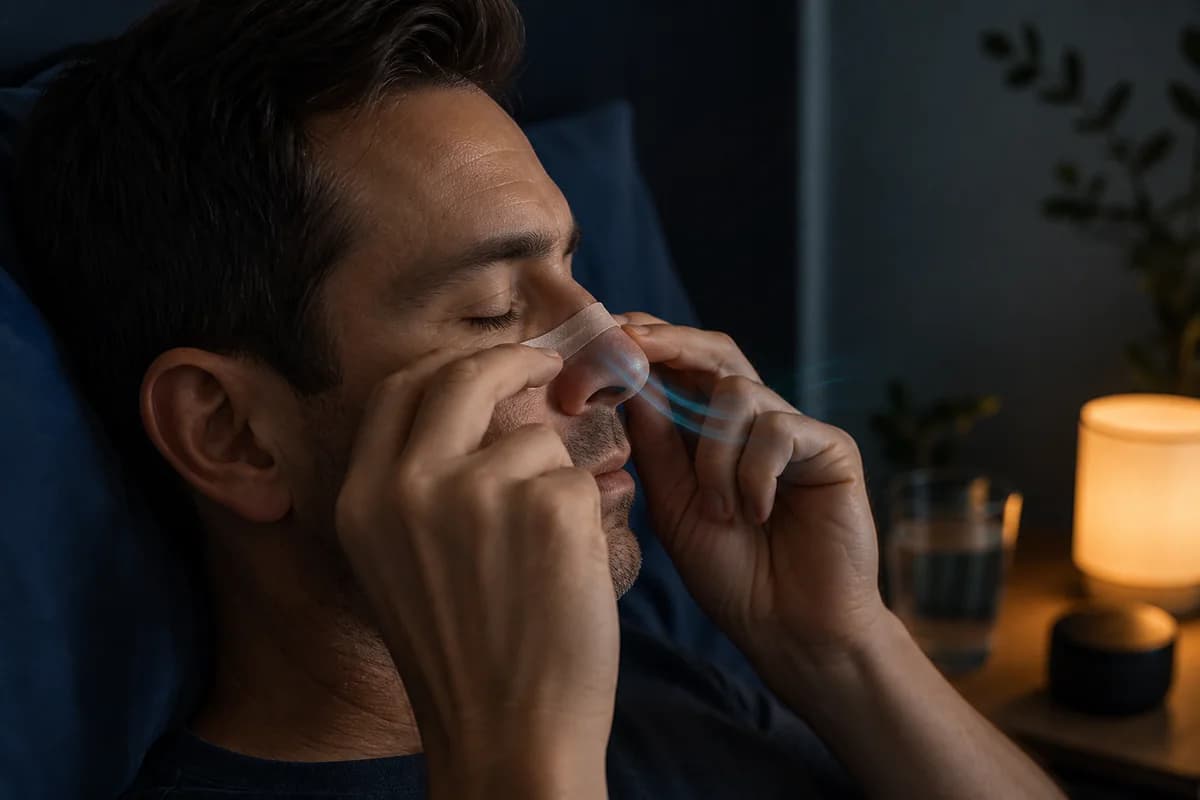
The 10 rules to remember
- Use nasal strips only for a clearly defined problemSee reference 1
- Start with the lowest-burden evidence-based optionSee reference 2
- Record a baseline before changing anythingSee reference 3
- Do not confuse a biological mechanism with a proven health outcomeSee reference 4
- Do not let nasal strips replace established careSee reference 5
- Use qualified clinical oversight when the intervention is medicalSee reference 6
- Stop when harms, abnormal symptoms or a worse trend appearSee reference 7
- Judge benefit with measurements that matter to the original goalSee reference 8
- Reassess cost, burden and uncertainty after the planned trialSee reference 9
- Avoid protocols based only on testimonials, influencers or clinic marketingSee reference 10
First principles: what this can actually change
A spring-like strip pulls the sidewalls of the nose outward, reducing resistance at the nasal valve.See reference 1,See reference 2
Obstructive sleep apnea usually involves collapse behind the tongue or soft palate, so widening the nostrils often leaves the main obstruction unchanged.See reference 3,See reference 4
A useful strip should improve a symptom that matters without delaying assessment of the underlying airway.See reference 5,See reference 6
A practical decision protocol
- Stage
- 1. Check the pattern
- What to do
- Look for nasal-valve narrowing, congestion and side-to-side blockage
- Why it matters
- Different causes need different careSee reference 1,See reference 2
- Stage
- 2. Apply correctly
- What to do
- Place on clean dry skin over the widest lower third of the nose
- Why it matters
- Position determines mechanical liftSee reference 3,See reference 4
- Stage
- 3. Run a short trial
- What to do
- Compare 3–7 nights with and without the strip
- Why it matters
- A within-person comparison reduces guessworkSee reference 5,See reference 6
- Stage
- 4. Escalate appropriately
- What to do
- Seek assessment for persistent obstruction or apnea symptoms
- Why it matters
- A strip cannot diagnose or cure airway diseaseSee reference 7,See reference 8
Timing, dose and frequency
- Decision
- At bedtime
- Practical answer
- Apply shortly before sleep after washing and drying the skin.See reference 1,See reference 2
- Decision
- Trial length
- Practical answer
- Several alternating nights are usually enough to judge comfort and congestion.See reference 3,See reference 4
- Decision
- With CPAP
- Practical answer
- A strip may improve comfort for some nasal-mask users but should not replace pressure or mask optimization.See reference 5,See reference 6
- Decision
- Persistent obstruction
- Practical answer
- Arrange medical review rather than using strips indefinitely without understanding the cause.See reference 7,See reference 8
What to measure
- Signal
- Subjective nasal openness
- How
- Rate 0–10 before and after application
- Interpretation
- A clear immediate change suggests nasal-valve contributionSee reference 1,See reference 2
- Signal
- Snoring
- How
- Use bed-partner report across matched nights
- Interpretation
- Less noise does not prove apnea controlSee reference 3,See reference 4
- Signal
- Skin tolerance
- How
- Inspect for redness, blistering or breakdown
- Interpretation
- Damage means the burden exceeds benefitSee reference 5,See reference 6
- Signal
- OSA outcomes
- How
- Use a sleep test when indicated
- Interpretation
- AHI, oxygen and symptoms determine treatmentSee reference 7,See reference 8
What the evidence actually shows
A 2026 meta-analysis of 17 studies found no significant improvement in AHI, oxygen saturation, snoring index or sleep architecture overall.See reference 1,See reference 2
Earlier reviews show strips can increase nasal-valve area and reduce perceived nasal resistance.See reference 3,See reference 4
The evidence supports symptom relief in selected nasal obstruction, not monotherapy for obstructive sleep apnea or a longevity effect.See reference 5,See reference 6
Evidence strength by claim
- Claim
- Makes nasal breathing feel easier
- Confidence
- Moderate
- Important boundary
- Most plausible with nasal-valve narrowingSee reference 1,See reference 2
- Claim
- Treats obstructive sleep apnea
- Confidence
- Low
- Important boundary
- Pooled objective sleep outcomes are not improvedSee reference 3,See reference 4
- Claim
- Reduces simple snoring
- Confidence
- Low
- Important boundary
- Results vary and snoring has multiple sourcesSee reference 5,See reference 6
- Claim
- Improves healthspan
- Confidence
- Very low
- Important boundary
- No long-term clinical outcomes evidenceSee reference 7,See reference 8
Limits and common overclaims
Many trials are small and device designs vary.See reference 4,See reference 7
Perceived openness is susceptible to expectation and does not localize obstruction precisely.See reference 5,See reference 8
Allergic rhinitis, septal deviation, polyps and sleep apnea require cause-specific management.See reference 6,See reference 9
A four-step implementation plan
- 1. Look for nasal-valve narrowing, congestion and side-to-side blockageSee reference 1
- 2. Place on clean dry skin over the widest lower third of the noseSee reference 2
- 3. Compare 3–7 nights with and without the stripSee reference 3
- 4. Seek assessment for persistent obstruction or apnea symptomsSee reference 4
Troubleshooting
- Problem
- Strip peels off
- Likely issue
- Oil, moisture or incorrect position
- Better next step
- Clean and dry the skin; do not add aggressive adhesiveSee reference 1,See reference 2
- Problem
- No airflow change
- Likely issue
- Obstruction may be deeper or inflammatory
- Better next step
- Stop buying stronger strips and assess the causeSee reference 3,See reference 4
- Problem
- Skin becomes sore
- Likely issue
- Adhesive or tension injury
- Better next step
- Stop and allow recoverySee reference 5,See reference 6
- Problem
- Snoring persists
- Likely issue
- The obstruction may be behind the nose
- Better next step
- Screen for sleep apnea and other causesSee reference 7,See reference 8
Safety and when to get medical help
Nasal strips are generally low risk, but stop for rash, blistering, broken skin or worsening congestion. Do not place over injured skin. They are not emergency airway devices and should never delay care for severe breathlessness, facial swelling, recurrent nosebleeds or suspected sleep apnea.See reference 1,See reference 5,See reference 9
Who is most likely to benefit
People with temporary congestion or nasal-valve narrowing who notice immediate easier nasal inspiration.See reference 2,See reference 6
Some CPAP users seeking a low-risk comfort adjunct after mask and humidification review.See reference 3,See reference 7
People with persistent symptoms benefit more from diagnosis than from indefinite strip use.See reference 4,See reference 8
Track five things
- Subjective nasal opennessSee reference 1
- SnoringSee reference 3
- Skin toleranceSee reference 5
- OSA outcomesSee reference 7
- Decision made after reviewing the resultSee reference 9
Frequently asked questions
Do nasal strips stop sleep apnea?
No. They may improve nasal airflow but pooled studies do not show reliable improvement in apnea severity.See reference 1
Internal or external dilator?
Both can widen the nasal valve; comfort and fit differ, while neither should be assumed to treat apnea.See reference 2
Can I use one every night?
Yes if skin remains healthy and the reason for persistent obstruction has been assessed.See reference 3
Where should it sit?
Across the lower third of the nose where the nostril sidewalls narrow, following the product instructions.See reference 4
Does this extend lifespan?
No human trial has shown that nasal strips extends lifespan. Any longevity claim must be separated from evidence for a specific symptom, diagnosis or surrogate marker.See reference 5
How quickly should it work?
Apply shortly before sleep after washing and drying the skin.See reference 6
Can it replace standard treatment?
No. A complementary tool should not displace care already shown to reduce symptoms, complications or mortality.See reference 7
How do I know whether it helped?
Use a pre-defined outcome such as subjective nasal openness and compare it with a baseline over an appropriate time window.See reference 8
Connect this decision to your wider health picture
LongevityMate helps organize measurements, symptoms, habits and trends so one test, device or treatment stays in context instead of becoming the whole plan.
See how LongevityMate worksGet the weekly longevity brief
The week's best longevity research in plain English. Free, every Tuesday.
References
- 1. Clinical Effectiveness of Nasal Dilators in Sleep-Disordered Breathing
CureusMeta-analysis
- 2. Nasal Dilators for Snoring and OSA
Pulmonary MedicineMeta-analysis
- 3. External Nasal Dilators: Definition and Current Uses
International Journal of General MedicineEvidence review
- 4. Safety and Efficacy of Mouth Taping: Systematic Review
PLOS OneSystematic review
- 5. Mouth Tape for CPAP Use in Mouth Breathing and OSA
Journal of Clinical Sleep MedicineRandomized trial
- 6. Mouth Closing With Mandibular Advancement Therapy
Annals of the American Thoracic SocietyRandomized trial
- 7. Weighted Blankets for Psychiatric Symptoms
Complementary Therapies in MedicineMeta-analysis
- 8. Diagnostic Testing for Adult Obstructive Sleep Apnea
American Academy of Sleep MedicineGuideline
- 9. PAP Treatment of Adult Obstructive Sleep Apnea
American Academy of Sleep MedicineGuideline
- 10. Oral Appliance Therapy Guideline
American Academy of Sleep MedicineGuideline
Editorial transparency
- Published by
- LongevityMate Editorial Team
- Published
- Updated
Medical disclaimer
This guide provides general health education. It does not diagnose a condition, prescribe treatment, replace individualized medical care, or guarantee a health or longevity outcome.