
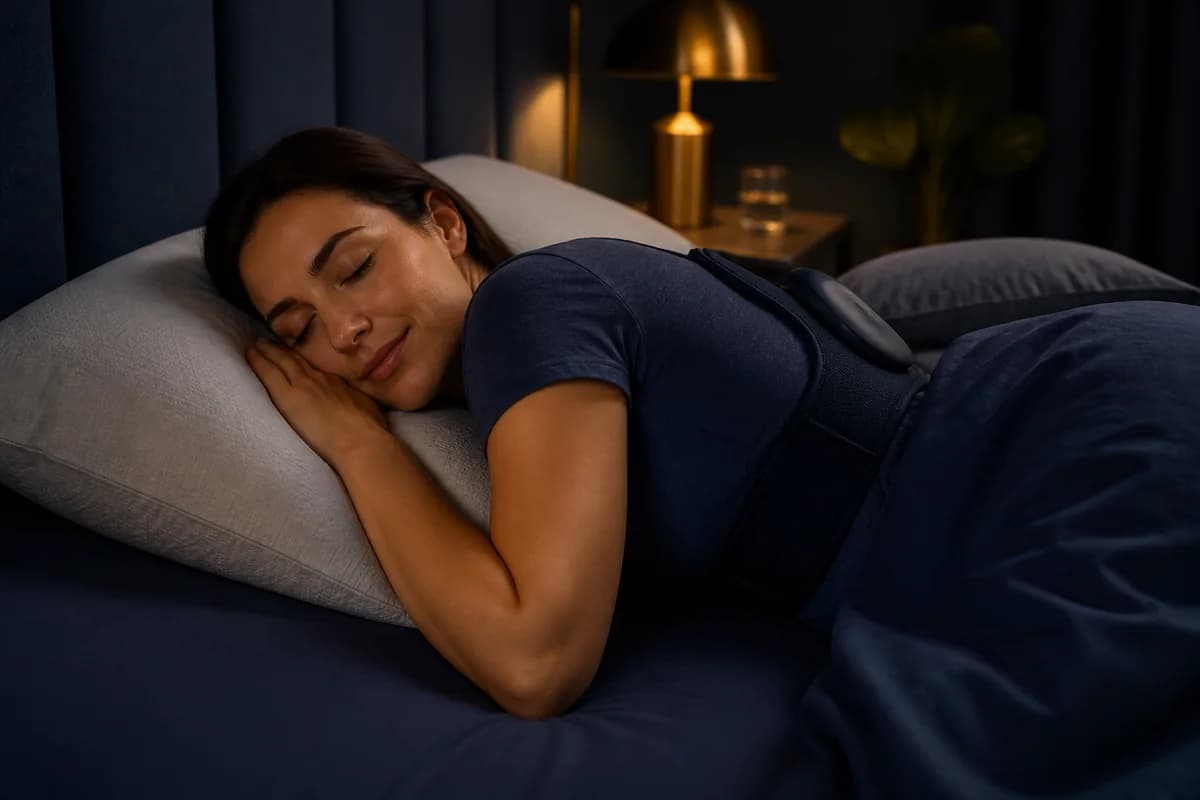
The 10 rules to remember
- Confirm obstructive sleep apnea and positional dependence with a valid sleep study before treating it.See reference 1
- Use the full AHI, supine AHI, non-supine AHI, oxygen data and symptoms—not snoring alone.See reference 2
- Choose positional therapy with a sleep clinician as primary, adjunctive or alternative care.See reference 3
- Expect CPAP to reduce AHI more on average even when positional therapy is easier to tolerate.See reference 4
- Use the device for the whole sleep period, because untreated supine time can preserve risk.See reference 5
- Build tolerance gradually and address shoulder, hip, neck or back discomfort early.See reference 6
- Prefer objective use and position data when available rather than relying only on memory.See reference 7
- Retest sleep objectively before concluding that side sleeping controls the disorder.See reference 8
- Reassess after major weight, alcohol, medicine, pregnancy or health changes.See reference 9
- Never drive sleepy or delay treatment of severe sleepiness while experimenting with position.See reference 10
First principles: what this tool can actually change
Gravity and upper-airway anatomy can make the tongue and soft tissues narrow the airway more when a susceptible person sleeps supine. Moving to a lateral position can reduce collapse for a positional phenotype but cannot correct every anatomical or non-anatomical cause of OSA.See reference 1,See reference 2
Positional OSA is commonly defined by a supine AHI at least twice the non-supine AHI, but definitions and minimum time in each position vary. The non-supine residual AHI and oxygen burden determine whether avoidance alone is likely to be adequate.See reference 3,See reference 4
Efficacy is the reduction while the device is used; effectiveness also includes comfort, nightly adherence and durability. A less powerful therapy used consistently can help, but only objective retesting shows whether residual disease is acceptable.See reference 5,See reference 6
A clinician-supervised positional therapy protocol
- Stage
- Confirm phenotype
- What to do
- Review diagnostic AHI by position, oxygen and sleep time
- Why it matters
- Identifies whether position meaningfully drives diseaseSee reference 1
- Stage
- Select method
- What to do
- Choose a tolerable trainer, pillow or barrier with the clinician
- Why it matters
- Balances efficacy and adherenceSee reference 2
- Stage
- Adapt
- What to do
- Increase use over 1-2 weeks while protecting comfort
- Why it matters
- Reduces early abandonmentSee reference 3
- Stage
- Verify
- What to do
- Repeat objective testing on therapy and review symptoms
- Why it matters
- Confirms residual OSA is controlledSee reference 4
Timing and frequency
- When
- Every sleep period
- Action
- Use throughout the night, including naps if the plan requiresSee reference 5
- When
- First 1-2 weeks
- Action
- Build tolerance and correct fit or pressure problemsSee reference 6
- When
- Within the clinician's review window
- Action
- Check objective adherence, position, symptoms and side effectsSee reference 7
- When
- After meaningful change
- Action
- Retest after weight, alcohol, medicines, surgery or symptom changeSee reference 8
What to measure
- Signal
- Supine and non-supine AHI
- How
- Obtain from valid sleep testing
- Interpretation
- Defines phenotype and residual diseaseSee reference 7
- Signal
- Time supine
- How
- Use objective device or sleep-study data
- Interpretation
- Shows whether the mechanism workedSee reference 8
- Signal
- Oxygen burden
- How
- Review nadir and time below clinical thresholds
- Interpretation
- AHI alone can miss consequenceSee reference 9
- Signal
- Symptoms and adherence
- How
- Sleepiness, snoring, comfort and nightly use
- Interpretation
- Determines real-world effectivenessSee reference 10
What the evidence supports
Cochrane evidence suggests positional therapy reduces AHI and sleepiness versus inactive control in positional OSA, while CPAP reduces AHI more and positional therapy may be worn longer.See reference 1,See reference 3
Modern vibrotactile devices reduce supine sleep and AHI in short-term trials and meta-analyses; a 2026 sham-controlled trial found a modest three-month AHI reduction and improved sleep quality but not daytime sleepiness.See reference 2,See reference 4
It can be a useful adjunct to PAP or oral-appliance therapy when residual events are position-dependent, but combination decisions need objective reassessment.See reference 5,See reference 6
Evidence strength by claim
- Claim
- Reduces supine sleep and AHI in positional OSA
- Confidence
- Moderate
- Important boundary
- Short-term evidence is stronger than long-termSee reference 1,See reference 2
- Claim
- Is worn longer than CPAP by some patients
- Confidence
- Low to moderate
- Important boundary
- Comfort does not prove adequate controlSee reference 3,See reference 4
- Claim
- Controls OSA as reliably as CPAP
- Confidence
- Not generally
- Important boundary
- CPAP reduces AHI more on averageSee reference 5,See reference 6
- Claim
- Treats untested snoring or prevents cardiovascular events
- Confidence
- Not established
- Important boundary
- Diagnosis and outcome evidence are requiredSee reference 7,See reference 8,See reference 9,See reference 10
Limitations and common overclaims
Trials use different positional definitions, devices and OSA severities, and many are short. Results cannot be generalized to non-positional, central or severe hypoxemic disease.See reference 3,See reference 7
A device can successfully prevent back sleeping while residual lateral OSA remains clinically important. Position adherence is not the same as treatment success.See reference 5,See reference 8
Older tennis-ball or bulky methods may be inexpensive but cause discomfort and poor long-term use; newer vibrotactile devices cost more and still do not guarantee adherence or control.See reference 9,See reference 10
How to make it stick
Ask for the sleep-study table by position and write down the clinician-agreed target: residual AHI, oxygen, symptoms and minimum use.See reference 1,See reference 2
Choose a method you can remove quickly and that does not restrict breathing or unsafe movement; adjust one fit variable at a time.See reference 3,See reference 4
Schedule verification before starting so improved snoring or an app's position graph does not become a substitute for a treatment study.See reference 5,See reference 6
Troubleshooting
- Problem
- Shoulder or hip pain
- Likely issue
- Forced lateral posture or poor support
- Better next step
- Adjust bedding or method and review musculoskeletal limitsSee reference 2,See reference 3
- Problem
- Device wakes you repeatedly
- Likely issue
- Feedback intensity or adaptation is poor
- Better next step
- Use the prescribed acclimation settings and contact the providerSee reference 4,See reference 5
- Problem
- Snoring improves but sleepiness remains
- Likely issue
- Residual OSA or another sleep problem
- Better next step
- Arrange objective reassessmentSee reference 6,See reference 7
- Problem
- Back sleeping returns
- Likely issue
- Method is not worn or no longer effective
- Better next step
- Review adherence data and choose another treatmentSee reference 8,See reference 9,See reference 10
Safety and when to stop
Do not replace CPAP, oral-appliance therapy or another prescribed treatment without a sleep clinician and objective confirmation that positional therapy controls AHI and oxygenation. Seek prompt care for severe daytime sleepiness, drowsy-driving risk, choking awakenings, chest symptoms or worsening cardiopulmonary disease. Position devices may be unsuitable with significant shoulder, hip, spine, mobility, balance, neurologic or skin problems, and anything that restricts movement or breathing should not be improvised.See reference 1,See reference 5,See reference 9
Who is most likely to benefit
It is most appropriate for adults with objectively confirmed positional OSA and a low enough non-supine burden that a sleep clinician considers avoidance meaningful.See reference 2,See reference 4
It may help as an adjunct when PAP or an oral appliance leaves position-dependent events, or as an alternative in selected mild-to-moderate cases after shared decision-making.See reference 5,See reference 7
It is unlikely to be sufficient for non-positional OSA, substantial residual lateral disease, central apnea or major oxygen impairment without another effective treatment.See reference 8,See reference 10
Track five things
- Baseline supine and non-supine AHI.See reference 1
- Nightly use and percentage of supine sleep.See reference 2
- Residual AHI and oxygen on treatment.See reference 3
- Sleepiness, snoring and drowsy-driving risk.See reference 4
- Pain, awakenings and continuation rate.See reference 5
Frequently asked questions
What is positional sleep apnea?
It is OSA that is substantially worse while supine, commonly defined as a supine AHI at least twice the non-supine AHI.See reference 1
Is side sleeping enough to treat sleep apnea?
Only for selected positional OSA and only after objective testing confirms acceptable control.See reference 2
Is positional therapy better than CPAP?
It may be easier to wear, but CPAP reduces AHI more on average and remains more reliable across phenotypes.See reference 3
Can I use a tennis ball shirt?
It is inexpensive but can be uncomfortable and poorly sustained; discuss a safer, tolerable purpose-designed option.See reference 4
How quickly does it work?
Position changes work that night when used, but adaptation takes days and treatment success must be objectively verified.See reference 5
Can a wearable prove it treated my apnea?
A position graph can show less back sleeping but cannot replace validated measurement of breathing and oxygen.See reference 6
Should I stop CPAP if I no longer snore?
No. Snoring is not a reliable measure of residual OSA; use clinician-supervised retesting.See reference 7
Does positional therapy improve longevity?
No direct evidence establishes a longevity benefit; the aim is adequate control of diagnosed OSA and its symptoms.See reference 8
Connect the protocol to your wider health picture
LongevityMate helps organize measurements, habits, symptoms and trends so one tool stays in context instead of becoming the whole plan.
See how LongevityMate worksGet the weekly longevity brief
The week's best longevity research in plain English. Free, every Tuesday.
References
- 1. Positional Therapy for Obstructive Sleep Apnoea
Cochrane Database of Systematic ReviewsSystematic review
- 2. Vibrotactile Positional Therapy Meta-analysis
ThoraxMeta-analysis
- 3. Vibrotactile Positional Therapy Randomized Trial
ThoraxRandomized trial
- 4. Oral Appliance Versus Positional Therapy
BMC Oral HealthMeta-analysis
- 5. New-generation Positional Therapy Devices
Journal of Clinical Sleep MedicineMeta-analysis
- 6. Long-term Sleep Position Trainer Adherence
SleepObservational study
- 7. Positional Therapy Compared With CPAP
Journal of Clinical Sleep MedicineRandomized trial
- 8. Sleep Position Trainer Randomized Trial
Journal of Sleep ResearchRandomized trial
- 9. Adult Obstructive Sleep Apnea Clinical Guideline
American Academy of Sleep MedicineGuideline
- 10. Guideline for Adult Obstructive Sleep Apnea
National Center for Respiratory MedicineGuideline
Editorial transparency
- Published by
- LongevityMate Editorial Team
- Published
- Updated
Medical disclaimer
This guide provides general health education. It does not diagnose a condition, prescribe treatment, replace individualized medical care, or guarantee a health or longevity outcome.