
The 10 rules to remember
- Diagnose OSA before buying a deviceSee reference 1
- Use a custom titratable applianceSee reference 2
- Coordinate dentist and sleep clinician careSee reference 3
- Start at a comfortable advancementSee reference 4
- Titrate gradually rather than maximallySee reference 5
- Track jaw pain and bite changeSee reference 6
- Wear it for every sleep once adaptedSee reference 7
- Verify treatment with objective testingSee reference 8
- Continue periodic dental follow-upSee reference 9
- Do not drive when dangerously sleepySee reference 10
First principles: what this can actually change
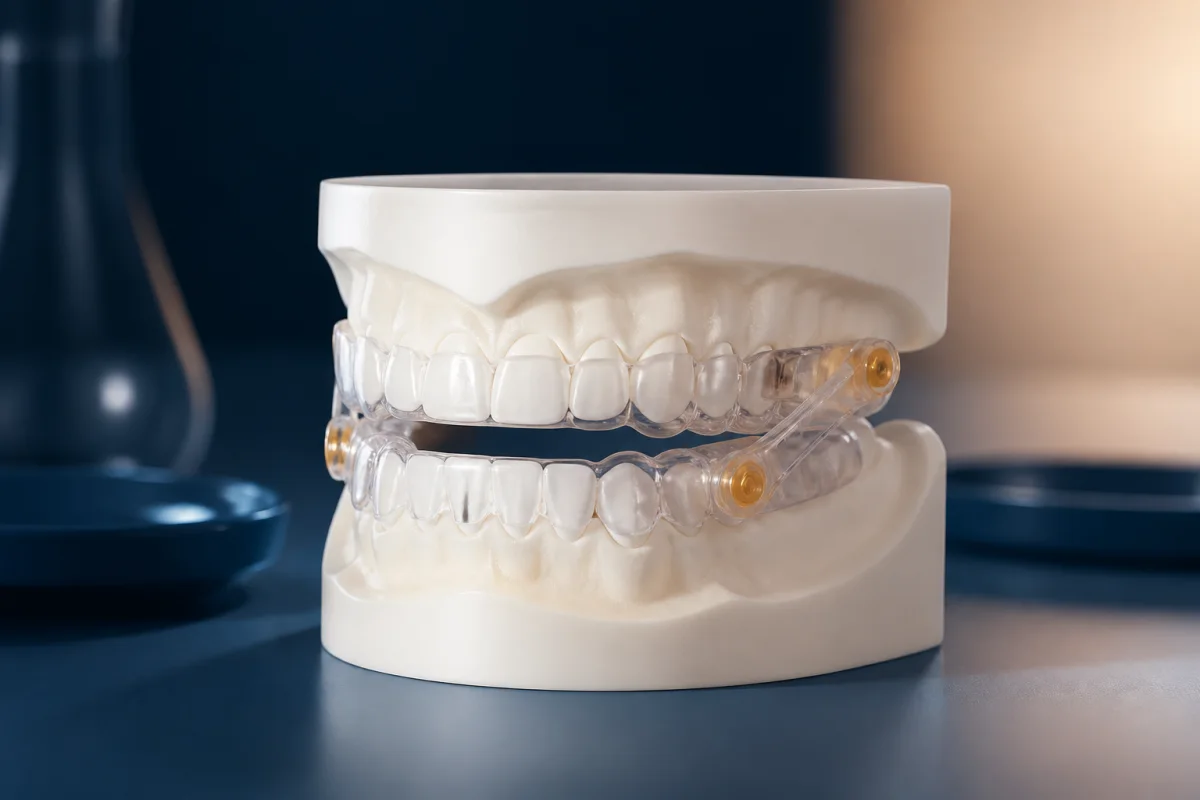
Mandibular advancement devices hold the lower jaw forward, enlarging and stabilizing the upper airway during sleep.See reference 1,See reference 2
More advancement can improve airway control but may increase jaw, tooth and bite side effects. The useful dose is the least advancement that adequately controls disease.See reference 3,See reference 4
Comfortable nightly use can offset lower physiological efficacy compared with CPAP for some people, but severe OSA and major desaturation need especially careful verification.See reference 5,See reference 6
A practical decision protocol
- Stage
- 1. Diagnose
- What to do
- Complete a sleep evaluation and objective test
- Why it matters
- Snoring alone does not define OSA severitySee reference 1,See reference 2
- Stage
- 2. Fit
- What to do
- Use dental examination, impressions or scans and a custom titratable device
- Why it matters
- Fit affects retention and safetySee reference 2,See reference 3
- Stage
- 3. Titrate
- What to do
- Advance gradually based on symptoms and clinician guidance
- Why it matters
- Balances efficacy with side effectsSee reference 3,See reference 4
- Stage
- 4. Verify
- What to do
- Repeat sleep testing at the therapeutic setting
- Why it matters
- Symptoms alone can miss residual diseaseSee reference 4,See reference 5
Timing and frequency
- Decision
- Adaptation
- Practical answer
- Increase wear gradually over days if advised, then use for the full sleep period.See reference 3,See reference 4
- Decision
- Titration
- Practical answer
- Adjust in small steps over weeks, allowing jaw symptoms to settle.See reference 4,See reference 5
- Decision
- Effectiveness testing
- Practical answer
- Test after a stable comfortable setting is reached, not on the first night.See reference 5,See reference 6
- Decision
- Long-term
- Practical answer
- Maintain dental and sleep follow-up because bite, teeth, weight and OSA can change.See reference 6,See reference 7
What to measure
- Signal
- Residual AHI/REI and oxygen
- How
- Use follow-up sleep testing
- Interpretation
- Confirms physiological controlSee reference 4,See reference 5
- Signal
- Sleepiness and snoring
- How
- Track patient and bed-partner report
- Interpretation
- Useful but insufficient aloneSee reference 5,See reference 6
- Signal
- Dental and jaw effects
- How
- Check bite, tooth movement and TMJ symptoms
- Interpretation
- Changes can become permanentSee reference 6,See reference 7
- Signal
- Adherence
- How
- Record nights and full-night use when possible
- Interpretation
- Real-world use determines effectSee reference 7,See reference 8
What the evidence actually shows
AASM and dental sleep medicine guidance recommends custom titratable oral appliances for adults with OSA who cannot tolerate CPAP or prefer an alternative.See reference 1,See reference 3
Oral appliances reduce AHI and sleepiness on average, although CPAP generally lowers respiratory events and oxygen disturbance more strongly.See reference 4,See reference 6
Long-term cardiovascular outcome evidence is less certain than event-control evidence, so treatment success should be verified rather than assumed.See reference 7,See reference 8
Evidence strength by claim
- Claim
- Reduces OSA severity in selected adults
- Confidence
- High
- Important boundary
- Response varies with anatomy and severitySee reference 1,See reference 2
- Claim
- Improves sleepiness and quality of life
- Confidence
- Moderate
- Important boundary
- Other causes of sleepiness still matterSee reference 3,See reference 4
- Claim
- Controls events as strongly as CPAP
- Confidence
- Moderate
- Important boundary
- CPAP is generally more physiologically effectiveSee reference 5,See reference 6
- Claim
- Over-the-counter guards are equivalent
- Confidence
- Low
- Important boundary
- Guidelines favor custom titratable devicesSee reference 7,See reference 8,See reference 9
Limits and common overclaims
Response is difficult to predict perfectly from symptoms, anatomy or body weight alone.See reference 3,See reference 7
Jaw discomfort, salivation, dry mouth, tooth movement and bite change can occur and require monitoring.See reference 5,See reference 8
A quiet night does not guarantee controlled oxygen or event frequency.See reference 9,See reference 10
A four-step implementation plan
- 1. Complete a sleep evaluation and objective testSee reference 1
- 2. Use dental examination, impressions or scans and a custom titratable deviceSee reference 2
- 3. Advance gradually based on symptoms and clinician guidanceSee reference 3
- 4. Repeat sleep testing at the therapeutic settingSee reference 4
Troubleshooting
- Problem
- Jaw pain
- Likely issue
- Advancement may be too fast or the joint is irritated
- Better next step
- Pause titration and contact the dentist; use prescribed jaw exercisesSee reference 2,See reference 3
- Problem
- Device falls out
- Likely issue
- Retention or fit is inadequate
- Better next step
- Have it adjusted rather than using adhesivesSee reference 4,See reference 5
- Problem
- Snoring improves but fatigue remains
- Likely issue
- Residual OSA or another sleep problem may persist
- Better next step
- Obtain objective follow-up and clinical reviewSee reference 6,See reference 7
- Problem
- Bite feels different in morning
- Likely issue
- Temporary repositioning or progressive dental change
- Better next step
- Use prescribed morning aligner and document persistent changeSee reference 8,See reference 9
Safety and when to get medical help
A dental and periodontal assessment is important before treatment. Seek prompt review for severe jaw pain, locked jaw, loose teeth, gum injury, major bite change or persistent dangerous sleepiness. People with severe OSA, major hypoxemia or cardiorespiratory disease need coordinated sleep-specialist oversight and objective verification.See reference 1,See reference 5,See reference 9
Who is most likely to benefit
Adults with mild-to-moderate OSA who prefer a portable non-PAP option and have suitable dentition.See reference 2,See reference 4
People with OSA who cannot tolerate CPAP despite good troubleshooting.See reference 5,See reference 7
Selected patients using combination therapy, such as an appliance plus positional treatment, under clinical guidance.See reference 8,See reference 10
Track five things
- Advancement settingSee reference 1
- Nightly wear and comfortSee reference 2
- Jaw, tooth and bite symptomsSee reference 3
- Snoring and daytime sleepinessSee reference 4
- Follow-up AHI/REI and oxygen resultsSee reference 5
Frequently asked questions
Is it just a mouth guard?
No. A therapeutic mandibular advancement device is custom fitted and holds the jaw in a controlled forward position.See reference 1
Is it better than CPAP?
CPAP generally controls breathing events more strongly, while some people use an oral appliance more consistently.See reference 2
Can I buy one online?
Guidelines favor a custom titratable appliance with dental oversight.See reference 3
Does it cure sleep apnea?
It controls airway collapse while worn; underlying anatomy and risk remain.See reference 4
How far should the jaw move?
Use gradual individualized titration, not maximum advancement.See reference 5
Do I need another sleep test?
Yes, objective follow-up is recommended to confirm effectiveness.See reference 6
Can it change my bite?
Yes. Long-term tooth and bite changes are recognized risks and need monitoring.See reference 7
Can I use it for severe OSA?
Sometimes when CPAP is not tolerated, but efficacy must be verified carefully and CPAP remains more reliable for event control.See reference 8
Connect this decision to your wider health picture
LongevityMate helps organize measurements, symptoms, habits and trends so a test or treatment stays in context instead of becoming the whole plan.
See how LongevityMate worksGet the weekly longevity brief
The week's best longevity research in plain English. Free, every Tuesday.
References
- 1. Oral Appliance Therapy Guideline
American Academy of Sleep MedicineGuideline
- 2. Oral Appliance Treatment for OSA
Journal of Clinical Sleep MedicineGuideline
- 3. Oral Appliances for OSA: Systematic Review
Journal of Clinical Sleep MedicineSystematic review
- 4. CPAP Compared With Oral Appliances
Sleep Medicine ReviewsMeta-analysis
- 5. Long-Term Dental Side Effects
American Journal of OrthodonticsObservational study
- 6. Definition of an Effective Oral Appliance
Journal of Dental Sleep MedicineOfficial guidance
- 7. Oral Appliance Therapy Standards
American Academy of Dental Sleep MedicineGuideline
- 8. PAP Treatment of Adult OSA
American Academy of Sleep MedicineGuideline
- 9. Diagnostic Testing for Adult OSA
American Academy of Sleep MedicineGuideline
- 10. Oral Appliance Adherence and Effectiveness
ThoraxRandomized trial
Editorial transparency
- Published by
- LongevityMate Editorial Team
- Published
- Updated
Medical disclaimer
This guide provides general health education. It does not diagnose a condition, prescribe treatment, replace individualized medical care, or guarantee a health or longevity outcome.