
The 10 rules to remember
- Start with the clinical questionSee reference 1
- Use TSH first for suspected primary diseaseSee reference 2
- Add free T4 according to the TSH resultSee reference 3
- Use free T3 mainly when TSH is lowSee reference 4
- Do not use reverse T3 to diagnose routine hypothyroidismSee reference 5
- Ask about biotin and assay interferenceSee reference 6
- Interpret pregnancy with pregnancy-specific careSee reference 7
- Repeat mild unexpected abnormalitiesSee reference 8
- Do not treat symptoms with thyroid hormone when tests are normalSee reference 9
- Avoid over-replacement because low TSH can harm heart and boneSee reference 10
First principles: what this can actually change
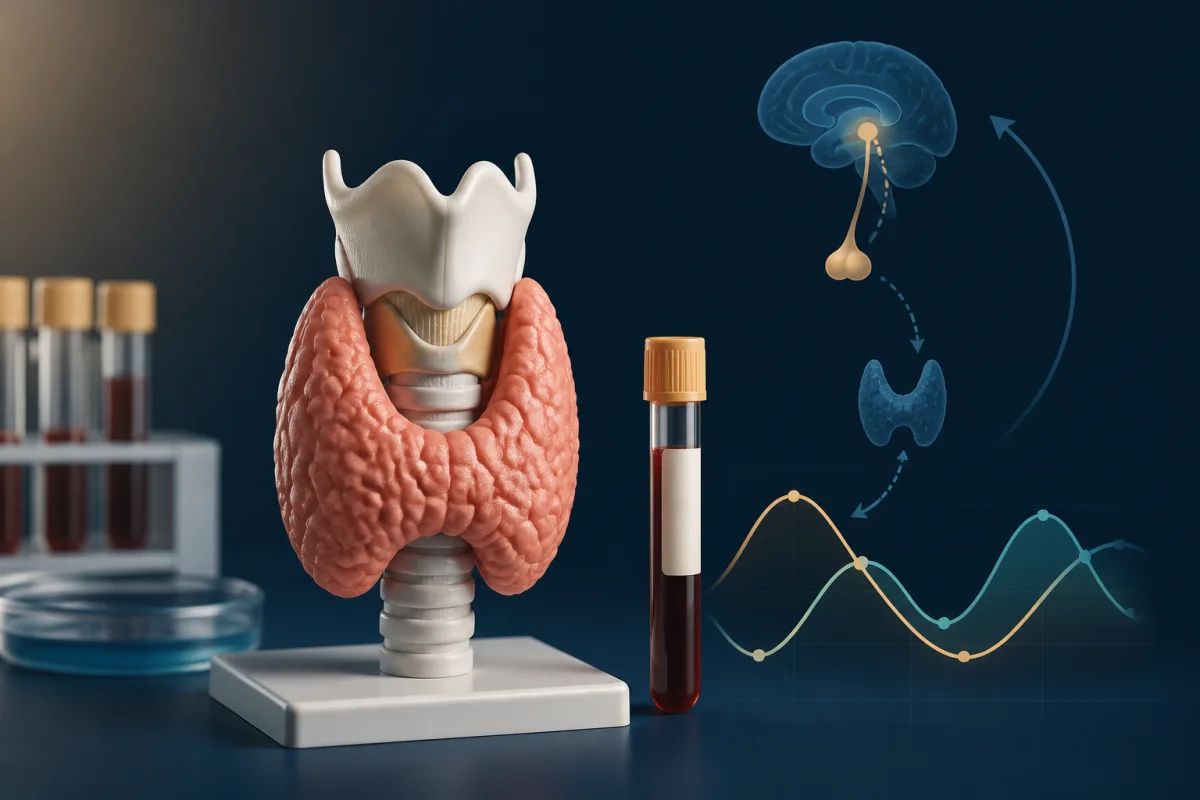
The pituitary senses circulating thyroid hormone and changes TSH, making TSH a sensitive signal of primary thyroid-gland dysfunction.See reference 1,See reference 2
Free T4 shows available circulating thyroxine and helps distinguish overt from subclinical patterns. Pituitary disease can break the usual TSH logic, so both tests are needed when suspected.See reference 3,See reference 4
Reference ranges describe populations, not a personal optimization target. Treatment is justified by persistent biochemical disease, symptoms, risk and context—not by moving every value to the middle.See reference 5,See reference 6
A practical decision protocol
- Stage
- 1. Define indication
- What to do
- Review symptoms, examination, medicines, pregnancy and risk
- Why it matters
- Avoids low-value screeningSee reference 1,See reference 2
- Stage
- 2. Order correctly
- What to do
- Use TSH with reflex free T4/T3 or a clinically appropriate panel
- Why it matters
- Matches the feedback physiologySee reference 2,See reference 3
- Stage
- 3. Remove interference
- What to do
- Report biotin, acute illness and relevant medicines
- Why it matters
- Prevents false patternsSee reference 3,See reference 4
- Stage
- 4. Confirm and act
- What to do
- Repeat or investigate according to severity and context
- Why it matters
- One mild result is not always diseaseSee reference 4,See reference 5
Timing and frequency
- Decision
- Routine suspected primary disease
- Practical answer
- Begin with TSH; use reflex free T4 and free T3 according to the result.See reference 3,See reference 4
- Decision
- Mild unexpected abnormality
- Practical answer
- Repeat after at least 6 weeks or a clinician-defined interval once transient factors settle.See reference 4,See reference 5
- Decision
- After levothyroxine change
- Practical answer
- TSH is commonly reviewed after roughly 6–8 weeks because steady state takes time.See reference 5,See reference 6
- Decision
- Pregnancy or severe symptoms
- Practical answer
- Use faster, specialist-guided timing and pregnancy-specific ranges.See reference 6,See reference 7
What to measure
- Signal
- TSH
- How
- Interpret with the laboratory range and clinical context
- Interpretation
- High usually suggests primary underactivity; low suggests excess, but exceptions existSee reference 4,See reference 5
- Signal
- Free T4
- How
- Pair with TSH
- Interpretation
- Separates overt from subclinical patterns and helps detect central diseaseSee reference 5,See reference 6
- Signal
- Free T3
- How
- Use mainly with low TSH or suspected hyperthyroidism
- Interpretation
- Can detect T3-predominant excessSee reference 6,See reference 7
- Signal
- Thyroid antibodies
- How
- Order when the cause or future risk matters
- Interpretation
- Support autoimmunity but do not measure symptom severitySee reference 7,See reference 8
What the evidence actually shows
Guidelines support a cascade approach that starts with TSH for most adults and adds thyroid hormones according to the result.See reference 1,See reference 3
Testing is valuable for symptomatic or higher-risk people, but USPSTF finds insufficient evidence that universal screening of asymptomatic nonpregnant adults improves outcomes.See reference 4,See reference 6
Levothyroxine is established treatment for overt primary hypothyroidism; benefit for mild subclinical disease is smaller and depends on TSH level, symptoms, age, pregnancy and risk.See reference 7,See reference 8
Evidence strength by claim
- Claim
- TSH plus free T4 diagnoses primary thyroid dysfunction
- Confidence
- High
- Important boundary
- Pituitary disease and acute illness need different interpretationSee reference 1,See reference 2
- Claim
- Treating overt hypothyroidism
- Confidence
- High
- Important boundary
- Dose and monitoring are individualizedSee reference 3,See reference 4
- Claim
- Universal screening of asymptomatic adults
- Confidence
- Low
- Important boundary
- Outcome benefit remains insufficientSee reference 5,See reference 6
- Claim
- Reverse T3 guides routine treatment
- Confidence
- Low
- Important boundary
- Not clinically useful in healthy outpatientsSee reference 7,See reference 8,See reference 9
Limits and common overclaims
Fatigue, weight change, hair loss, anxiety and temperature sensitivity have many causes; symptoms alone are not diagnostic.See reference 3,See reference 7
Acute illness and medicines can create non-thyroidal patterns that should not trigger reflex long-term treatment.See reference 5,See reference 8
High-dose biotin can produce falsely high or low immunoassay results, so supplement disclosure is part of test quality.See reference 9,See reference 10
A four-step implementation plan
- 1. Review symptoms, examination, medicines, pregnancy and riskSee reference 1
- 2. Use TSH with reflex free T4/T3 or a clinically appropriate panelSee reference 2
- 3. Report biotin, acute illness and relevant medicinesSee reference 3
- 4. Repeat or investigate according to severity and contextSee reference 4
Troubleshooting
- Problem
- High TSH with normal free T4
- Likely issue
- Possible subclinical hypothyroidism or transient change
- Better next step
- Repeat, review antibodies and decide by level, symptoms and riskSee reference 2,See reference 3
- Problem
- Low TSH with normal hormones
- Likely issue
- Possible subclinical hyperthyroidism, medicine or interference
- Better next step
- Repeat and assess cause, heart and bone riskSee reference 4,See reference 5
- Problem
- Symptoms despite normal tests
- Likely issue
- Another cause may be responsible
- Better next step
- Broaden evaluation rather than escalating thyroid hormoneSee reference 6,See reference 7
- Problem
- Results conflict with the clinical picture
- Likely issue
- Assay interference, pituitary disease or illness may be present
- Better next step
- Discuss repeat testing or specialist laboratory reviewSee reference 8,See reference 9
Safety and when to get medical help
Seek urgent care for severe chest pain, fainting, marked breathlessness, confusion, very rapid or irregular heartbeat, severe weakness or symptoms of thyroid storm or myxedema. Pregnancy, pituitary disease, amiodarone or lithium use, thyroid nodules, major heart disease and extreme TSH or hormone values need clinician-led interpretation.See reference 1,See reference 5,See reference 9
Who is most likely to benefit
People with compatible symptoms, goiter, thyroid nodules, autoimmune disease, relevant medicines or strong family history.See reference 2,See reference 4
People planning pregnancy or pregnant, using pregnancy-specific guidance.See reference 5,See reference 7
Patients already treated for thyroid disease who need dose and safety monitoring—not frequent testing without a treatment decision.See reference 8,See reference 10
Track five things
- TSH, free T4 and free T3 with datesSee reference 1
- Symptoms and heart rate in contextSee reference 2
- Dose, timing and adherence of thyroid medicineSee reference 3
- Biotin and interacting medicine useSee reference 4
- Pregnancy, antibodies and underlying diagnosisSee reference 5
Frequently asked questions
What is the best first thyroid test?
TSH is usually first for suspected primary thyroid disease, with free T4 added according to the result.See reference 1
What does high TSH mean?
It often indicates an underactive thyroid, but free T4, persistence and context determine whether disease is overt or subclinical.See reference 2
What does low TSH mean?
It can indicate thyroid hormone excess, over-replacement, medicine effects, illness or assay interference.See reference 3
Should I test free T3?
It is useful mainly when TSH is low or hyperthyroidism is suspected; it is rarely helpful for routine hypothyroidism.See reference 4
Do I need reverse T3?
No. It is not clinically useful for diagnosing routine hypothyroidism in healthy outpatients.See reference 5
Can biotin affect results?
Yes. High-dose biotin can distort some assays; ask the laboratory how long to pause it.See reference 6
Should everyone be screened?
USPSTF finds insufficient evidence for universal screening of asymptomatic nonpregnant adults.See reference 7
How soon after a dose change should I retest?
Often about 6–8 weeks for levothyroxine, but follow the prescriber's plan.See reference 8
Connect this decision to your wider health picture
LongevityMate helps organize measurements, symptoms, habits and trends so a test or treatment stays in context instead of becoming the whole plan.
See how LongevityMate worksGet the weekly longevity brief
The week's best longevity research in plain English. Free, every Tuesday.
References
- 1. Thyroid Disease: Assessment and Management
NICEGuideline
- 2. Thyroid Dysfunction: Screening
U.S. Preventive Services Task ForceGuideline
- 3. Thyroid Function Tests
American Thyroid AssociationOfficial guidance
- 4. Guidelines for Treatment of Hypothyroidism
American Thyroid AssociationGuideline
- 5. Hypothyroidism in Adults Guideline
AACE and American Thyroid AssociationGuideline
- 6. Biotin Interference in Laboratory Tests
U.S. Food and Drug AdministrationOfficial guidance
- 7. Thyroid Hormone Therapy for Subclinical Hypothyroidism
JAMAMeta-analysis
- 8. TRUST Trial of Thyroxine in Older Adults
New England Journal of MedicineRandomized trial
- 9. Subclinical Hyperthyroidism and Cardiovascular Outcomes
Archives of Internal MedicineObservational study
- 10. Thyroid Testing in Acute Illness
Clinical MedicineEvidence review
Editorial transparency
- Published by
- LongevityMate Editorial Team
- Published
- Updated
Medical disclaimer
This guide provides general health education. It does not diagnose a condition, prescribe treatment, replace individualized medical care, or guarantee a health or longevity outcome.