
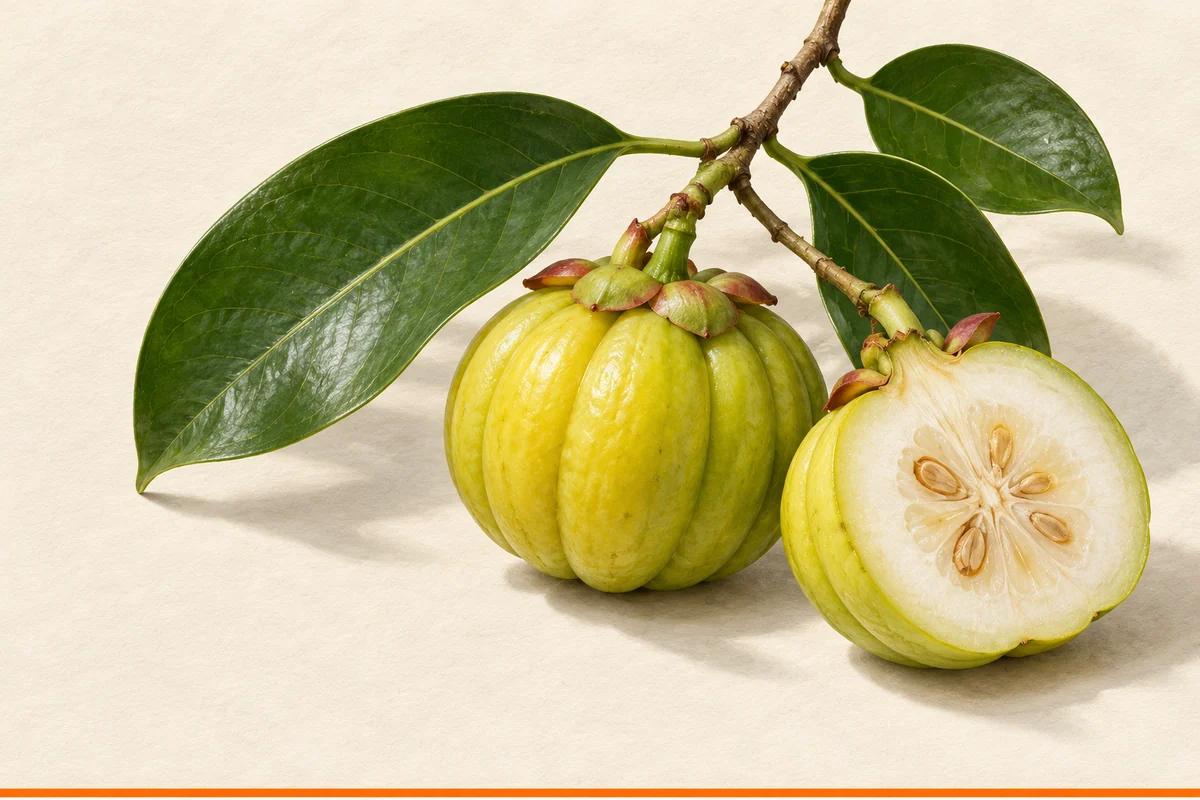
Raw fruit, extract mass and HCA are different things
The fruit rind contains HCA and has a history of culinary use. A concentrated supplement extract is a different exposure. The amount of extract is not automatically the amount of HCA, and a photograph of the fruit cannot identify a capsule’s composition or establish its safety.See reference 1,See reference 2
What human weight-loss evidence can establish
- Evidence
- 1998 randomised placebo-controlled trial
- Studied context
- 135 adults; 12 weeks; 3,000 mg/day of extract supplying 1,500 mg/day HCA, with a dietary programme
- Finding and limitation
- Weight loss and fat-mass loss were not significantly better than placebo. Only 84 participants completed the full protocolSee reference 2
- Evidence
- Current NCCIH evidence summary
- Studied context
- Human weight-loss studies across differing products
- Finding and limitation
- Some studies suggest modest effects and others no effect. A consistent personal benefit is not establishedSee reference 1
- Evidence
- Regulator safety evidence
- Studied context
- Reports involving Garcinia/HCA, including cases without another suspected ingredient
- Finding and limitation
- Rare liver injury can be serious. Reports identify a safety concern but do not provide a reliable rate per userSee reference 3
Losing weight during a trial is not proof the extract caused it
In the 1998 trial, both groups lost weight while following the study programme. Mean loss was 3.2 kg with Garcinia and 4.1 kg with placebo; the difference was not statistically significant. Quoting only the active group’s before-and-after change would misrepresent the comparison.See reference 2
The trial is old, had substantial dropout and does not settle every formulation. Those limits do not justify assuming that another extract works. Studied amounts describe the experiment; they do not identify a recommended or proven safe dose.See reference 1,See reference 2
What the liver warnings mean
Australia’s TGA warns of rare liver injury from Garcinia/HCA ingredients. Earlier reports often involved blends, but later cases have included Garcinia/HCA as the only suspected ingredient. Some cases were severe and required hospital care or transplantation. A blend can complicate causality without making the ingredient concern disappear.See reference 3
The reports cannot tell a reader their personal probability of harm, and short trials cannot exclude an uncommon serious reaction. TGA advises people with current or past liver problems to avoid these ingredients. It also advises stopping the product and seeking medical advice if signs such as yellow skin or eyes, dark urine or unusual tiredness occur.See reference 3
Other medicines and populations need attention
NCCIH reports interactions with some medicines affecting the liver and some affecting serotonin. Headache, nausea, diarrhoea and other digestive symptoms are also reported. Safety during pregnancy and breastfeeding is poorly understood. The exact product and all medicines belong in a clinician or pharmacist review.See reference 1
Regulators can take different actions
As one current jurisdictional example, France’s order of 16 April 2026 renewed a one-year suspension on importing and marketing supplements containing Garcinia cambogia and preparations from its parts, effective 18 April 2026. This is a French measure; it does not establish a worldwide legal status.See reference 4
Australia’s advisory and France’s restriction use different regulatory tools, but neither is evidence of a weight-loss benefit. Availability for sale, a standardised HCA percentage or a quality-test certificate cannot by itself prove effectiveness or rule out liver injury.See reference 2,See reference 3,See reference 4
Common questions
Is Garcinia the same as HCA?
No. Garcinia is the plant source; HCA is one constituent. Extract mass, HCA amount and a multi-ingredient product are different descriptions.See reference 1,See reference 2
Is it a reliable weight-loss supplement?
The evidence is mixed or shows little benefit. The large 1998 trial did not find an advantage over placebo under its study conditions.See reference 1,See reference 2
Does a pure extract avoid the liver concern?
No. TGA reports cases where Garcinia/HCA was the only suspected ingredient. Product purity is not proof that an ingredient cannot cause harm.See reference 3
Can a short trial establish a safe long-term amount?
No. Limited duration and participant numbers cannot exclude uncommon serious harms or establish safety for everyone.See reference 1,See reference 2,See reference 3
Get the weekly longevity brief
The week's best longevity research in plain English. Free, every Tuesday.
References
- 1. Garcinia cambogia: usefulness and safety
National Center for Complementary and Integrative HealthOfficial guidance
- 2. Garcinia cambogia (hydroxycitric acid) as a potential antiobesity agent: a randomized controlled trial
Heymsfield and colleagues; JAMARandomized trial
- 3. Garcinia gummi-gutta and HCA: potential rare liver injury
Therapeutic Goods AdministrationOfficial guidance
- 4. Order renewing the suspension of Garcinia cambogia supplements in France
French Republic, Journal officiel; LégifranceOfficial guidance
Editorial transparency
- Published by
- LongevityMate Editorial
- Review
- Editorial evidence review (AI-assisted)
- Published
- Updated
Medical disclaimer
General education only. AI-assisted editorial evidence review is not a qualified clinical assessment. This guide does not diagnose a condition, interpret a personal result, choose treatment or recommend a supplement dose. Discuss testing, symptoms, medicines and supplements with a qualified health professional.