
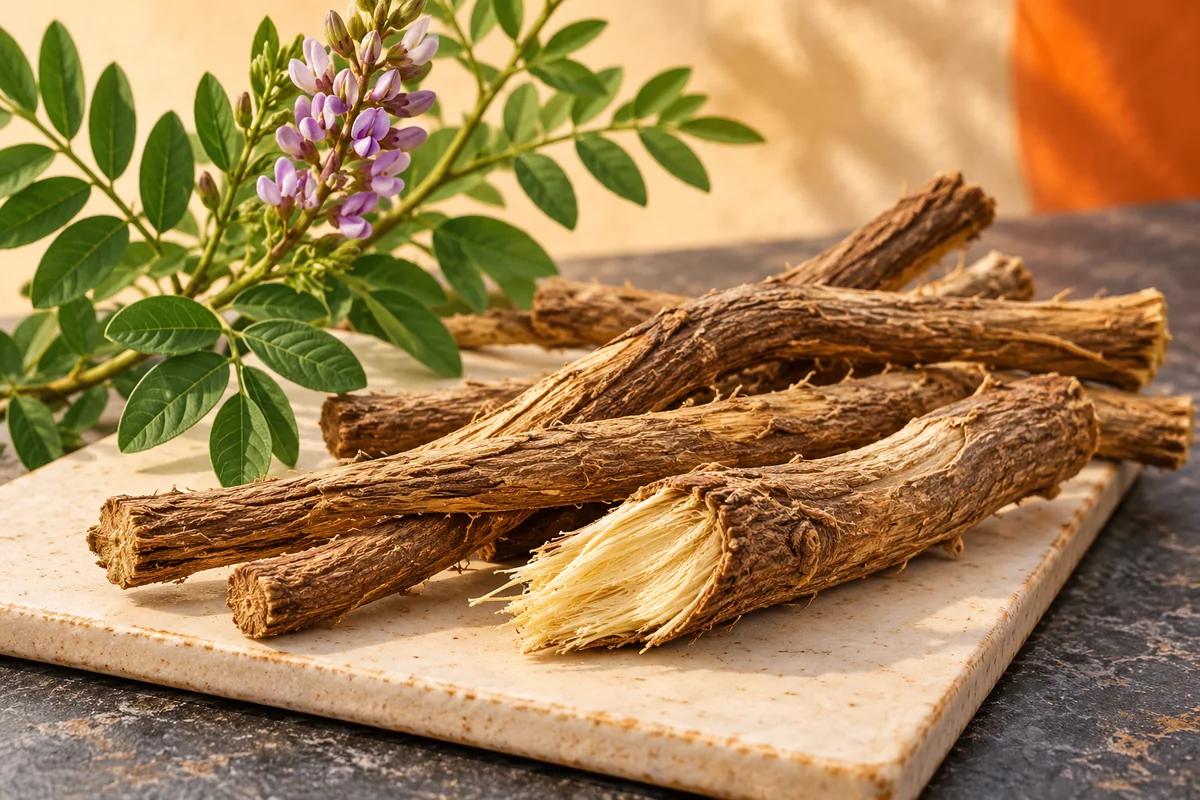
Similar names do not mean the same exposure
- Product
- Ordinary licorice root or extract
- Important distinction
- May contain glycyrrhizin, which can cause serious adverse effectsSee reference 1
- Product
- DGL extract
- Important distinction
- Processed to reduce glycyrrhizin; check the exact extract and specification rather than assuming zeroSee reference 1,See reference 2,See reference 3
- Product
- Licorice-flavoured sweets
- Important distinction
- Some contain anise instead of actual licorice; they are not the studied DGL extractSee reference 1
- Product
- Multi-herb digestive product
- Important distinction
- Its findings cannot identify licorice alone as the cause of any benefitSee reference 1
Two trials, two populations and a defined extract
- Study
- 2012 functional dyspepsia trial
- Population and studied exposure
- 50 adults; GutGard, 75 mg twice daily for 30 days
- Finding and limit
- Symptoms and quality-of-life scores improved versus placebo. A small, short trial of one extract cannot establish all DGL products or long-term careSee reference 2
- Study
- 2025 reflux-symptom trial
- Population and studied exposure
- 200 adults randomised at one centre; GutGard, 150 mg/day for 28 days
- Finding and limit
- Several symptom measures improved. Day-28 data were available for 78 extract and 87 placebo participants; rescue-medicine use did not differ significantlySee reference 3
- Study
- Broader evidence context
- Population and studied exposure
- NCCIH review of licorice uses
- Finding and limit
- High-quality evidence remains insufficient to clearly support a health-condition use; digestive effects of licorice alone remain uncertainSee reference 1
Why the newer study does not settle reflux treatment
The 2025 study enrolled selected adults with mild-to-moderate reflux-related symptoms, excluded several higher-risk groups, and did not compare the extract with standard reflux medicine. Planned acid-monitoring and lower-oesophageal-sphincter measurements were not completed. Symptom improvement is not proof of healed oesophageal injury or equivalence to usual treatment.See reference 3
The study was sponsored by Natural Remedies Private Limited, which provided technical input into design and protocol development. The authors reported that the sponsor did not collect, analyse or report the data. This is relevant context, not proof that the result is invalid.See reference 3
Reduced does not automatically mean absent
The two trial reports describe different maximum glycyrrhizin specifications for their extracts: no more than 0.5% in the earlier report and no more than 3.0% in the later report. These are published specifications, not measurements of a reader’s product. They make it especially important not to translate the word DGL into “zero glycyrrhizin”.See reference 2,See reference 3
The root’s safety history still matters
Glycyrrhizin-containing licorice can cause serious heart and electrolyte problems, especially with large or prolonged exposure or relevant heart, kidney or blood-pressure conditions. Removing a constituent may change a risk; it does not by itself prove benefit or safety for all people.See reference 1
NCCIH notes reported corticosteroid interactions, pregnancy risk from large oral licorice exposure, and limited breastfeeding evidence. Its statement that glycyrrhizin-free oral products might be safe for up to four months is not a guarantee for every DGL product or a recommendation to use one for four months.See reference 1
A useful label and evidence check
Keep the plant name, extract, residual-glycyrrhizin specification, other ingredients and proposed purpose available for a pharmacist or clinician. Check whether the product actually matches a human trial. Study amounts describe research rather than a self-treatment dose; do not stop prescribed reflux treatment to copy trial eligibility rules.See reference 1,See reference 2,See reference 3
Common questions
Is DGL proven to cure reflux or ulcers?
No. Short, product-specific symptom trials do not establish a cure, healing of tissue injury or equivalence to standard care.See reference 1,See reference 2,See reference 3
Is DGL the same as licorice root tea?
No. DGL is processed to reduce glycyrrhizin, while ordinary root preparations can retain it. The exact specification matters.See reference 1,See reference 2,See reference 3
Does DGL mean no glycyrrhizin at all?
Do not assume that from the name. The published trial products had stated residual specifications, and an individual product still needs its own label and quality information.See reference 2,See reference 3
Can short-term tolerability prove long-term safety?
No. A trial lasting about a month cannot settle uncommon or long-term harms, and its excluded populations remain evidence gaps.See reference 2,See reference 3
Get the weekly longevity brief
The week's best longevity research in plain English. Free, every Tuesday.
References
- 1. Licorice root: usefulness and safety
National Center for Complementary and Integrative HealthOfficial guidance
- 2. An extract of Glycyrrhiza glabra (GutGard) alleviates symptoms of functional dyspepsia: a randomized, double-blind, placebo-controlled study
Raveendra and colleagues; Evidence-Based Complementary and Alternative MedicineRandomized trial
- 3. Efficacy and safety of GutGard in managing gastroesophageal reflux-related symptoms: randomized placebo-controlled trial
Raj and colleagues; Complementary Medicine ResearchRandomized trial
Editorial transparency
- Published by
- LongevityMate Editorial
- Review
- Editorial evidence review (AI-assisted)
- Published
- Updated
Medical disclaimer
General education only. AI-assisted editorial evidence review is not a qualified clinical assessment. This guide does not diagnose a condition, interpret a personal result, choose treatment or recommend a supplement dose. Discuss testing, symptoms, medicines and supplements with a qualified health professional.