
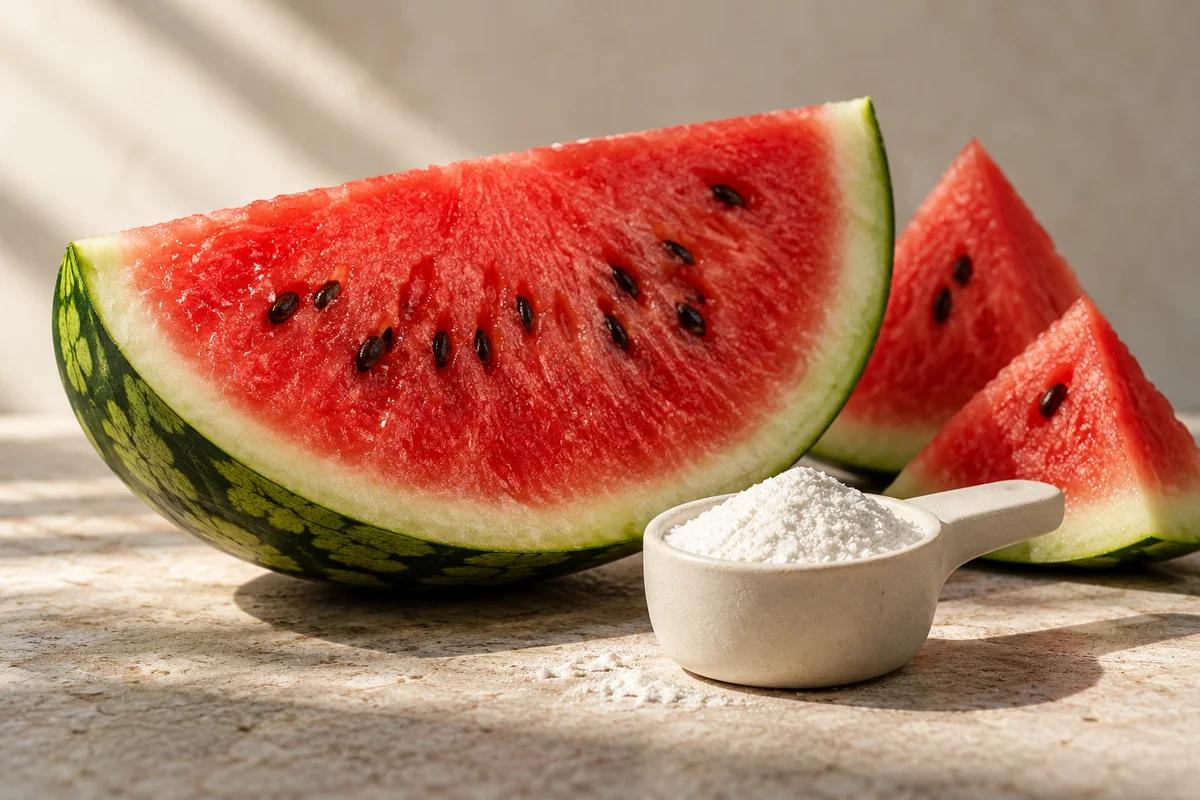
A plausible pathway is a reason to test a claim
The body can convert citrulline to arginine, which is involved in nitric oxide production. Nitric oxide can widen blood vessels. These biochemical steps are not the same outcome as completing a race faster, lifting more weight or recovering better; those outcomes need their own trials.See reference 1
Selected exercise evidence: outcome and form matter
- Study
- Resistance exercise, 2010
- What was tested
- 41 men; 8 g citrulline malate versus placebo in a crossover bench-press study
- What it showed
- More repetitions and less reported soreness in this specific short experiment; not proof of long-term training gains.See reference 2
- Study
- Treadmill test, 2006
- What was tested
- 17 young adults; pure L-citrulline, 3 g before testing or 9 g over the preceding day
- What it showed
- Time to exhaustion was slightly lower with citrulline, contrary to the proposed benefit.See reference 3
- Study
- Endurance synthesis, 2023
- What was tested
- Nine studies with 158 participants
- What it showed
- No significant pooled improvement in the time-to-exhaustion or time-to-completion outcomes assessed.See reference 4
- Study
- Cycling test, 2025
- What was tested
- 20 moderately active adults; 100 mg/kg/day of L-citrulline for 10 days in a crossover trial
- What it showed
- No statistically significant improvement in time to exhaustion versus placebo.See reference 5
Study amounts describe research, not a personal plan
The amounts in the table belong to the named formulations, populations and protocols. A single-session result cannot establish what happens after months of use, and a trial in a small group cannot guarantee a response for an individual. The table is not a dose recommendation.See reference 2,See reference 3,See reference 4,See reference 5
The 2025 study also illustrates why a promising subgroup trend is not a confirmed benefit: the overall endurance result was not statistically significant. Its small sample leaves uncertainty rather than proving that every possible use is ineffective.See reference 5
L-citrulline and citrulline malate are not equal by scoop weight
Pure L-citrulline and a mixture containing citrulline plus malate are different ingredient descriptions. Eight grams of citrulline malate is not eight grams of pure L-citrulline. Check whether a label gives the amount of the mixture or the amount of L-citrulline, and whether other active ingredients are included.See reference 1,See reference 2
A result from a multi-ingredient product cannot establish what L-citrulline contributed on its own. Likewise, a claim about a particular malate ratio does not prove superiority without a relevant comparison.See reference 1
Short-term tolerability leaves important gaps
Stomach discomfort has been reported. The NIH review notes that safety has not been adequately assessed for use over months. Small short-term studies cannot establish a universal safe amount or rule out uncommon problems.See reference 1,See reference 2
These exercise trials do not settle suitability during pregnancy, for children, with medical conditions or alongside medicines. Review those circumstances with a qualified professional rather than assuming that a familiar food ingredient makes a concentrated supplement suitable.See reference 1,See reference 4,See reference 5
A useful way to assess a product claim
Ask whether the supporting study tested the exact ingredient form, the exercise task you care about and a relevant population. Look for a measured outcome and a comparison group. Be cautious when a claim jumps from a change in a blood-flow marker to a guaranteed training result.See reference 1,See reference 4
Common questions
Is watermelon equivalent to a studied citrulline supplement?
No. A food serving and a measured supplement amount are different exposures. The presence of citrulline in watermelon does not show that eating it reproduces a supplement trial.See reference 1
Does more nitric oxide prove better exercise performance?
No. A pathway or biomarker can be interesting without producing a useful change in the exercise outcome. The trial evidence needs to be assessed separately.See reference 1,See reference 4
Get the weekly longevity brief
The week's best longevity research in plain English. Free, every Tuesday.
References
- 1. Dietary Supplements for Exercise and Athletic Performance: Health Professional Fact Sheet
NIH Office of Dietary SupplementsOfficial guidance
- 2. Citrulline malate enhances athletic anaerobic performance and relieves muscle soreness
Pérez-Guisado and Jakeman, Journal of Strength and Conditioning ResearchRandomized trial
- 3. L-citrulline reduces time to exhaustion and insulin response to a graded exercise test
Hickner and colleagues, Medicine & Science in Sports & ExerciseRandomized trial
- 4. Effects of citrulline on endurance performance in young healthy adults: a systematic review and meta-analysis
Harnden and colleagues, Journal of the International Society of Sports NutritionMeta-analysis
- 5. Ergogenic effects of a 10-day L-citrulline supplementation on time to exhaustion
Schierbauer and colleagues, Frontiers in Sports and Active LivingRandomized trial
Editorial transparency
- Published by
- LongevityMate Editorial
- Review
- Editorial evidence review (AI-assisted)
- Published
- Updated
Medical disclaimer
General education only. AI-assisted editorial evidence review is not a qualified clinical assessment. This guide does not diagnose a condition, interpret a personal result, choose treatment or recommend a supplement dose. Discuss testing, symptoms, medicines and supplements with a qualified health professional.