
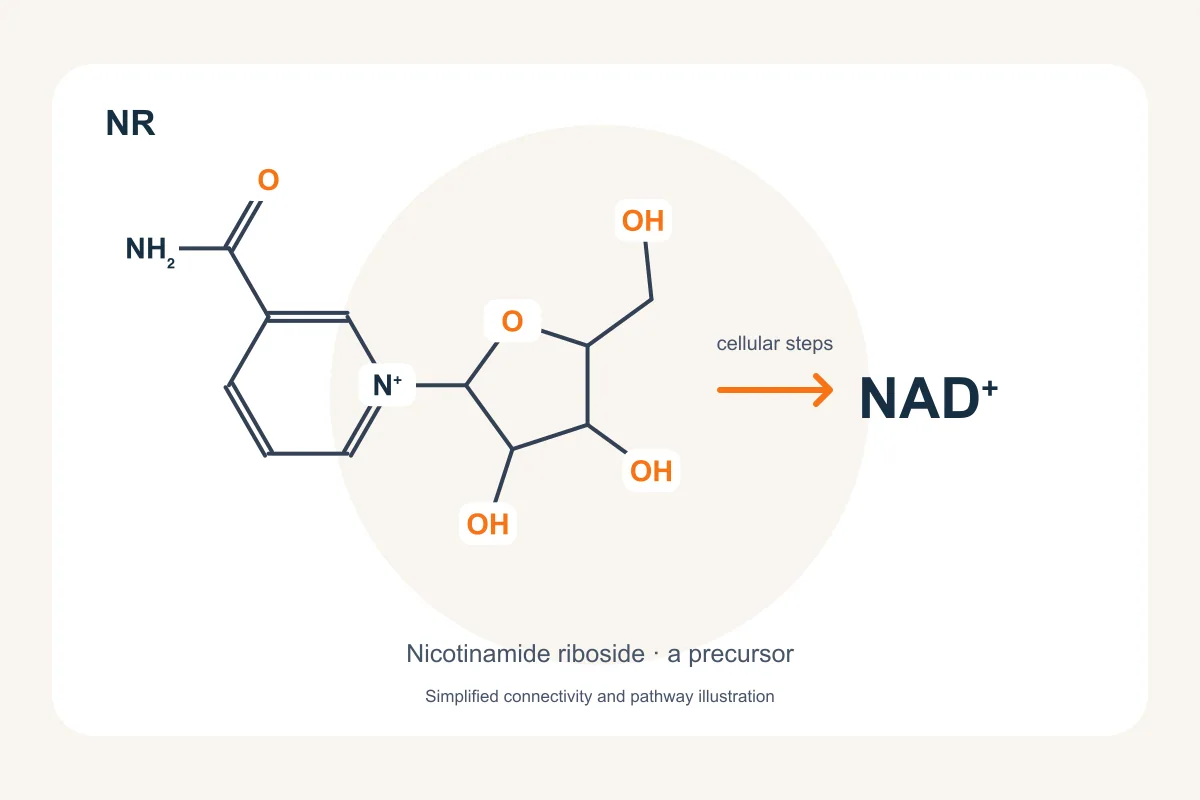
Identify the ingredient before the claim
NR is one NAD precursor; it is not a generic name for all products marketed as “NAD boosters.” Nicotinamide riboside chloride is the material assessed in the cited EFSA opinion. An assessment of a defined ingredient under specified uses is not approval of an anti-aging effect or of every product blend. NR, NMN (nicotinamide mononucleotide), nicotinamide and nicotinic acid are distinct ingredients; their amounts and evidence should not be treated as interchangeable.See reference 5
Selected human trials, with their limits
- Trial and population
- Martens, 2018: 24 middle-aged and older adults
- Studied exposure
- 1,000 mg/day in a crossover study with 6-week periods
- Outcome and boundary
- NAD-related blood-cell markers increased. This short trial was not a lifespan trial.See reference 1
- Trial and population
- Dollerup, 2018: 40 men with obesity and insulin resistance
- Studied exposure
- 2,000 mg/day for 12 weeks
- Outcome and boundary
- No improvement in insulin sensitivity. This result does not establish effects in every other population.See reference 2
- Trial and population
- NICE, 2024: 90 people with peripheral artery disease
- Studied exposure
- NR 1,000 mg/day, NR plus resveratrol, or placebo for 6 months
- Outcome and boundary
- The NR-only arm suggested a walking-distance benefit; a small disease-specific trial, not proof of general rejuvenation.See reference 3
- Trial and population
- NOPARK, 2026: 410 people randomized with early Parkinson disease
- Studied exposure
- NR 500 mg twice daily or placebo for 52 weeks
- Outcome and boundary
- The primary clinical score favoured placebo; the findings did not support NR as a disease-modifying treatment.See reference 4
A biomarker response and a useful outcome are different
Increasing NAD-related markers shows a biochemical response to the intervention. It does not by itself tell us whether someone thinks more clearly, walks farther, avoids illness or lives longer. Those are separate outcomes, measured in different trials.See reference 1,See reference 2,See reference 3
The NICE walking study used a prespecified one-sided screening threshold and called for a larger confirmatory trial. Its preliminary signal should not be presented as settled treatment evidence or as a result in healthy adults.See reference 3
The selected trials above do not demonstrate longer human life. Nor should a result in one disease group be applied to healthy adults as if the participants, outcome and treatment context were the same.See reference 1,See reference 2,See reference 3,See reference 4
Why the October 2026 result matters
NOPARK was a randomized, placebo-controlled phase 3 study. Its primary Parkinson clinical outcome was worse with NR than placebo after 52 weeks. That finding challenges claims built only on earlier small or mechanistic studies; it does not establish that the same effect occurs in healthy people.See reference 4
The abstract also reports fewer serious adverse events in the NR group. That does not cancel the unfavourable primary efficacy result: tolerability, adverse events and improvement in the disease are different questions. This guide summarizes the public abstract and does not claim a full-text reanalysis.See reference 4
Safety evidence has a population, product and time limit
The short Martens trial reported that NR was well tolerated. That is useful information about that study, but it cannot guarantee safety for years of unsupervised use or for people unlike its participants.See reference 1
Do not turn the research amounts into a dose plan. An EFSA safety assessment is specific to the assessed material and conditions; a higher research exposure is not automatically a consumer recommendation. Personal suitability, medicines, pregnancy and medical conditions need an appropriate professional assessment.See reference 5
Questions that make an NR claim easier to assess
Ask which exact ingredient and amount were studied, whether the product contains other active ingredients, and whether the claimed benefit was actually measured in comparable people. A higher NAD measurement is insufficient support for a promise of “reversed aging.” Keep any prescribed treatment separate from supplement marketing.See reference 1,See reference 3,See reference 4,See reference 5
Common questions
Does raising NAD prove that NR slows aging?
No. A change in a biomarker is not a demonstrated change in lifespan or a clinical outcome. The selected human trials cannot support that leap.See reference 1,See reference 2,See reference 3,See reference 4
Does the NOPARK trial prove the same outcome in healthy adults?
No. It is important evidence in people with early Parkinson disease, under that trial protocol. It neither demonstrates a healthy-aging benefit nor establishes the same effect in all other populations.See reference 4
Get the weekly longevity brief
The week's best longevity research in plain English. Free, every Tuesday.
References
- 1. Chronic nicotinamide riboside supplementation is well-tolerated and elevates NAD+ in healthy middle-aged and older adults
Martens and colleagues, Nature CommunicationsRandomized trial
- 2. A randomized placebo-controlled clinical trial of nicotinamide riboside in obese men
Dollerup and colleagues, American Journal of Clinical NutritionRandomized trial
- 3. Nicotinamide riboside for peripheral artery disease: the NICE randomized clinical trial
McDermott and colleagues, Nature CommunicationsRandomized trial
- 4. Nicotinamide Riboside for Patients With Early-Stage Parkinson Disease: The NOPARK Randomized Clinical Trial
Brakedal and colleagues, JAMARandomized trial
- 5. Safety of nicotinamide riboside chloride as a novel food and bioavailability of nicotinamide from this source
EFSA Panel on Nutrition, Novel Foods and Food Allergens, EFSA JournalEvidence review
Editorial transparency
- Published by
- LongevityMate Editorial
- Review
- Editorial evidence review (AI-assisted)
- Published
- Updated
Medical disclaimer
General education only. AI-assisted editorial evidence review is not a qualified clinical assessment. This guide does not diagnose a condition, interpret a personal result, choose treatment or recommend a supplement dose. Discuss testing, symptoms, medicines and supplements with a qualified health professional.