
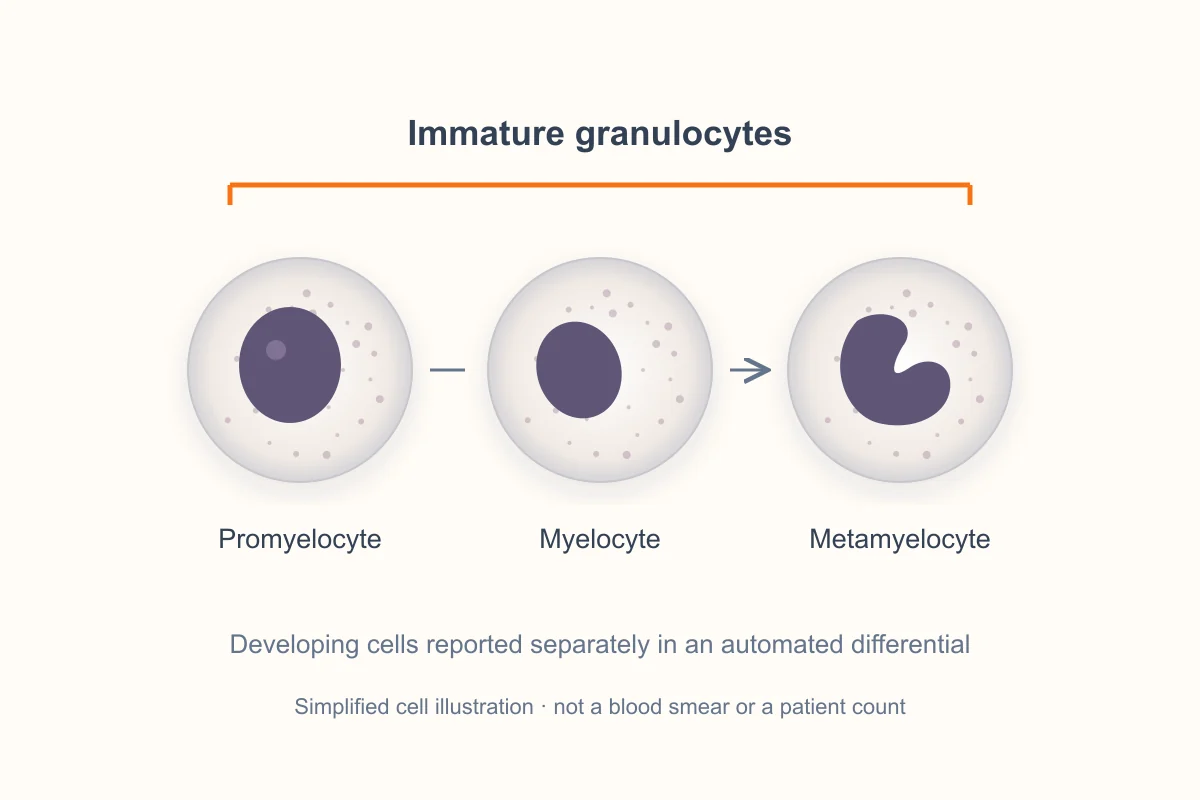
Which developing cells does IG include?
In the Sysmex automated definition, IG includes promyelocytes, myelocytes and metamyelocytes. Band neutrophils are not included in that IG group. This is a method-specific definition: an automated IG result is not interchangeable with every laboratory’s manual “left shift” description.See reference 1
IG are not blasts. Cleveland Clinic Laboratories describes blasts as a separately reviewed and reported finding. An IG flag therefore does not mean that a report has found blasts, and it cannot establish leukaemia.See reference 3
IG percentage and absolute IG are different quantities
- Report item
- IG%
- What it describes
- The proportion of white blood cells classified as immature granulocytes
- Read alongside
- The total white blood cell countSee reference 1
- Report item
- IG# or absolute IG
- What it describes
- Their number in a stated volume of blood
- Read alongside
- The printed unit and laboratory intervalSee reference 1,See reference 3
- Report item
- Instrument flag or smear comment
- What it describes
- A laboratory observation that may prompt its review procedure
- Read alongside
- The final differential and any separate cell findingsSee reference 3
The same percentage can represent different counts
For illustration, 1% of a total WBC count of 10 × 10⁹/L is 0.10 × 10⁹/L. At a WBC count of 20 × 10⁹/L, the same 1% corresponds to 0.20 × 10⁹/L. These are arithmetic examples, not normal ranges or action thresholds.See reference 1
Keep the original unit: 0.10 × 10⁹/L is numerically equal to 0.10 × 10³/µL, or 100 cells/µL. A change in notation is not a biological change. Use the reported absolute value when available rather than rebuilding it from an already rounded percentage.See reference 1
A flag is a question to interpret, not a diagnosis
Infection, inflammation and other marrow stimuli can increase circulating immature cells. The manufacturer specifically cautions that IG alone cannot predict infection or sepsis. It does not identify an organism, choose an antibiotic or replace assessment of a person who is unwell.See reference 2
Small numbers can also occur in benign settings. Cleveland Clinic Laboratories cautions against over-interpreting them and notes that healthy people can occasionally exceed its interval. Both the scale of the result and the rest of the report matter.See reference 3
Use the interval for this laboratory and population
There is no single internet cutoff that can replace your report. Reference intervals and smear-review policies depend on the laboratory, and age matters. Pregnancy and the newborn period need particular context. A laboratory’s technical review threshold is not a universal disease threshold.See reference 2,See reference 3
A low, zero or rounded IG result is not an overall immune-strength score. IG is one part of a differential; the total WBC count and other white-cell populations answer different questions.See reference 1,See reference 4
Useful details for the follow-up conversation
A blood differential usually needs no special preparation, though tests collected with it may have separate instructions. Your clinician considers symptoms, medical history, medicines and other blood results when deciding what an abnormal report means.See reference 4
Keep the test date, IG% and absolute IG, their units and intervals, the total WBC count and any smear comment together. Useful questions are why the test was ordered, whether the result fits the wider CBC, and whether the laboratory or clinician needs further review.See reference 3,See reference 4
Common questions
Are immature granulocytes the same as blasts?
No. They are different reporting categories, and suspected blasts are assessed separately. An IG flag cannot diagnose leukaemia.See reference 3
Does high IG prove a bacterial infection?
No. IG may contribute to an assessment, but the count alone cannot establish or predict infection or sepsis.See reference 2
Can a normal IG result rule out infection?
No stand-alone rule-out is established by this test. The clinical question and the wider assessment remain necessary.See reference 2
Should IG percent and absolute IG have the same number?
No. One is a proportion and the other a count per blood volume. Their relationship also depends on the total white blood cell count.See reference 1
Get the weekly longevity brief
The week's best longevity research in plain English. Free, every Tuesday.
See your blood results in context
If you already have blood test results, the paid LongevityMate app can help you view related markers together. It provides educational context, not a diagnosis or a replacement for your clinician.
Explore blood test analysisReferences
- 1. Glossary: immature granulocytes and the 6-part differential
Sysmex EuropeOfficial guidance
- 2. Immature granulocyte (IG) count
Sysmex EuropeOfficial guidance
- 3. Changes to CBCDIF result reporting
Cleveland Clinic LaboratoriesOfficial guidance
- 4. Blood differential
MedlinePlus, U.S. National Library of MedicineOfficial guidance
Editorial transparency
- Published by
- LongevityMate Editorial
- Review
- Editorial evidence review (AI-assisted)
- Published
- Updated
Medical disclaimer
General education only. AI-assisted editorial evidence review is not a qualified clinical assessment. This guide does not diagnose a condition, interpret a personal result, choose treatment or recommend a supplement dose. Discuss testing, symptoms, medicines and supplements with a qualified health professional.