
The 10 rules to remember
- Define the clinical or training goalSee reference 1
- Check device contraindicationsSee reference 2
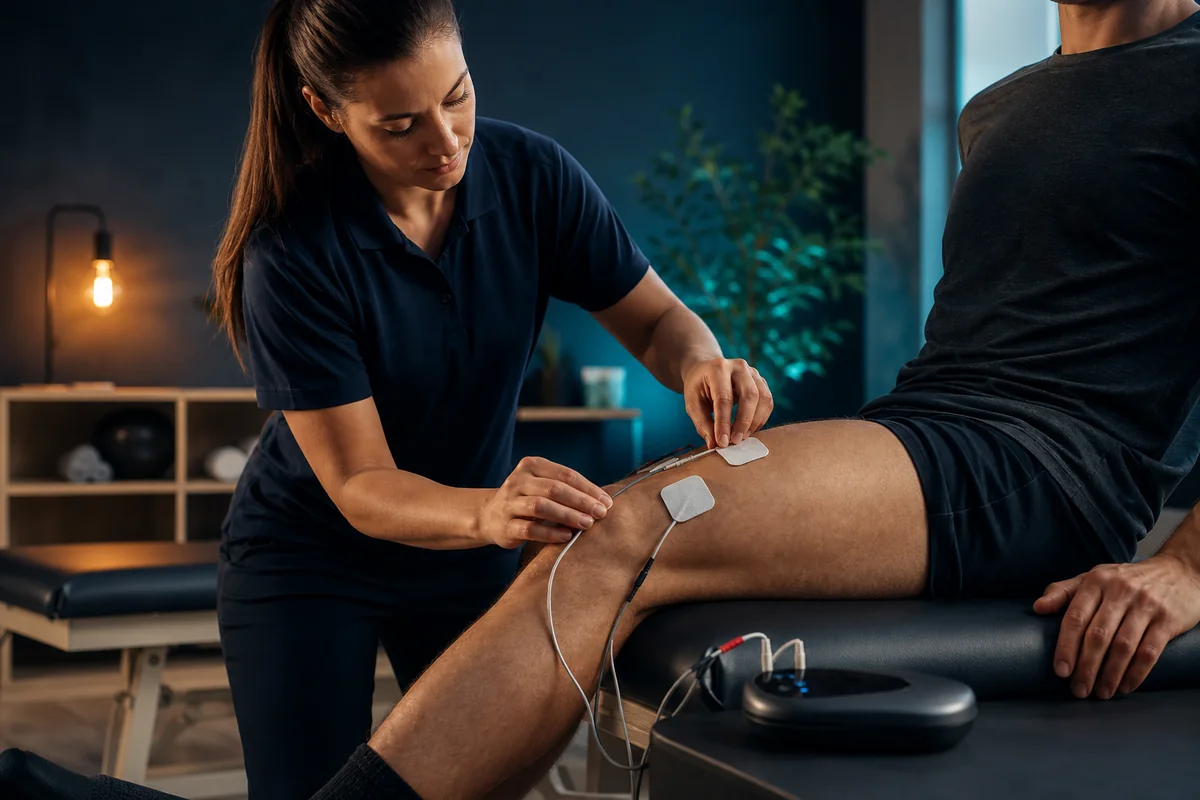
- Learn electrode placementSee reference 3
- Prepare clean intact skinSee reference 4
- Select the prescribed programSee reference 5
- Increase to a strong tolerable contractionSee reference 6
- Pair with voluntary contraction when directedSee reference 7
- Inspect skin after useSee reference 8
- Track function rather than sensationSee reference 1
- Review target-muscle strength or function after 4–12 weeks; stop if the result does not justify the burden.See reference 2
First principles: what this can actually change
Electrical pulses depolarize motor nerves and produce contractions without the usual voluntary recruitment sequence.See reference 1,See reference 2
A training effect requires sufficient contraction intensity and repeated sessions; a mild tingling sensation alone is unlikely to create meaningful adaptation.See reference 2,See reference 3
NMES can target an underused muscle, but voluntary movement remains important for coordination, balance, skill and whole-body capacity.See reference 3,See reference 4
A practical protocol
- Stage
- Start
- What to do
- Define the clinical or training goal
- Why it matters
- Define the goal and baselineSee reference 1,See reference 2
- Stage
- Set up
- What to do
- Check device contraindications
- Why it matters
- Reduce avoidable errorSee reference 2,See reference 3
- Stage
- Apply
- What to do
- Learn electrode placement
- Why it matters
- Use a repeatable doseSee reference 3,See reference 4
- Stage
- Review
- What to do
- Prepare clean intact skin
- Why it matters
- Keep only what helpsSee reference 4,See reference 5
Timing and frequency
- Decision
- Starting dose
- Practical answer
- Protocol-specific; commonly several sessions weekly for 4–12 weeks under professional direction.See reference 2,See reference 3
- Decision
- First review
- Practical answer
- 4–12 weeksSee reference 3,See reference 4
- Decision
- Best timing
- Practical answer
- Use within a rehabilitation or strength session when the target muscle can recover; do not use while driving, bathing or sleeping.See reference 4,See reference 5
- Decision
- Stop rule
- Practical answer
- Stop for chest symptoms, dizziness, severe pain, burns, persistent skin reaction, unexpected weakness or device malfunction.See reference 5,See reference 6
What to measure
- Signal
- Target-muscle strength or function
- How to use it
- Record before starting and at the review point
- Caveat
- Use the same methodSee reference 3,See reference 4
- Signal
- Muscle size, activation and skin tolerance
- How to use it
- Track weekly rather than reacting daily
- Caveat
- Expect normal variationSee reference 4,See reference 5
- Signal
- Adherence
- How to use it
- Record sessions or days used
- Caveat
- No exposure means no fair testSee reference 5,See reference 6
- Signal
- Adverse effects
- How to use it
- Record symptoms and severity
- Caveat
- Current amplitude cannot be compared directly across people, electrode sizes or devices.See reference 6,See reference 7
What the evidence actually shows
Systematic reviews support NMES for selected rehabilitation populations and for mitigating muscle loss during immobilization, with outcomes dependent on dose and the condition treated.See reference 1,See reference 2,See reference 3
Evidence does not support consumer claims that passive stimulation reproduces the cardiovascular, metabolic, bone or skill benefits of a complete exercise program.See reference 4,See reference 5,See reference 6
Most studies measure short-term symptoms, physiology or performance rather than clinical events or lifespan. Results therefore support a bounded use case, not broad longevity marketing.See reference 6,See reference 7,See reference 8
Evidence strength by claim
- Claim
- Target-muscle strength or function
- Evidence
- Moderate in selected rehabilitation uses
- Verdict
- Systematic reviews support NMES for selected rehabilitation populations and for mitigating muscle loss during immobilization, with outcomes dependent on dose and the condition treated.See reference 1,See reference 2
- Claim
- Muscle size, activation and skin tolerance
- Evidence
- Mixed or context-dependent
- Verdict
- Evidence does not support consumer claims that passive stimulation reproduces the cardiovascular, metabolic, bone or skill benefits of a complete exercise program.See reference 3,See reference 4
- Claim
- Safety
- Evidence
- Depends on screening and dose
- Verdict
- Do not use over implanted electronic devices unless the treating specialist and device guidance permit it. Avoid the carotid sinus, chest-crossing placements, pregnancy abdomen, broken skin, active cancer site or suspected clot.See reference 5,See reference 6
- Claim
- Longer life
- Evidence
- Not directly tested
- Verdict
- Do not convert an intermediate outcome into a lifespan promiseSee reference 7,See reference 8
Limits and common overclaims
Protocols vary in frequency, pulse width, duty cycle and intensity.See reference 2,See reference 3
People who tolerate stronger contractions often obtain larger effects, complicating comparisons.See reference 3,See reference 4
Consumer devices may not match clinical equipment or supervised technique.See reference 4,See reference 5
A four-step implementation plan
- Define the exact reason you are trying NMES.See reference 1
- Record a baseline for target-muscle strength or function.See reference 2
- Use the same protocol for 4–12 weeks.See reference 3
- Continue only if benefit outweighs cost, time, discomfort and risk.See reference 4
Troubleshooting
- Problem
- No benefit
- What to do
- Check adherence, dose and whether target-muscle strength or function is the right outcomeSee reference 2
- Problem
- Discomfort
- What to do
- Reduce the dose; stop for warning symptomsSee reference 3
- Problem
- Confusing data
- What to do
- Use a longer trend and the same measurement conditionsSee reference 4
- Problem
- Too much burden
- What to do
- Choose the simpler intervention that solves the same problemSee reference 5
Safety and who should be cautious
Do not use over implanted electronic devices unless the treating specialist and device guidance permit it. Avoid the carotid sinus, chest-crossing placements, pregnancy abdomen, broken skin, active cancer site or suspected clot. Stop for chest symptoms, dizziness, severe pain, burns, persistent skin reaction, unexpected weakness or device malfunction.See reference 5,See reference 6,See reference 7
Who is most likely to benefit
It is most useful when injury, surgery, illness or poor activation prevents a muscle from receiving enough voluntary training stimulus.See reference 2,See reference 3
It is less useful when adopted only because a score, trend or influencer made it seem mandatory.See reference 4,See reference 5
People with symptoms, diagnosed disease, pregnancy, recent surgery or complex medicines should adapt the protocol with an appropriate clinician.See reference 6,See reference 7
Track five things
- Target-muscle strength or functionSee reference 1
- Muscle size, activation and skin toleranceSee reference 2
- The exact dose and timingSee reference 3
- Symptoms and adverse effectsSee reference 4
- Whether the result changes a real decisionSee reference 5
Frequently asked questions
What is Electrical muscle stimulation?
Neuromuscular electrical stimulation, or NMES, sends current through surface electrodes to produce muscle contractions. It can support rehabilitation and help preserve or improve muscle in selected settings, but it is an adjunct rather than a replacement for voluntary exercise.See reference 1,See reference 2
How often should I use NMES?
Protocol-specific; commonly several sessions weekly for 4–12 weeks under professional direction.See reference 2,See reference 3
How long before NMES works?
Use 4–12 weeks as the first meaningful review point. Immediate comfort or device readings are not the same as a durable health effect.See reference 3,See reference 4
What should I track?
Track target-muscle strength or function, muscle size, activation and skin tolerance, adherence and adverse effects under similar conditions.See reference 4,See reference 5
Is NMES safe?
Do not use over implanted electronic devices unless the treating specialist and device guidance permit it. Avoid the carotid sinus, chest-crossing placements, pregnancy abdomen, broken skin, active cancer site or suspected clot.See reference 5,See reference 6
When should I stop?
Stop for chest symptoms, dizziness, severe pain, burns, persistent skin reaction, unexpected weakness or device malfunction.See reference 6,See reference 7
Does NMES increase lifespan?
No trial proves that this tool extends an individual's lifespan. Its value depends on whether it improves a relevant symptom, behavior, function or established risk factor.See reference 7,See reference 8
Can it replace sleep, exercise, nutrition or medical care?
No. It is an optional layer around the fundamentals and should not delay evaluation of persistent or serious symptoms.See reference 8,See reference 1
Connect the protocol to your wider health picture
LongevityMate helps organize habits, symptoms, measurements and trends so one intervention stays in context instead of becoming the whole plan.
See how LongevityMate worksGet the weekly longevity brief
The week's best longevity research in plain English. Free, every Tuesday.
References
- 1. Electrical Stimulation and Muscle Strength Gains in Healthy Adults: A Systematic Review.
Journal of strength and conditioning researchSystematic review
- 2. Neuromuscular Electrical Stimulation Training vs. Conventional Strength Training: A Systematic Review and Meta-Analysis of the Effect on Strength Development.
Journal of strength and conditioning researchMeta-analysis
- 3. The effects of neuromuscular electrical stimulation on hospitalised adults: systematic review and meta-analysis of randomised controlled trials.
Age and ageingMeta-analysis
- 4. Superimposing neuromuscular electrical stimulation onto voluntary contractions to improve muscle strength and mass: A systematic review.
European journal of sport scienceSystematic review
- 5. A Comparison of Neuromuscular Electrical Stimulation Parameters for Postoperative Quadriceps Strength in Patients After Knee Surgery: A Systematic Review.
Sports healthSystematic review
- 6. Effect of Neuromuscular Electrical Stimulation in Patients With Critical Illness: An Updated Systematic Review and Meta-Analysis of Randomized Controlled Trials.
Critical care medicineMeta-analysis
- 7. Electronic muscle stimulators
U.S. Food and Drug AdministrationOfficial guidance
- 8. NMES after ACL surgery: systematic review
PubMedSystematic review
Editorial transparency
- Published by
- LongevityMate Editorial Team
- Published
- Updated
Medical disclaimer
This guide provides general health education. It does not diagnose a condition, prescribe treatment, replace individualized medical care, or guarantee a health or longevity outcome.