
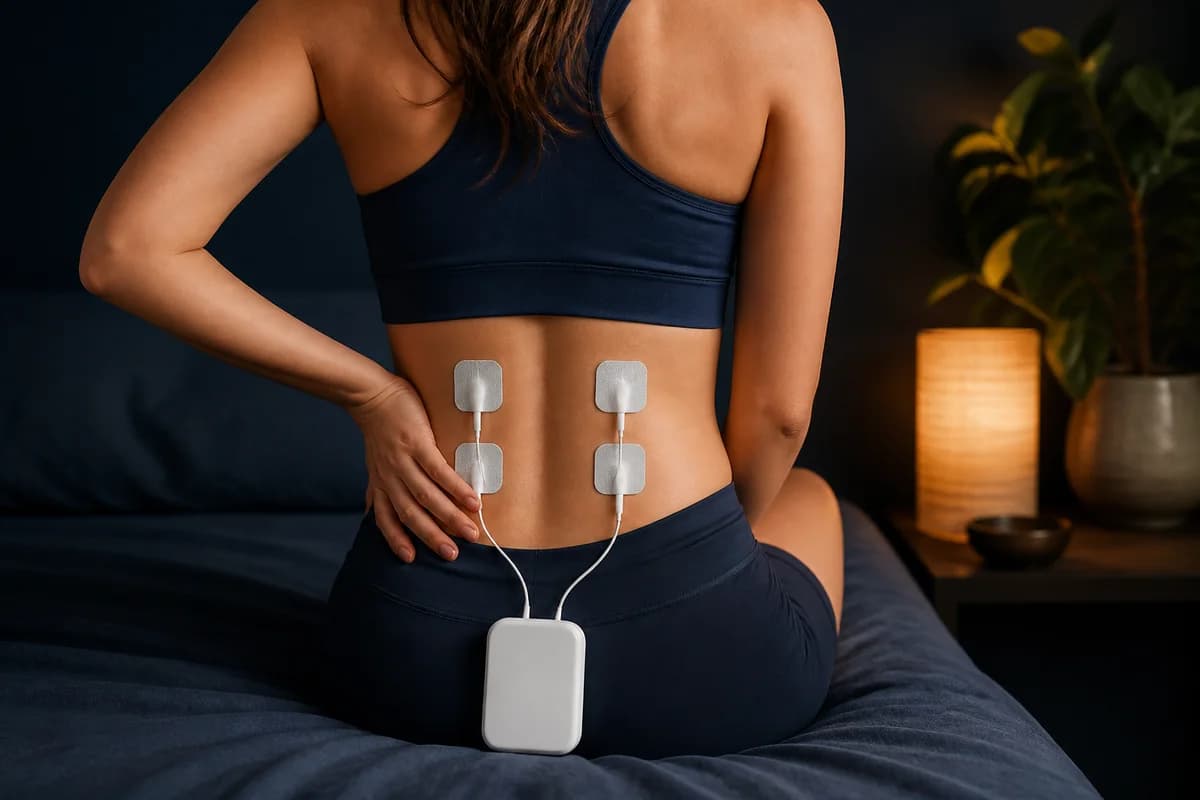
The 10 rules to remember
- TENS is for temporary symptom relief; it does not diagnose or repair the cause of pain.See reference 1
- Effective trials generally use a strong but non-painful sensation rather than barely perceptible output.See reference 2
- The certainty of benefit differs by pain condition and older reviews found substantial uncertainty.See reference 3
- A condition-specific negative review should outweigh generic marketing claims.See reference 4
- Follow the exact device labeling because electrode restrictions and contraindications vary.See reference 5
- Do not place current across the chest or near an implanted electronic device without specialist clearance.See reference 6
- Pregnancy safety is not established for unsupervised use; obtain obstetric guidance.See reference 7
- TENS should not mask worsening weakness, numbness, infection or another red-flag symptom.See reference 8
- Knee, back or neuropathic pain evidence cannot be generalized to every body part.See reference 9
- Stop if the trial does not produce meaningful relief or irritates the skin.See reference 10
First principles: what this tool can actually change
Electrical pulses activate sensory nerves through the skin. Proposed analgesic effects include segmental inhibition of pain signaling and activation of descending inhibitory pathways; the device changes pain processing, not tissue structure.See reference 1,See reference 2
Dose depends on pulse settings, electrode position and especially intensity. If the sensation fades as nerves adapt, a safe increase within the device instructions may be needed to maintain a strong comfortable stimulus.See reference 3,See reference 4
A reversible tool is valuable only if relief improves a useful action such as walking, sleep preparation or rehabilitation without concealing a condition that requires assessment.See reference 5,See reference 6
A practical protocol
- Stage
- Prepare
- What to do
- Confirm suitability; clean, dry and inspect intact skin
- Why it matters
- Improves contact and reduces irritation riskSee reference 1
- Stage
- Place pads
- What to do
- Surround the painful area using the labeled diagram
- Why it matters
- Current path and anatomy determine exposureSee reference 2
- Stage
- Set intensity
- What to do
- Strong comfortable tingling, never painful
- Why it matters
- Adequate intensity appears important for effectSee reference 3
- Stage
- Trial and review
- What to do
- Start 20-30 minutes; compare pain during and after
- Why it matters
- Identifies responders without automatic long useSee reference 4
Timing and frequency
- When
- First use
- Action
- Use while awake, seated and able to remove pads immediatelySee reference 5
- When
- During pain or activity
- Action
- Use only when the device instructions allow and it does not impair safetySee reference 6
- When
- After each session
- Action
- Inspect skin and record magnitude and duration of reliefSee reference 7
- When
- After 1-2 weeks
- Action
- Stop if there is no repeatable meaningful benefitSee reference 8
What to measure
- Signal
- Pain intensity
- How
- Same 0-10 scale before, during and after
- Interpretation
- Immediate relief is the primary realistic targetSee reference 7
- Signal
- Function
- How
- A pain-limited movement or task
- Interpretation
- Relief should enable safe useful activitySee reference 8
- Signal
- Duration
- How
- Minutes or hours until pain returns
- Interpretation
- Determines practical valueSee reference 9
- Signal
- Skin response
- How
- Redness, itching, blistering or burn
- Interpretation
- Persistent irritation means stop and reviewSee reference 10
What the evidence supports
A large meta-analysis across acute and chronic pain trials found lower pain during or immediately after strong non-painful TENS compared with placebo, but diagnoses and protocols were heterogeneous.See reference 1,See reference 3
Earlier Cochrane overviews rated chronic-pain evidence very low certainty because trials were small, methods varied and reporting was inconsistent.See reference 2,See reference 4
TENS is non-drug, adjustable and reversible, which can make a monitored personal trial reasonable when contraindications are excluded and the goal is temporary relief.See reference 5,See reference 6
Evidence strength by claim
- Claim
- Reduces pain during or immediately after treatment
- Confidence
- Moderate overall
- Important boundary
- Response and certainty vary by conditionSee reference 1,See reference 2
- Claim
- Provides durable relief after the unit is removed
- Confidence
- Uncertain
- Important boundary
- Most evidence concerns short-term outcomesSee reference 3,See reference 4
- Claim
- Replaces rehabilitation or disease treatment
- Confidence
- Not supported
- Important boundary
- Analgesia does not correct the causeSee reference 5,See reference 6
- Claim
- Prevents disease or improves longevity
- Confidence
- Not established
- Important boundary
- No relevant human outcome evidenceSee reference 7,See reference 8,See reference 9,See reference 10
Limitations and common overclaims
TENS trials vary in intensity, frequency, pad placement, duration, comparator and diagnosis. Pooling them can obscure which protocol helps which person.See reference 3,See reference 7
Blinding is difficult because active stimulation is felt. Weak sham stimulation and inadequate active intensity can bias results in opposite directions.See reference 5,See reference 8
Pain reduction may encourage useful movement, but it can also mask a worsening injury. TENS output should never be used to override red-flag symptoms.See reference 9,See reference 10
How to make it stick
Photograph or diagram a clinician-approved pad layout, but never copy an internet layout that conflicts with your unit's labeling.See reference 1,See reference 2
Record intensity, duration and relief for the first five sessions. This quickly shows whether the device is worth continuing.See reference 3,See reference 4
Use relief to support a defined activity or rehabilitation plan; if it only adds device time without functional value, simplify.See reference 5,See reference 6
Troubleshooting
- Problem
- Tingling fades
- Likely issue
- Sensory accommodation
- Better next step
- Increase only within a strong comfortable range and device instructionsSee reference 2,See reference 3
- Problem
- No relief
- Likely issue
- Wrong target, placement or non-response
- Better next step
- Verify technique; stop after a fair short trialSee reference 4,See reference 5
- Problem
- Skin is red or itchy
- Likely issue
- Adhesive or electrical irritation
- Better next step
- Turn off, remove pads and do not reuse on irritated skinSee reference 6,See reference 7
- Problem
- Muscle jerks or pain increases
- Likely issue
- Intensity or mode is unsuitable
- Better next step
- Stop, reduce output and seek guidance if symptoms persistSee reference 8,See reference 9,See reference 10
Safety and when to stop
Do not place electrodes across the chest, on the front or sides of the neck, over the eyes or head, on broken, infected or numb skin, or where current could affect an implanted pacemaker, defibrillator or other electronic device. Do not use in water, while driving, operating machinery or asleep. Seek device-specific clinical advice for pregnancy, epilepsy, cancer, circulation problems or reduced sensation. Stop for burns, blistering, severe irritation, dizziness, palpitations, breathing difficulty, new weakness or numbness.See reference 1,See reference 5,See reference 9
Who is most likely to benefit
A short trial can be reasonable for an adult with a defined pain problem who wants a non-drug adjunct and can safely operate and monitor the device.See reference 2,See reference 4
It is poorly suited to unexplained new pain, progressive neurologic symptoms, people unable to feel or inspect the skin, or anyone with a relevant implanted electronic device without specialist clearance.See reference 5,See reference 7
Clinical input is especially useful when pain is severe, persistent, postoperative, pregnancy-related or part of a complex neurologic or cardiac condition.See reference 8,See reference 10
Track five things
- Pain before, during and after treatment.See reference 1
- Electrode position and program.See reference 2
- Intensity and session duration.See reference 3
- Minutes or hours of relief.See reference 4
- Skin irritation and other adverse effects.See reference 5
Frequently asked questions
How strong should a TENS unit feel?
Use a strong but comfortable tingling that is not painful and does not cause unwanted muscle contraction, within the device instructions.See reference 1
How long should a TENS session last?
A 20-30 minute first trial is practical. Some labeled uses allow longer, but benefit and skin response should guide exposure.See reference 2
Where should I put TENS pads?
Place them around the painful area using the manufacturer's or clinician's diagram, never across the chest or on restricted anatomy.See reference 3
Can I sleep with a TENS unit on?
No for unsupervised consumer use: you cannot monitor skin, leads or symptoms while asleep.See reference 4
Can I use TENS every day?
Some users can if the labeling allows, skin remains healthy and benefit is clear; daily use is not evidence that the underlying problem is improving.See reference 5
Can TENS be used with a pacemaker?
Potential interference makes this a specialist decision. Do not self-test it.See reference 6
Can I use TENS while pregnant?
Safety depends on indication and electrode location and is not established for unsupervised use. Ask the obstetric clinician.See reference 7
Does TENS heal injuries?
No. It may alter pain temporarily but has not been shown to repair tissue or replace rehabilitation.See reference 8
Connect the protocol to your wider health picture
LongevityMate helps organize measurements, habits, symptoms and trends so one tool stays in context instead of becoming the whole plan.
See how LongevityMate worksGet the weekly longevity brief
The week's best longevity research in plain English. Free, every Tuesday.
References
- 1. TENS (transcutaneous electrical nerve stimulation)
NHSOfficial guidance
- 2. Efficacy and safety of TENS for acute and chronic pain
BMJ OpenMeta-analysis
- 3. TENS for chronic pain: an overview of Cochrane Reviews
Cochrane Database of Systematic ReviewsSystematic review
- 4. TENS for knee osteoarthritis
Cochrane Database of Systematic ReviewsSystematic review
- 5. FDA classification for transcutaneous electrical nerve stimulators
U.S. Food and Drug AdministrationOfficial guidance
- 6. TENS for neuropathic pain in adults
Cochrane Database of Systematic ReviewsSystematic review
- 7. TENS for fibromyalgia in adults
Cochrane Database of Systematic ReviewsSystematic review
- 8. TENS versus placebo for chronic low-back pain
Cochrane Database of Systematic ReviewsSystematic review
- 9. Electrical stimulation for pain in knee osteoarthritis
Cochrane evidence reviewSystematic review
- 10. Chronic pain: assessment and management
National Institute for Health and Care ExcellenceGuideline
Editorial transparency
- Published by
- LongevityMate Editorial Team
- Published
- Updated
Medical disclaimer
This guide provides general health education. It does not diagnose a condition, prescribe treatment, replace individualized medical care, or guarantee a health or longevity outcome.