
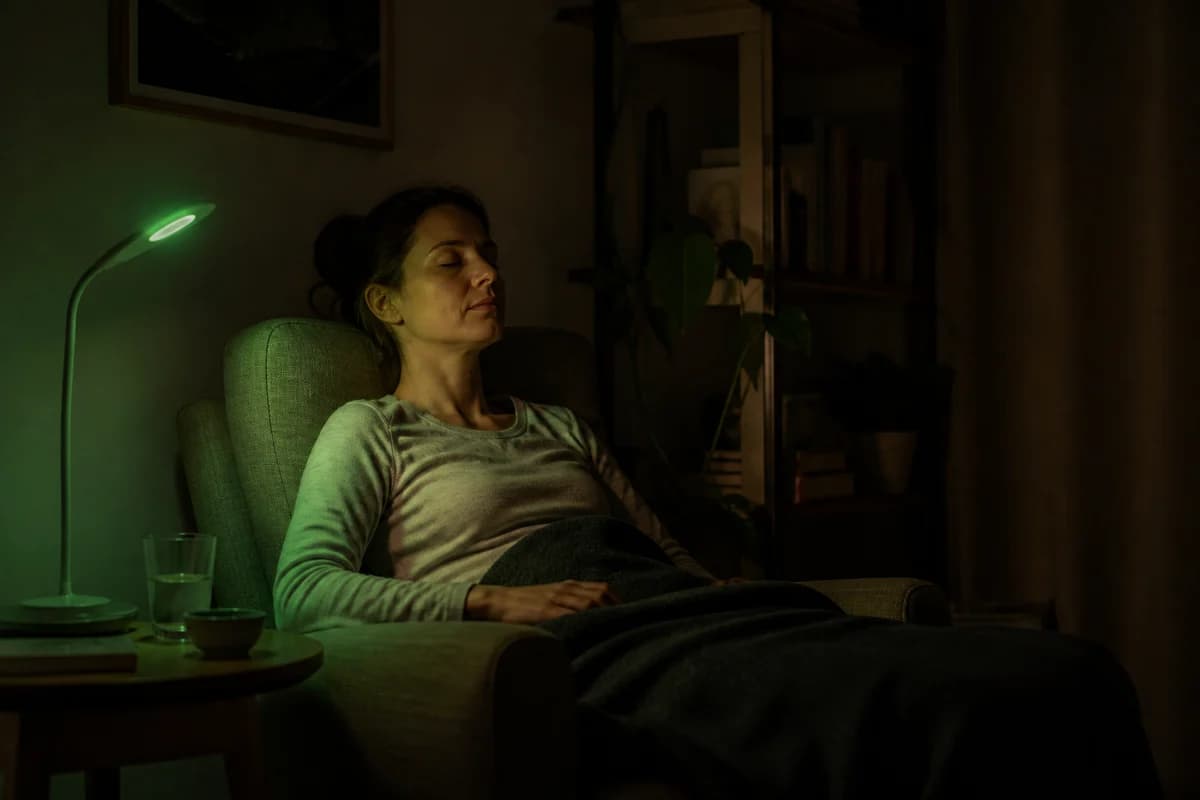
The rules to remember
- Confirm the headache diagnosisSee reference 1,See reference 2
- Keep standard care stableSee reference 2,See reference 3
- Choose a low-glare documented sourceSee reference 3,See reference 4
- Use the same distance and durationSee reference 4,See reference 5
- Start with a short comfortable sessionSee reference 5,See reference 6
- Do not stare into LEDsSee reference 6,See reference 7
- Track monthly migraine daysSee reference 7,See reference 8
- Review after eight to twelve weeksSee reference 8,See reference 9
- Stop for worsening or visual symptomsSee reference 9,See reference 10
- Check the official guidance and evidence boundaries before escalating the protocol.See reference 10,See reference 1
First principles: what this can actually change
Migraine can amplify discomfort from visual pathways and ordinary light.See reference 1,See reference 2
Green wavelengths may produce less photophobia than blue, red or white light in experimental settings.See reference 2,See reference 3
Comfort with one color does not prove disease modification or validate every green bulb.See reference 3,See reference 4
A practical protocol
- Stage
- Define
- What to do
- Confirm the headache diagnosis
- Why it matters
- Reduce avoidable errorSee reference 1,See reference 2
- Stage
- Screen
- What to do
- Keep standard care stable
- Why it matters
- Reduce avoidable errorSee reference 2,See reference 3
- Stage
- Apply
- What to do
- Choose a low-glare documented source
- Why it matters
- Keep the dose repeatableSee reference 3,See reference 4
- Stage
- Apply
- What to do
- Use the same distance and duration
- Why it matters
- Keep the dose repeatableSee reference 4,See reference 5
- Stage
- Review
- What to do
- Start with a short comfortable session
- Why it matters
- Keep the dose repeatableSee reference 5,See reference 6
- Stage
- Review
- What to do
- Do not stare into LEDs
- Why it matters
- Keep only what helpsSee reference 6,See reference 7
Timing and frequency
- Decision
- Starting frequency
- Practical answer
- A consistent daily trial is more interpretable than occasional rescue use, but no universally validated consumer dose exists.See reference 2,See reference 3
- Decision
- First review
- Practical answer
- 8–12 weeksSee reference 3,See reference 4
- Decision
- Best timing
- Practical answer
- Use when it does not delay sleep or acute treatment; consistency matters more than a claimed optimal hour.See reference 4,See reference 5
- Decision
- Stop rule
- Practical answer
- Stop for increased headache, eye pain, persistent after-images, dizziness or seizure symptoms; seek urgent care for headache red flags.See reference 5,See reference 6,See reference 7
What to measure
- Signal
- Monthly migraine days
- How to use it
- Record a baseline and compare at the review point
- Caveat
- Use the same method and conditionsSee reference 3,See reference 4
- Signal
- Headache intensity, medicine use and function
- How to use it
- Track a weekly trend
- Caveat
- Expect normal variationSee reference 4,See reference 5
- Signal
- Adherence
- How to use it
- Record the exact dose and timing
- Caveat
- No exposure means no fair testSee reference 5,See reference 6
- Signal
- Interpretation
- How to use it
- Ask whether the result changes a real decision
- Caveat
- Color name, wavelength, brightness, distance and ambient light all change the exposure.See reference 6,See reference 7
What the evidence actually shows
Small early studies report improvements in headache frequency or intensity and laboratory work supports lower discomfort from green light in some people with migraine.See reference 1,See reference 2,See reference 3
Trials are too small and heterogeneous to establish a standard prescription or show that green light prevents complications or replaces established migraine treatment.See reference 4,See reference 5,See reference 6
Most studies measure short-term symptoms, physiology or biomarkers rather than clinical events or lifespan. The evidence supports a bounded experiment, not a longevity guarantee.See reference 6,See reference 7,See reference 8
Evidence strength by claim
- Claim
- Monthly migraine days
- Evidence
- Emerging and low certainty
- Verdict
- Small early studies report improvements in headache frequency or intensity and laboratory work supports lower discomfort from green light in some people with migraine.See reference 1,See reference 2
- Claim
- Headache intensity, medicine use and function
- Evidence
- Mixed or context-dependent
- Verdict
- Trials are too small and heterogeneous to establish a standard prescription or show that green light prevents complications or replaces established migraine treatment.See reference 3,See reference 4
- Claim
- Safety
- Evidence
- Depends on screening and dose
- Verdict
- Avoid staring directly into bright LEDs. Use extra caution with photosensitive epilepsy, retinal or eye disease, bipolar mania triggered by light or medicines that increase photosensitivity. Keep prescribed migraine care available.See reference 5,See reference 7
- Claim
- Longer life
- Evidence
- Not directly tested
- Verdict
- Do not turn an intermediate outcome into a lifespan promise.See reference 6,See reference 8
Limits and common overclaims
Several studies are uncontrolled or small.See reference 2,See reference 3
Devices and wavelength bands differ.See reference 3,See reference 4
Expectation and difficulty blinding colored light can bias results.See reference 4,See reference 5
A four-step implementation plan
- Define the exact reason you are trying green light therapy.See reference 1
- Record a baseline for monthly migraine days.See reference 2
- Use the same protocol until the 8–12 weeks review point.See reference 3
- Continue only if benefit outweighs cost, time, discomfort and risk.See reference 4
Troubleshooting
- Problem
- No benefit
- What to do
- Check adherence, dose and whether monthly migraine days is the right outcomeSee reference 2
- Problem
- Discomfort
- What to do
- Reduce the dose and stop for warning symptomsSee reference 3
- Problem
- Confusing data
- What to do
- Use the same measurement conditions and a longer trendSee reference 4
- Problem
- Too much burden
- What to do
- Choose the simpler intervention that solves the same problemSee reference 5
Safety and who should be cautious
Avoid staring directly into bright LEDs. Use extra caution with photosensitive epilepsy, retinal or eye disease, bipolar mania triggered by light or medicines that increase photosensitivity. Keep prescribed migraine care available. Stop for increased headache, eye pain, persistent after-images, dizziness or seizure symptoms; seek urgent care for headache red flags.See reference 5,See reference 6,See reference 7
Who is most likely to benefit
A person with diagnosed migraine and light sensitivity who wants a low-burden adjunct may reasonably test it while tracking outcomes.See reference 2,See reference 3
It is less useful when adopted only because a score, trend or influencer made green light therapy seem mandatory.See reference 4,See reference 5
People with symptoms, diagnosed disease, pregnancy, recent surgery or complex medicines should adapt the protocol with an appropriate clinician.See reference 6,See reference 7
Track five things
- Monthly migraine daysSee reference 1
- Headache intensity, medicine use and functionSee reference 2
- The exact dose and timingSee reference 3
- Symptoms and adverse effectsSee reference 4
- Whether the result changes a real decisionSee reference 5
Frequently asked questions
What is Green light therapy for migraine?
Narrow-band green light may be less uncomfortable than other wavelengths during migraine, and small uncontrolled or early trials suggest possible reductions in headache burden. Evidence is preliminary, devices vary, and green light should be treated as a low-risk adjunct rather than a replacement for migraine diagnosis or proven care.See reference 1,See reference 2
How often should I use green light therapy?
A consistent daily trial is more interpretable than occasional rescue use, but no universally validated consumer dose exists.See reference 2,See reference 3
How long before green light therapy works?
Use 8–12 weeks as the first meaningful review point. Immediate sensations or device scores are not durable health outcomes.See reference 3,See reference 4
What should I track?
Track monthly migraine days, headache intensity, medicine use and function, adherence and adverse effects under similar conditions.See reference 4,See reference 5
Is green light therapy safe?
Avoid staring directly into bright LEDs. Use extra caution with photosensitive epilepsy, retinal or eye disease, bipolar mania triggered by light or medicines that increase photosensitivity. Keep prescribed migraine care available.See reference 5,See reference 6
When should I stop?
Stop for increased headache, eye pain, persistent after-images, dizziness or seizure symptoms; seek urgent care for headache red flags.See reference 6,See reference 7
Does green light therapy increase lifespan?
No human trial proves that this tool extends an individual's lifespan. Its value depends on whether it improves a relevant symptom, behavior, function or established risk factor.See reference 7,See reference 8
Can it replace sleep, exercise, nutrition or medical care?
No. It is an optional layer around the fundamentals and should not delay evaluation of persistent or serious symptoms.See reference 8,See reference 9
Connect the protocol to your wider health picture
LongevityMate helps organize habits, symptoms, measurements and trends so one intervention stays in context instead of becoming the whole plan.
See how LongevityMate worksGet the weekly longevity brief
The week's best longevity research in plain English. Free, every Tuesday.
References
- 1. Evaluation of green light exposure on headache frequency and quality of life in migraine patients: A preliminary one-way cross-over clinical trial.
Cephalalgia : an international journal of headacheEvidence review
- 2. Narrow band green light effects on headache, photophobia, sleep, and anxiety among migraine patients: an open-label study conducted online using daily headache diary.
Frontiers in neurologyEvidence review
- 3. Light Therapy in Chronic Migraine.
Current pain and headache reportsEvidence review
- 4. Evaluating the Potential of Green Light Exposure on Nociception-A Mini Review.
CNS & neurological disorders drug targetsEvidence review
- 5. Neurobiology of Photophobia.
Journal of neuro-ophthalmology : the official journal of the North American Neuro-Ophthalmology SocietyEvidence review
- 6. Green Light Therapy for Pain and Pain-Related Psychosocial Outcomes: A Systematic Review of Human Studies.
Journal of clinical medicineSystematic review
- 7. Migraine
National Institute of Neurological Disorders and StrokeOfficial guidance
- 8. Headaches
National Health ServiceOfficial guidance
- 9. Migraine treatment
National Institute for Health and Care ExcellenceGuideline
- 10. Phototherapy safety
U.S. Food and Drug AdministrationOfficial guidance
Editorial transparency
- Published by
- LongevityMate Editorial Team
- Published
- Updated
Medical disclaimer
This guide provides general health education. It does not diagnose a condition, prescribe treatment, replace individualized medical care, or guarantee a health or longevity outcome.