
The 10 rules to remember
- Interpret oxygen saturation with symptoms, altitude, diagnosis and your clinician's plan—not as a universal pass-fail number.See reference 1
- Use a medical-purpose device when readings will guide care; wellness products may not have equivalent review.See reference 2
- Rest and warm the hand before measuring because poor perfusion can produce unstable or false values.See reference 3
- Keep still and wait for a stable pulse and saturation rather than accepting the first displayed number.See reference 4
- Remove nail products when practical and check the device-specific instructions.See reference 5
- Repeat an unexpected result and compare the displayed pulse with your measured or known pulse.See reference 6
- Recognize that readings may overestimate oxygen in some people with darker skin pigmentation.See reference 7
- Do not let a normal reading override severe breathing, neurologic or circulation symptoms.See reference 8
- Do not change prescribed oxygen flow without the clinician's instructions.See reference 9
- Track trends only when monitoring has a clear action threshold and end point.See reference 10
First principles: what this tool can actually change
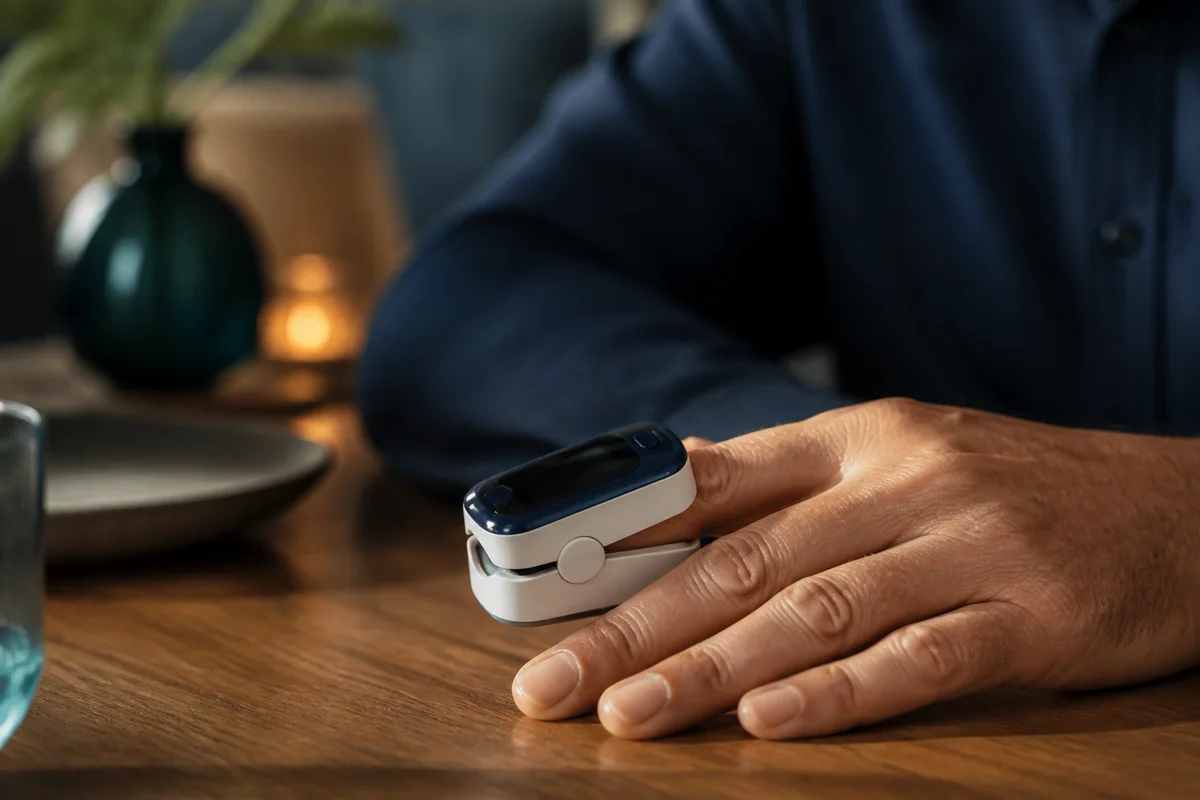
Pulse oximeters shine red and infrared light through pulsating tissue and estimate the proportion of oxygenated hemoglobin from light absorption. They do not directly sample arterial blood and the displayed number is an estimate with a device error range.See reference 1,See reference 2
Motion, weak blood flow, skin temperature, nail products, ambient light, dyshemoglobins and sensor design can distort the optical signal. A stable display does not guarantee that the estimate is unbiased.See reference 3,See reference 4
Accuracy matters most near treatment thresholds. Evidence of occult hypoxemia and average overestimation in some darker-pigmented groups means a borderline reassuring reading should never dismiss concerning symptoms or clinical judgment.See reference 5,See reference 6
A practical protocol
- Stage
- Prepare
- What to do
- Rest 5 minutes; warm the hand and remove interfering nail products
- Why it matters
- Improves perfusion and optical conditionsSee reference 1
- Stage
- Place
- What to do
- Use the labeled finger and orientation; support the relaxed hand
- Why it matters
- Maintains sensor alignmentSee reference 2
- Stage
- Stabilize
- What to do
- Stay still for 30-60 seconds and check pulse agreement
- Why it matters
- Avoids transient and motion-corrupted valuesSee reference 3
- Stage
- Act
- What to do
- Record SpO2, pulse, symptoms and follow the personal threshold
- Why it matters
- A number has meaning only in clinical contextSee reference 4
Timing and frequency
- When
- At baseline
- Action
- Learn your stable reading when well under the same conditionsSee reference 5
- When
- During a monitored illness
- Action
- Measure only at the frequency in the care planSee reference 6
- When
- After an unexpected reading
- Action
- Warm, reposition and repeat after a few minutes without delaying careSee reference 7
- When
- With worsening symptoms
- Action
- Escalate based on symptoms even before another readingSee reference 8
What to measure
- Signal
- SpO2
- How
- Use the stable value rather than the first flash
- Interpretation
- An estimate, not arterial blood gasSee reference 7
- Signal
- Pulse
- How
- Compare display with a reliable pulse count or device
- Interpretation
- Mismatch suggests signal artifactSee reference 8
- Signal
- Signal quality
- How
- Use waveform or perfusion indicator when available
- Interpretation
- Low signal reduces confidenceSee reference 9
- Signal
- Symptoms
- How
- Breathlessness, color change, confusion, chest pain or fatigue
- Interpretation
- Can outweigh a reassuring numberSee reference 10
What the evidence supports
Pulse oximetry is a useful, rapid and noninvasive estimate for monitoring selected respiratory and cardiac conditions when technique and an action plan are sound.See reference 1,See reference 3
Serial measurements can show direction of change, but home monitoring has value only when a clinician defines how readings combine with symptoms and when escalation occurs.See reference 2,See reference 4
The device does not identify why oxygen is low, assess ventilation or replace examination and arterial blood testing when precision is needed.See reference 5,See reference 6
Evidence strength by claim
- Claim
- Estimates oxygen saturation noninvasively
- Confidence
- High for intended use
- Important boundary
- Individual error can be clinically importantSee reference 1,See reference 2
- Claim
- Supports selected home-monitoring plans
- Confidence
- Moderate
- Important boundary
- Needs device quality and action thresholdsSee reference 3,See reference 4
- Claim
- Performs equally across all skin pigmentation
- Confidence
- Not supported
- Important boundary
- Bias and occult hypoxemia are documentedSee reference 5,See reference 6
- Claim
- A normal reading excludes serious illness
- Confidence
- Not supported
- Important boundary
- Symptoms and other physiology remain essentialSee reference 7,See reference 8,See reference 9,See reference 10
Limitations and common overclaims
Regulatory accuracy specifications describe performance across tested ranges and populations, not a guarantee that every reading is within a fixed number of percentage points.See reference 3,See reference 7
Evidence links darker skin pigmentation and racialized groups with higher risk of unrecognized hypoxemia in some hospital datasets, but outpatient magnitude and individual risk remain uncertain.See reference 5,See reference 8
Carbon monoxide exposure can produce a falsely reassuring conventional SpO2, and a pulse oximeter does not measure carbon dioxide or respiratory effort. Suspected exposure or hypoventilation needs urgent clinical testing.See reference 9,See reference 10
How to make it stick
Write the plan beside the device: usual range, repeat procedure, contact threshold, emergency symptoms and who to call.See reference 1,See reference 2
Practice once when well and compare pulse agreement so you can recognize an unstable signal during illness.See reference 3,See reference 4
Record a short series with time and symptoms rather than repeatedly measuring until a preferred number appears.See reference 5,See reference 6
Troubleshooting
- Problem
- Reading jumps
- Likely issue
- Motion, cold hand or weak perfusion
- Better next step
- Warm, support and keep the finger stillSee reference 2,See reference 3
- Problem
- No reading
- Likely issue
- Poor contact, polish, bright light or low battery
- Better next step
- Reposition, shield, remove interference and check powerSee reference 4,See reference 5
- Problem
- Low number but you feel well
- Likely issue
- True hypoxemia or device error
- Better next step
- Repeat correctly and follow the defined contact thresholdSee reference 6,See reference 7
- Problem
- Normal number but severe symptoms
- Likely issue
- False reassurance or problem not measured by SpO2
- Better next step
- Seek urgent assessment immediatelySee reference 8,See reference 9,See reference 10
Safety and when to stop
Seek emergency help for severe or rapidly worsening breathlessness, blue or gray lips or face, confusion, collapse, chest pain, inability to speak normally, or another serious symptom regardless of SpO2. Follow the individualized threshold given for your condition, altitude, pregnancy status and prescribed oxygen. At sea level, a persistent unexpected reading in the low 90s generally warrants prompt clinical advice and around 90% or below is an emergency in many plans, but do not wait for a threshold when symptoms are severe. Never change oxygen flow without instructions.See reference 1,See reference 5,See reference 9
Who is most likely to benefit
It is most useful for people with a diagnosed condition or acute illness when a clinician has provided a home-monitoring and escalation plan.See reference 2,See reference 4
It is less useful as constant screening in a healthy asymptomatic person because normal variation and device error can create false reassurance or anxiety.See reference 5,See reference 7
People with darker skin pigmentation should be explicitly told about possible overestimation and use symptoms and trends conservatively near action thresholds.See reference 8,See reference 10
Track five things
- Stable SpO2 and pulse.See reference 1
- Time, posture and altitude.See reference 2
- Finger, signal quality and device.See reference 3
- Symptoms and breathing effort.See reference 4
- Repeat value and action taken.See reference 5
Frequently asked questions
What is a normal SpO2?
It depends on altitude, health and the person. Many healthy adults at sea level are in the mid-to-high 90s, but use your clinical baseline and plan.See reference 1
Which finger should I use?
Use the device instructions; an index or middle finger is common. Consistent technique matters more than chasing a preferred finger.See reference 2
How long should I wait?
Usually 30-60 seconds or until both pulse and saturation are stable with an adequate signal.See reference 3
Does skin tone affect accuracy?
Yes. Evidence shows clinically relevant overestimation and occult hypoxemia can occur, particularly with darker pigmentation.See reference 4
Can nail polish change the result?
It can interfere with some devices. Remove it when practical or follow the manufacturer's validated alternative placement.See reference 5
Is 92% an emergency?
It often triggers prompt clinical contact at sea level, but diagnosis, altitude and personal plans differ. Severe symptoms always override the number.See reference 6
Can it detect carbon monoxide poisoning?
A standard pulse oximeter can look falsely normal. Suspected exposure requires emergency assessment and specific testing.See reference 7
Can I adjust home oxygen from the reading?
Only according to a clinician-prescribed titration plan; otherwise contact the treating service.See reference 8
Connect the protocol to your wider health picture
LongevityMate helps organize measurements, habits, symptoms and trends so one tool stays in context instead of becoming the whole plan.
See how LongevityMate worksGet the weekly longevity brief
The week's best longevity research in plain English. Free, every Tuesday.
References
- 1. Pulse Oximeters: Use, Accuracy and FDA Actions
U.S. Food and Drug AdministrationOfficial guidance
- 2. Improving Pulse Oximeter Performance Across Skin Tones
U.S. Food and Drug AdministrationOfficial guidance
- 3. Pulse Oximetry Accuracy by Skin Pigmentation
BMC MedicineSystematic review
- 4. Skin Pigmentation and PPG Accuracy
Journal of Medical Internet ResearchMeta-analysis
- 5. Skin Tone and Pulse Oximetry Accuracy
British Journal of AnaesthesiaSystematic review
- 6. Disparities in Occult Hypoxemia
Journal of General Internal MedicineMeta-analysis
- 7. Racial Bias in Pulse Oximetry Measurement
New England Journal of MedicineObservational study
- 8. Pulse Oximetry, Skin Pigmentation and Occult Hypoxemia
Respiratory MedicineObservational study
- 9. Home-based Monitoring in Chronic Lung Disease
American Thoracic SocietyOfficial guidance
- 10. Pulse Oximetry for Monitoring at Home
Annals of the American Thoracic SocietyEvidence review
Editorial transparency
- Published by
- LongevityMate Editorial Team
- Published
- Updated
Medical disclaimer
This guide provides general health education. It does not diagnose a condition, prescribe treatment, replace individualized medical care, or guarantee a health or longevity outcome.