
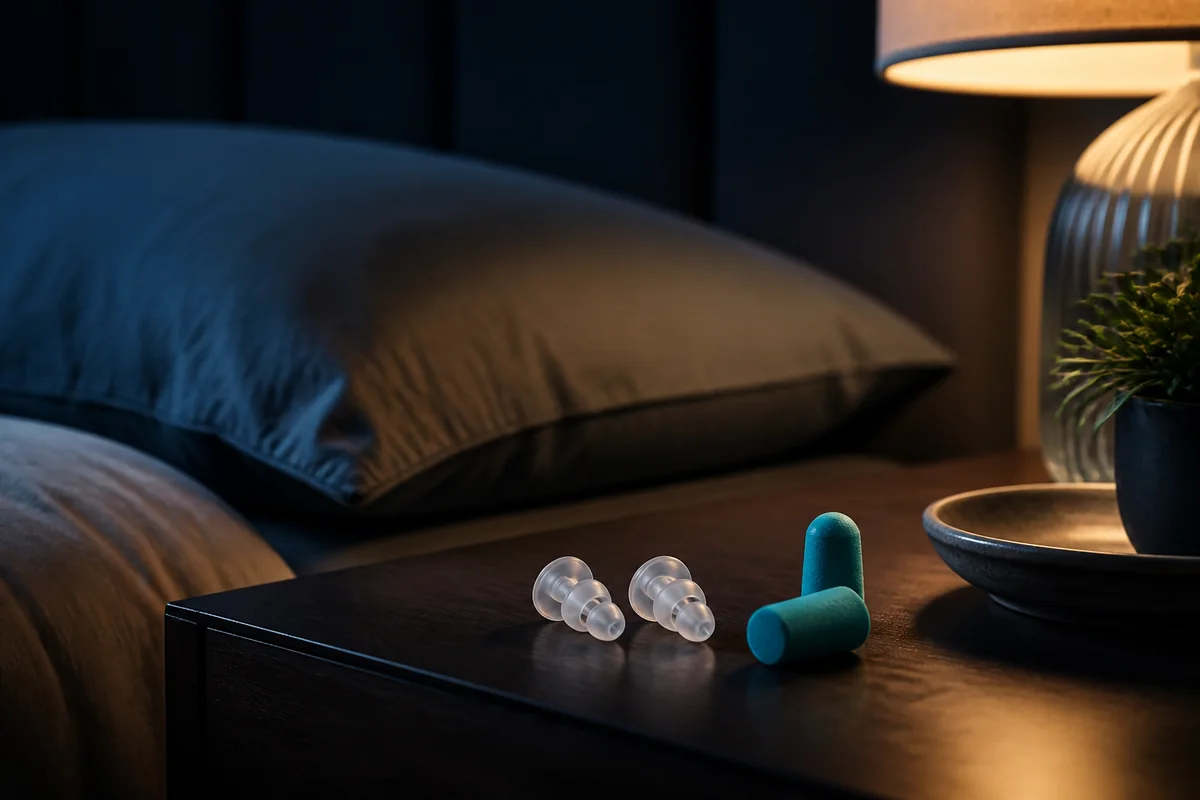
The 10 rules to remember
- Identify noise as the likely sleep disruptorSee reference 1
- Choose foam, silicone or custom plugs for comfortSee reference 2
- Insert according to the product instructionsSee reference 3
- Test alarms and emergency awarenessSee reference 4
- Use clean handsSee reference 5
- Replace disposable plugs and clean reusable typesSee reference 6
- Track awakenings and comfort for one to two weeksSee reference 7
- Address structural noise sources when practicalSee reference 8
- Stop for ear symptomsSee reference 1
- Review noise-related awakenings after 1–2 weeks; stop if the result does not justify the burden.See reference 2
First principles: what this can actually change
Earplugs attenuate noise before it reaches the auditory system, reducing the chance that traffic, neighbours or hospital sounds trigger arousal.See reference 1,See reference 2
Fit determines real-world attenuation. A high laboratory rating does not help when a plug is inserted incorrectly or repeatedly falls out.See reference 2,See reference 3
Complete silence is neither guaranteed nor always desirable because alarms, children and emergency cues may still matter.See reference 3,See reference 4
A practical protocol
- Stage
- Start
- What to do
- Identify noise as the likely sleep disruptor
- Why it matters
- Define the goal and baselineSee reference 1,See reference 2
- Stage
- Set up
- What to do
- Choose foam, silicone or custom plugs for comfort
- Why it matters
- Reduce avoidable errorSee reference 2,See reference 3
- Stage
- Apply
- What to do
- Insert according to the product instructions
- Why it matters
- Use a repeatable doseSee reference 3,See reference 4
- Stage
- Review
- What to do
- Test alarms and emergency awareness
- Why it matters
- Keep only what helpsSee reference 4,See reference 5
Timing and frequency
- Decision
- Starting dose
- Practical answer
- Use on noisy nights or nightly if ears remain healthy and plugs are cleaned or replaced correctly.See reference 2,See reference 3
- Decision
- First review
- Practical answer
- 1–2 weeksSee reference 3,See reference 4
- Decision
- Best timing
- Practical answer
- Insert immediately before sleep after testing alarms and ensuring the ear canal is dry.See reference 4,See reference 5
- Decision
- Stop rule
- Practical answer
- Stop and seek care for pain, discharge, sudden hearing change, marked blockage or persistent irritation.See reference 5,See reference 6
What to measure
- Signal
- Noise-related awakenings
- How to use it
- Record before starting and at the review point
- Caveat
- Use the same methodSee reference 3,See reference 4
- Signal
- Subjective sleep quality and ear comfort
- How to use it
- Track weekly rather than reacting daily
- Caveat
- Expect normal variationSee reference 4,See reference 5
- Signal
- Adherence
- How to use it
- Record sessions or days used
- Caveat
- No exposure means no fair testSee reference 5,See reference 6
- Signal
- Adverse effects
- How to use it
- Record symptoms and severity
- Caveat
- Hospital studies combine earplugs with eye masks or other interventions, limiting attribution.See reference 6,See reference 7
What the evidence actually shows
Trials and reviews in intensive-care and hospital settings suggest earplugs, often combined with eye masks, can improve perceived sleep and sometimes delirium-related outcomes.See reference 1,See reference 2,See reference 3
Home-bedroom evidence is limited, and plugs do not treat insomnia, tinnitus, sleep apnea or the underlying noise source. Benefits depend heavily on fit and comfort.See reference 4,See reference 5,See reference 6
Most studies measure short-term symptoms, physiology or performance rather than clinical events or lifespan. Results therefore support a bounded use case, not broad longevity marketing.See reference 6,See reference 7,See reference 8
Evidence strength by claim
- Claim
- Noise-related awakenings
- Evidence
- Moderate in noisy settings; limited at home
- Verdict
- Trials and reviews in intensive-care and hospital settings suggest earplugs, often combined with eye masks, can improve perceived sleep and sometimes delirium-related outcomes.See reference 1,See reference 2
- Claim
- Subjective sleep quality and ear comfort
- Evidence
- Mixed or context-dependent
- Verdict
- Home-bedroom evidence is limited, and plugs do not treat insomnia, tinnitus, sleep apnea or the underlying noise source. Benefits depend heavily on fit and comfort.See reference 3,See reference 4
- Claim
- Safety
- Evidence
- Depends on screening and dose
- Verdict
- Avoid use with an active ear infection, drainage or significant ear pain. Repeated use can irritate skin or contribute to wax impaction in susceptible people.See reference 5,See reference 6
- Claim
- Longer life
- Evidence
- Not directly tested
- Verdict
- Do not convert an intermediate outcome into a lifespan promiseSee reference 7,See reference 8
Limits and common overclaims
Many studies involve acutely ill hospital patients rather than healthy sleepers.See reference 2,See reference 3
Combined interventions make the independent effect of earplugs difficult to isolate.See reference 3,See reference 4
Self-reported sleep can improve even when objective sleep changes are small.See reference 4,See reference 5
A four-step implementation plan
- Define the exact reason you are trying sleep earplugs.See reference 1
- Record a baseline for noise-related awakenings.See reference 2
- Use the same protocol for 1–2 weeks.See reference 3
- Continue only if benefit outweighs cost, time, discomfort and risk.See reference 4
Troubleshooting
- Problem
- No benefit
- What to do
- Check adherence, dose and whether noise-related awakenings is the right outcomeSee reference 2
- Problem
- Discomfort
- What to do
- Reduce the dose; stop for warning symptomsSee reference 3
- Problem
- Confusing data
- What to do
- Use a longer trend and the same measurement conditionsSee reference 4
- Problem
- Too much burden
- What to do
- Choose the simpler intervention that solves the same problemSee reference 5
Safety and who should be cautious
Avoid use with an active ear infection, drainage or significant ear pain. Repeated use can irritate skin or contribute to wax impaction in susceptible people. Stop and seek care for pain, discharge, sudden hearing change, marked blockage or persistent irritation.See reference 5,See reference 6,See reference 7
Who is most likely to benefit
They are most useful for people whose awakenings clearly track to unpredictable noise and who can still hear essential alarms.See reference 2,See reference 3
It is less useful when adopted only because a score, trend or influencer made it seem mandatory.See reference 4,See reference 5
People with symptoms, diagnosed disease, pregnancy, recent surgery or complex medicines should adapt the protocol with an appropriate clinician.See reference 6,See reference 7
Track five things
- Noise-related awakeningsSee reference 1
- Subjective sleep quality and ear comfortSee reference 2
- The exact dose and timingSee reference 3
- Symptoms and adverse effectsSee reference 4
- Whether the result changes a real decisionSee reference 5
Frequently asked questions
What is Sleep earplugs?
Earplugs reduce sound reaching the ear and can improve sleep when intermittent environmental noise is the real problem. Most trials are in hospitals rather than ordinary bedrooms, so the direct home evidence is smaller than marketing suggests.See reference 1,See reference 2
How often should I use sleep earplugs?
Use on noisy nights or nightly if ears remain healthy and plugs are cleaned or replaced correctly.See reference 2,See reference 3
How long before sleep earplugs works?
Use 1–2 weeks as the first meaningful review point. Immediate comfort or device readings are not the same as a durable health effect.See reference 3,See reference 4
What should I track?
Track noise-related awakenings, subjective sleep quality and ear comfort, adherence and adverse effects under similar conditions.See reference 4,See reference 5
Is sleep earplugs safe?
Avoid use with an active ear infection, drainage or significant ear pain. Repeated use can irritate skin or contribute to wax impaction in susceptible people.See reference 5,See reference 6
When should I stop?
Stop and seek care for pain, discharge, sudden hearing change, marked blockage or persistent irritation.See reference 6,See reference 7
Does sleep earplugs increase lifespan?
No trial proves that this tool extends an individual's lifespan. Its value depends on whether it improves a relevant symptom, behavior, function or established risk factor.See reference 7,See reference 8
Can it replace sleep, exercise, nutrition or medical care?
No. It is an optional layer around the fundamentals and should not delay evaluation of persistent or serious symptoms.See reference 8,See reference 1
Connect the protocol to your wider health picture
LongevityMate helps organize habits, symptoms, measurements and trends so one intervention stays in context instead of becoming the whole plan.
See how LongevityMate worksGet the weekly longevity brief
The week's best longevity research in plain English. Free, every Tuesday.
References
- 1. Non-pharmacological sleep interventions for adult patients in intensive care Units: A systematic review.
Intensive & critical care nursingSystematic review
- 2. The Impact of Earplugs and Eye Masks on Sleep Quality in Surgical ICU Patients at Risk for Frequent Awakenings.
Critical care medicineRandomized trial
- 3. Noise reduction interventions in intensive care units: a systematic review.
Intensive & critical care nursingSystematic review
- 4. The Efficacy of Earplugs as a Sleep Hygiene Strategy for Reducing Delirium in the ICU: A Systematic Review and Meta-Analysis.
Critical care medicineMeta-analysis
- 5. SleepSure: a pilot randomized-controlled trial to assess the effects of eye masks and earplugs on the quality of sleep for patients in hospital.
Clinical rehabilitationRandomized trial
- 6. Effectiveness of sound and darkness interventions for critically ill patients' sleep quality: A systematic review and component network meta-analysis.
Nursing in critical careMeta-analysis
- 7. Environmental noise guidelines for the European Region
World Health OrganizationGuideline
- 8. How loud is too loud?
National Institute on Deafness and Other Communication DisordersOfficial guidance
Editorial transparency
- Published by
- LongevityMate Editorial Team
- Published
- Updated
Medical disclaimer
This guide provides general health education. It does not diagnose a condition, prescribe treatment, replace individualized medical care, or guarantee a health or longevity outcome.