
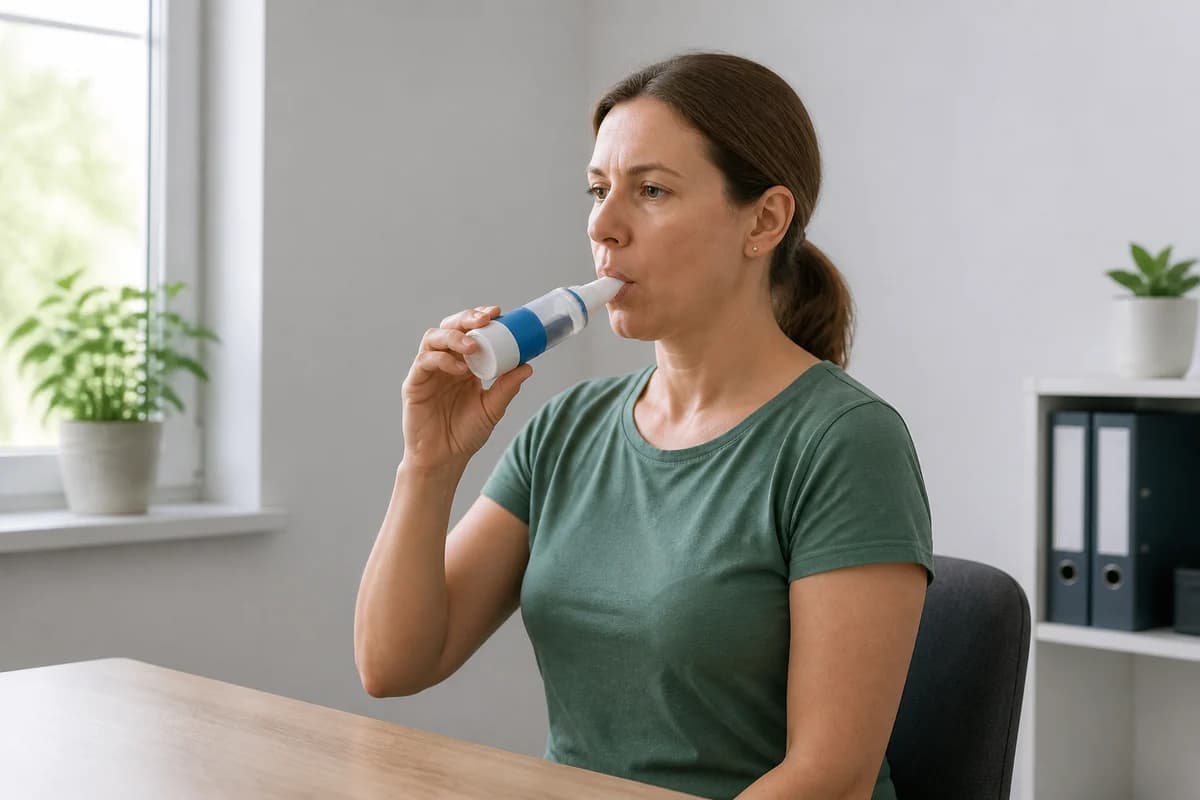
The rules to remember
- Screen unexplained breathlessnessSee reference 1,See reference 2
- Learn seated techniqueSee reference 2,See reference 3
- Measure a baseline when possibleSee reference 3,See reference 4
- Choose tolerable resistanceSee reference 4,See reference 5
- Complete slow controlled breathsSee reference 5,See reference 6
- Rest if technique breaksSee reference 6,See reference 7
- Progress resistance graduallySee reference 7,See reference 8
- Track strength and symptomsSee reference 8,See reference 9
- Review after six to eight weeksSee reference 9,See reference 10
- Check the official guidance and evidence boundaries before escalating the protocol.See reference 10,See reference 1
First principles: what this can actually change
Breathing against a threshold or resistance overloads inspiratory muscles.See reference 1,See reference 2
Progressive overload can increase inspiratory pressure and endurance like other muscle training.See reference 2,See reference 3
Strength gains do not diagnose the cause of breathlessness or guarantee better clinical outcomes.See reference 3,See reference 4
A practical protocol
- Stage
- Define
- What to do
- Screen unexplained breathlessness
- Why it matters
- Reduce avoidable errorSee reference 1,See reference 2
- Stage
- Screen
- What to do
- Learn seated technique
- Why it matters
- Reduce avoidable errorSee reference 2,See reference 3
- Stage
- Apply
- What to do
- Measure a baseline when possible
- Why it matters
- Keep the dose repeatableSee reference 3,See reference 4
- Stage
- Apply
- What to do
- Choose tolerable resistance
- Why it matters
- Keep the dose repeatableSee reference 4,See reference 5
- Stage
- Review
- What to do
- Complete slow controlled breaths
- Why it matters
- Keep the dose repeatableSee reference 5,See reference 6
- Stage
- Review
- What to do
- Rest if technique breaks
- Why it matters
- Keep only what helpsSee reference 6,See reference 7
Timing and frequency
- Decision
- Starting frequency
- Practical answer
- Many studies use roughly 30 breaths once or twice daily on five to seven days per week, but clinical protocols should follow the treating professional and device.See reference 2,See reference 3
- Decision
- First review
- Practical answer
- 6–8 weeksSee reference 3,See reference 4
- Decision
- Best timing
- Practical answer
- Use when rested; separate from a key workout at first if it causes respiratory fatigue.See reference 4,See reference 5
- Decision
- Stop rule
- Practical answer
- Stop for chest pain, fainting, blue lips, severe or prolonged breathlessness, new wheeze, palpitations or oxygen desaturation outside a clinician-set range.See reference 5,See reference 6,See reference 7
What to measure
- Signal
- Maximal inspiratory pressure or validated symptom/function measure
- How to use it
- Record a baseline and compare at the review point
- Caveat
- Use the same method and conditionsSee reference 3,See reference 4
- Signal
- Exercise tolerance and perceived breathlessness
- How to use it
- Track a weekly trend
- Caveat
- Expect normal variationSee reference 4,See reference 5
- Signal
- Adherence
- How to use it
- Record the exact dose and timing
- Caveat
- No exposure means no fair testSee reference 5,See reference 6
- Signal
- Interpretation
- How to use it
- Ask whether the result changes a real decision
- Caveat
- Device resistance levels are not interchangeable and technique strongly affects readings.See reference 6,See reference 7
What the evidence actually shows
Meta-analyses show improved inspiratory strength and possible gains in exercise capacity or dyspnea in selected populations, with effect size depending on baseline weakness and protocol.See reference 1,See reference 2,See reference 3
It cannot replace pulmonary rehabilitation, aerobic conditioning, inhalers, heart treatment or evaluation of unexplained breathlessness.See reference 4,See reference 5,See reference 6
Most studies measure short-term symptoms, physiology or biomarkers rather than clinical events or lifespan. The evidence supports a bounded experiment, not a longevity guarantee.See reference 6,See reference 7,See reference 8
Evidence strength by claim
- Claim
- Maximal inspiratory pressure or validated symptom/function measure
- Evidence
- Moderate for inspiratory strength; condition-specific for clinical outcomes
- Verdict
- Meta-analyses show improved inspiratory strength and possible gains in exercise capacity or dyspnea in selected populations, with effect size depending on baseline weakness and protocol.See reference 1,See reference 2
- Claim
- Exercise tolerance and perceived breathlessness
- Evidence
- Mixed or context-dependent
- Verdict
- It cannot replace pulmonary rehabilitation, aerobic conditioning, inhalers, heart treatment or evaluation of unexplained breathlessness.See reference 3,See reference 4
- Claim
- Safety
- Evidence
- Depends on screening and dose
- Verdict
- Get clinical guidance with heart or lung disease, recent chest surgery, uncontrolled hypertension, pneumothorax history, severe asthma, respiratory infection or unexplained shortness of breath. Keep rescue treatment available if prescribed.See reference 5,See reference 7
- Claim
- Longer life
- Evidence
- Not directly tested
- Verdict
- Do not turn an intermediate outcome into a lifespan promise.See reference 6,See reference 8
Limits and common overclaims
Populations and protocols vary.See reference 2,See reference 3
Some studies combine training with rehabilitation.See reference 3,See reference 4
Small samples and short follow-up limit clinical conclusions.See reference 4,See reference 5
A four-step implementation plan
- Define the exact reason you are trying respiratory muscle trainer.See reference 1
- Record a baseline for maximal inspiratory pressure or validated symptom/function measure.See reference 2
- Use the same protocol until the 6–8 weeks review point.See reference 3
- Continue only if benefit outweighs cost, time, discomfort and risk.See reference 4
Troubleshooting
- Problem
- No benefit
- What to do
- Check adherence, dose and whether maximal inspiratory pressure or validated symptom/function measure is the right outcomeSee reference 2
- Problem
- Discomfort
- What to do
- Reduce the dose and stop for warning symptomsSee reference 3
- Problem
- Confusing data
- What to do
- Use the same measurement conditions and a longer trendSee reference 4
- Problem
- Too much burden
- What to do
- Choose the simpler intervention that solves the same problemSee reference 5
Safety and who should be cautious
Get clinical guidance with heart or lung disease, recent chest surgery, uncontrolled hypertension, pneumothorax history, severe asthma, respiratory infection or unexplained shortness of breath. Keep rescue treatment available if prescribed. Stop for chest pain, fainting, blue lips, severe or prolonged breathlessness, new wheeze, palpitations or oxygen desaturation outside a clinician-set range.See reference 5,See reference 6,See reference 7
Who is most likely to benefit
People with measured inspiratory weakness, selected pulmonary conditions or a defined performance goal are more plausible candidates than healthy users seeking a generic lung detox.See reference 2,See reference 3
It is less useful when adopted only because a score, trend or influencer made respiratory muscle trainer seem mandatory.See reference 4,See reference 5
People with symptoms, diagnosed disease, pregnancy, recent surgery or complex medicines should adapt the protocol with an appropriate clinician.See reference 6,See reference 7
Track five things
- Maximal inspiratory pressure or validated symptom/function measureSee reference 1
- Exercise tolerance and perceived breathlessnessSee reference 2
- The exact dose and timingSee reference 3
- Symptoms and adverse effectsSee reference 4
- Whether the result changes a real decisionSee reference 5
Frequently asked questions
What is Respiratory muscle training?
Inspiratory muscle trainers make breathing in against resistance, progressively loading the diaphragm and accessory muscles. Evidence supports improved inspiratory strength and selected exercise or symptom outcomes in some clinical and athletic populations, but device use does not replace aerobic training or treatment of heart and lung disease.See reference 1,See reference 2
How often should I use respiratory muscle trainer?
Many studies use roughly 30 breaths once or twice daily on five to seven days per week, but clinical protocols should follow the treating professional and device.See reference 2,See reference 3
How long before respiratory muscle trainer works?
Use 6–8 weeks as the first meaningful review point. Immediate sensations or device scores are not durable health outcomes.See reference 3,See reference 4
What should I track?
Track maximal inspiratory pressure or validated symptom/function measure, exercise tolerance and perceived breathlessness, adherence and adverse effects under similar conditions.See reference 4,See reference 5
Is respiratory muscle trainer safe?
Get clinical guidance with heart or lung disease, recent chest surgery, uncontrolled hypertension, pneumothorax history, severe asthma, respiratory infection or unexplained shortness of breath. Keep rescue treatment available if prescribed.See reference 5,See reference 6
When should I stop?
Stop for chest pain, fainting, blue lips, severe or prolonged breathlessness, new wheeze, palpitations or oxygen desaturation outside a clinician-set range.See reference 6,See reference 7
Does respiratory muscle trainer increase lifespan?
No human trial proves that this tool extends an individual's lifespan. Its value depends on whether it improves a relevant symptom, behavior, function or established risk factor.See reference 7,See reference 8
Can it replace sleep, exercise, nutrition or medical care?
No. It is an optional layer around the fundamentals and should not delay evaluation of persistent or serious symptoms.See reference 8,See reference 9
Connect the protocol to your wider health picture
LongevityMate helps organize habits, symptoms, measurements and trends so one intervention stays in context instead of becoming the whole plan.
See how LongevityMate worksGet the weekly longevity brief
The week's best longevity research in plain English. Free, every Tuesday.
References
- 1. Inspiratory muscle training, with or without concomitant pulmonary rehabilitation, for chronic obstructive pulmonary disease (COPD).
The Cochrane database of systematic reviewsSystematic review
- 2. Inspiratory Muscle Training Program Using the PowerBreath(®): Does It Have Ergogenic Potential for Respiratory and/or Athletic Performance? A Systematic Review with Meta-Analysis.
International journal of environmental research and public healthMeta-analysis
- 3. Time-Efficient Inspiratory Muscle Strength Training Lowers Blood Pressure and Improves Endothelial Function, NO Bioavailability, and Oxidative Stress in Midlife/Older Adults With Above-Normal Blood Pressure.
Journal of the American Heart AssociationRandomized trial
- 4. Inspiratory Muscle Training in Patients With Heart Failure: What Is New? Systematic Review and Meta-Analysis.
Physical therapyMeta-analysis
- 5. Effects of inspiratory muscle training in COPD patients: A systematic review and meta-analysis.
The clinical respiratory journalMeta-analysis
- 6. Inspiratory muscle training enhances recovery post-COVID-19: a randomised controlled trial.
The European respiratory journalRandomized trial
- 7. Pulmonary rehabilitation
American Thoracic SocietyGuideline
- 8. Shortness of breath
National Health ServiceOfficial guidance
- 9. COPD
National Heart, Lung, and Blood InstituteOfficial guidance
- 10. Asthma
Global Initiative for AsthmaGuideline
Editorial transparency
- Published by
- LongevityMate Editorial Team
- Published
- Updated
Medical disclaimer
This guide provides general health education. It does not diagnose a condition, prescribe treatment, replace individualized medical care, or guarantee a health or longevity outcome.